Weighing portions of almonds
If you weigh almonds in grams according to a recipe, look for an easy-to-read display and suitable increments for the weight range you actually use.


For weighing portions of almonds and adding ingredients one at a time to a bowl, scales that display grams and have a tare function are a sensible starting point. The key things to consider are the combined weight of the bowl and ingredients, whether you can see the display and buttons clearly, and how much storage space you have. Precision scales are worth considering if you also weigh very small quantities, but their maximum capacity may be too low for a full mixing bowl.
If you weigh almonds in grams according to a recipe, look for an easy-to-read display and suitable increments for the weight range you actually use.
When adding almonds and other ingredients one at a time, a tare function, enough capacity for the bowl and its contents, and a clear view of the display are all important.
Check that the scales and bowl will fit on your worktop, and that you have somewhere suitable to store the scales after baking.
| What matters | What to check | Who it's especially relevant to |
|---|---|---|
| Reading almond portions | Gram display and increments for the weight range you need. | If I weigh almonds according to a recipe, I want to read the gram measurement clearly in the right range. Around 36% of shoppers would make almond portions their top selection criterion. |
| Weighing into a bowl | Tare function; capacity for the bowl and ingredients combined. | If I weigh almonds and other ingredients in the same bowl, I want to be able to tare the scales as I go without losing sight of the maximum capacity. Around 29% of shoppers would prioritise weighing ingredients in stages. |
| Worktop and storage space | Scale dimensions and bowl placement; clear view of the display and buttons. | When space is limited, I need scales that work alongside the bowl and can be stored away neatly afterwards. Around 21% of shoppers would prioritise worktop space and storage. |
| Small additional quantities | Check the increments and maximum capacity together; display increments are not independent proof of accuracy. | If I weigh very small quantities of ingredients as well as almonds, a suitable precision range matters to me. Around 14% of shoppers would choose precision weighing as their main concern. |
CASO lists the FinoCompact as having 0.1 g increments, but also a maximum capacity of 500 g. The display alone does not prove independently tested measurement accuracy.
Choose a precision range only if you really weigh quantities this small, and check the capacity separately, including the weight of the container.
Tare resets the display to zero, but it does not change the scales' maximum total capacity.
Compare the weight of your bowl plus the largest quantity of ingredients you plan to add with the stated maximum capacity.
Tefal lists different increments for the Optiss BC50U0 depending on the weight range. A Joybuy product page, however, identifies the model as BC5005; these model numbers are not the same.
Check the full model number before buying, rather than comparing product family names alone.
CASO states that two AAA batteries are not included with the FinoCompact. With the battery-free KitchenEcostyle, the base of the bowl must fit the platform in the relevant position; moving the lever is needed to generate power.
Check the battery type and what's included, as well as the base of the bowl you usually bake with. You may need to buy batteries separately for the FinoCompact.
Two AAA batteries are not included with the CASO FinoCompact.
The Optiss BC50U0 is worth considering for weighing portions in grams and adding ingredients to a bowl.
The Page Compact 300 is a slim set of kitchen scales that takes up little space when stored after baking.
The KS 34 Stainless Steel, article number 70312, has a higher stated capacity for larger containers or heavier loads.
The digital kitchen scales 3201000339 combine a tare function with a weighing surface measuring 23 × 15 cm.
The FinoCompact and KitchenDuo cater for different weighing ranges, while the KitchenEcostyle generates power through movement.
This selection includes digital scales for weighing portions in grams and using a bowl, with options for different capacity and storage needs.
 No image available
The tare function may be useful for weighing portions in grams and adding ingredients to a bowl one at a time.
The product information lists 1 g increments, a maximum capacity of 5 kg, tare, automatic shut-off, and g, ml, oz, lb and fl oz units.
 No image available
Described as portable coffee and kitchen scales; check that the product specifications suit your bowl and baking routine.
 No image available
The removable bowl may be handy for weighing ingredients directly; check that its size suits the quantities in your recipes.
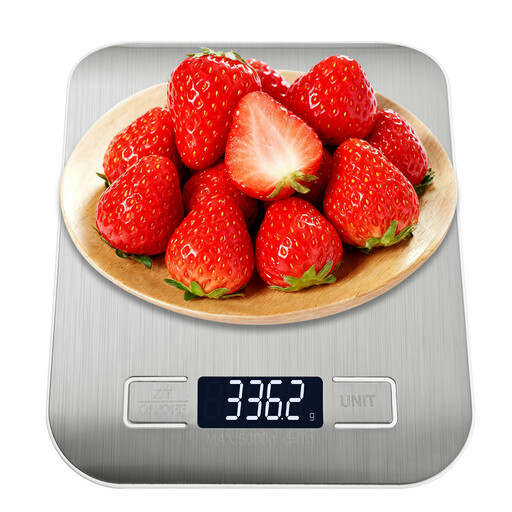 No image available
For weighing almonds and other baking ingredients in grams, the stated increments are worth checking.
The product information lists 1 g increments, a capacity of up to 5 kg, several units of measurement and a white stainless steel surface.
 No image available
The higher stated capacity may be useful for heavier containers or ingredients; check that the scales suit your actual needs.
The product information lists 1 g increments, a 10 kg capacity, Bluetooth, several units of measurement and app connectivity.
No. Place a suitable bowl on the scales and tare them before adding the almonds. Remember that the bowl and its contents count towards the maximum capacity; you can tare the scales again before adding more ingredients.
Place the scales on a firm, level surface. For the GEFU SCORE, the manufacturer's instructions recommend using a soft, slightly damp cloth and warn against allowing water to enter the appliance. Check the instructions for your specific model rather than rinsing the scales without checking first.
Check which type of batteries you need and whether they are included: CASO says that two AAA batteries are not included with the FinoCompact. If a product is faulty, distinguish your statutory rights against the seller from a voluntary manufacturer's guarantee, as explained by the Verbraucherzentrale (German consumer advice centre).
The Physikalisch-Technische Bundesanstalt does not specify any statutory minimum requirements for household scales. This does not apply to weighing goods for sale, which may be subject to different requirements.
The German Environment Agency advises against putting old electrical equipment in household waste. Take the scales to an appropriate collection or take-back point, and remove the batteries beforehand if possible; batteries should be taken separately to a battery collection point.