Bread bakers with small kitchens
If you have limited storage space after weighing, compare slim models with scales that can be hung up. Also make sure your bowl fits on the platform and doesn’t block the display.


For weighing bread flour when worktop space is limited, a digital kitchen scale that stores flat and has a tare function is a sensible choice, provided there’s enough room on the platform for your bowl and the display. When weighing heavy dough, the total weight of the bowl and ingredients matters; for small quantities of ingredients, the increments are important. Smaller display increments alone don’t prove a correspondingly high level of accuracy.
If you have limited storage space after weighing, compare slim models with scales that can be hung up. Also make sure your bowl fits on the platform and doesn’t block the display.
If you’re using a heavy bowl or making a large batch of dough, the scale needs to support the total weight. Check the capacity of the specific model, including the bowl.
If you weigh small quantities as well as flour, compare the increments and usable weight range. Also check that the bowl and dough will stay within the maximum capacity.
First, measure the available worktop space and the base of your usual bowl. Then you can compare storage, tare function, capacity and increments to suit the quantities you bake with.
The following buying considerations apply to people who want to weigh flour for bread using a digital kitchen scale when worktop space is limited.
| Consideration | What to look for | Who is this important to? |
|---|---|---|
| Space and storage | Measure your worktop and the base of your bowl; compare the scale’s footprint and storage options. ADE lists the Denise KE874 as 1,1 cm high, while Tefal says the Optiss BC50U0 has a retractable hook. | If I have limited worktop space, I want the scale to be easy to put away after baking and still fit my bowl when I’m weighing ingredients. Around 36% of consumers are likely to have this space-related concern. |
| Weighing into a bowl | Check that the scale has a tare function that’s easy to use with your bowl, and leave room for the display and buttons. | If I want to weigh flour and other ingredients one after another in the same bowl, an accessible tare function is important. Around 29% of consumers are likely to prioritise this way of weighing. |
| Capacity with the bowl | Add the weight of the bowl to the largest quantity of ingredients you plan to weigh, then compare the total with the model’s capacity. Zwilling lists a capacity of up to 10 kg for the Enfinigy 53011-051-0; the scale measures 24,50 × 18,80 cm. | If I’m weighing a heavy bowl or a large batch of dough, the total load must not exceed the model’s limit. Around 21% of consumers are likely to have this capacity-related concern. |
| Small quantities | Compare the increments and weighing range with the quantities of ingredients you actually weigh. Tefal lists different increments for different weight ranges on the Optiss BC50U0. | If I weigh small quantities of ingredients as well as flour, I want suitable display increments while still having enough capacity for the bowl. Around 14% of consumers are likely to prioritise small quantities. |
A slim scale is easier to store, but its weighing platform may be too small for your bread-making bowl.
Measure the base of your bowl and the available worktop space. Also check the specific model to see whether the display remains visible when the bowl is in place.
Tare resets the display, but it doesn’t increase the maximum permitted total load.
Compare the total weight of your bowl and the largest quantity of ingredients you plan to weigh with the model’s capacity.
Increments describe the steps shown on the display; on their own, they don’t prove the scale’s actual measurement error.
Compare the increments with the weight range you need. To assess measurement performance, look for a test of the exact same model.
Dimensions, capacities and increments apply to the specific models listed. A manufacturer’s stated increments are not independent proof of measurement accuracy.
According to Tefal, the Optiss BC50U0 combines a glass platform and tare function with a retractable hook for hanging storage.
The KS 22 has a small stainless-steel weighing platform; according to Beurer, the KS 36 is designed for finer increments at a lower capacity.
According to ADE, the Denise KE874 is a slim kitchen scale with a tare function that’s easy to store in a small kitchen.
The 3201000339 digital kitchen scale is a platform scale with a tare function for weighing ingredients into a bowl.
According to Zwilling, the Enfinigy 53011-051-0 has a capacity of up to 10 kg, a tare function and a USB-rechargeable battery.
Digital kitchen scales for weighing flour and other ingredients when baking; the stated dimensions and capacities can help you check how each model fits your worktop and bowl.
 No image available
The tare function is useful for weighing ingredients one after another in the same bowl.
Stated capacity: 5 kg; 1-g increments; LCD display.
 No image available
The stated tare function is useful for weighing ingredients into a bowl.
Stated capacity: 5 kg; 1-g increments; LCD display; units: g, ml, oz, lb and fl.
 No image available
The stated capacity may be useful for heavier bowls and larger quantities of ingredients; the total load must stay within the model’s limit.
Stated capacity: 10 kg; 1-g increments; dimensions: 21 × 15,5 × 2,9 cm; materials: stainless steel and plastic.
 No image available
The removable bowl is an option if you want to weigh ingredients directly into it.
Stated maximum load: 5 kg; dimensions: 20,5 × 18 × 4,5 cm.
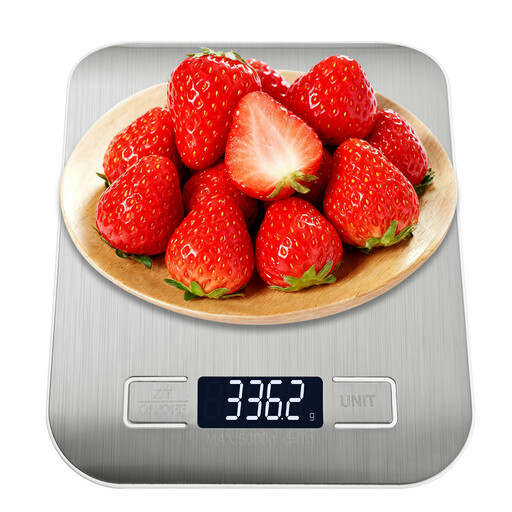 No image available
Compare the stated footprint and height of the scale with the space available on your worktop.
Stated capacity: 5 kg; 1-g increments; dimensions: 18 × 14 × 1,5 cm; stainless-steel surface.
No. The total load includes the bowl and ingredients. Tare resets the display to zero, but doesn’t increase the capacity. Beurer lists a maximum of 3 kg for the KS 22, while Zwilling lists up to 10 kg for the Enfinigy 53011-051-0.
No. Use a bowl that sits securely on the platform and keeps the total weight, including the ingredients, within the scale’s capacity. You can use tare to reset the display to zero before adding more ingredients. Check that the buttons and display remain accessible beside the bowl.
In Germany, statutory rights against the seller are set out by law, while a guarantee is offered voluntarily. The Verbraucherzentrale (German consumer advice centre) points out that these are different rights and promises.
No. Waste electrical equipment must be taken to an authorised collection or take-back point, and used batteries must be returned separately. According to Germany’s Federal Environment Ministry, battery legislation in force since 7 October 2025 provides for free returns of used batteries through retailers or suitable collection points. For returning a small item of waste electrical equipment to a retailer that is required to accept it, without buying a replacement, one condition is that no external dimension may exceed 25 cm.