Granola makers weighing honey in a bowl
If you weigh sticky honey directly into a bowl, you’ll want to be able to tare the bowl. Make sure the bowl and its contents don’t obscure the display or tare button.


For sticky honey, a scale with a tare function is handy: place your bowl on the scale, tare it and weigh the honey straight into it. Then choose a scale to suit the way you work. If you prepare several ingredients in advance, easy-to-reach buttons and a clear display matter. For large bowls, also check the weighing platform and capacity, including the weight of the bowl and its contents.
If you weigh sticky honey directly into a bowl, you’ll want to be able to tare the bowl. Make sure the bowl and its contents don’t obscure the display or tare button.
For larger batches of granola, you’ll need enough room for your bowl and a capacity that allows for its weight as well as its contents.
If you sometimes measure very small amounts of other ingredients as well as honey, a scale with a separate precision-weighing range may be worth considering.
First, check that you can easily tare a bowl when weighing honey. Then make sure the bowl size, total load and storage requirements suit the way you prepare your ingredients.
| What you need | What to check when buying | Who is it important for? |
|---|---|---|
| Weighing honey in a bowl | Check for a tare function, easy-to-reach buttons and a display that remains visible with a bowl on the scale. | If I weigh sticky honey directly into a bowl, I want to be able to tare its weight and still see the display. For around 36% of consumers, weighing honey in a bowl is the top priority. |
| Portioning ingredients in advance | Check that you can easily use the tare function again between ingredients and that the display stays clear. | If I weigh ingredients before preparing a recipe, I need a smooth process using one or more bowls. For around 29% of consumers, portioning several ingredients in advance is the priority. |
| Large bowl and total load | Compare the base of your bowl with the platform, and check that the combined weight of the bowl and all its contents is within the maximum capacity. | If I prepare a larger batch of granola in a bowl, I need enough platform space and capacity for the full load. For around 21% of consumers, weighing large batches is the main consideration. |
| Space and cleaning | Check the scale’s dimensions and whether your bowl fits; follow the cleaning instructions for the specific model. | If worktop or storage space is limited, I want a scale that fits where I need to keep it and can be cleaned as instructed. For around 14% of consumers, compact everyday use is the main priority. |
The tare function removes the bowl’s weight from the display, but it doesn’t increase the scale’s maximum capacity. The bowl and any ingredients already added still count towards the load.
Compare the maximum capacity with the weight of your heaviest bowl when full.
Manufacturer information about display increments describes how the display changes. On its own, it doesn’t show how large the actual measurement error is.
Compare the increments and weighing range with the quantities you need to measure. To make claims about accuracy, the specific model needs to be tested across the relevant weighing range.
A large bowl can obscure the display or buttons. The Hold function on the Soehnle Page Profi 300 can keep the reading visible after weighing; GEFU says the SCORE can also be read without a mobile phone.
First check that the bowl, display and controls work well together. Choose extra features according to what you actually need.
The Optiss BC50U0 is a tare scale with graduated display increments for both smaller and larger quantities of ingredients.
The KS 19 Pure White is a slim tare scale; the KS 34 is a separate model with a stainless steel surface and Hold function.
According to the manufacturer, the Page Profi 300 is designed for larger bowls and heavier loads.
The Isabella combines a large weighing platform with a separate precision-weighing platform.
The SCORE may also appeal to buyers who want to use a nutrition app as an extra feature.
This selection includes digital kitchen scales with a range of features, including models with a tare function, a scale with a removable bowl and a coffee and kitchen scale. Check each model to see whether its stated features suit the way you prepare granola.
 No image available
The product name lists a tare function, which is useful when weighing honey in a bowl.
The product name also lists a maximum capacity of 5 kg, an LCD display, a Bluetooth connection to an app and a stainless steel finish.
 No image available
The tare function listed in the product name is useful for removing the bowl’s weight when weighing honey.
The product name lists a stainless steel platform, a maximum capacity of 5 kg, automatic switch-off and 1-g increments. It also lists the units g, ml, oz, lb and fl oz.
 No image available
The tare function listed in the product name is useful if you want to weigh honey directly into a bowl.
The product name lists a maximum capacity of 10 kg, 1-g increments and dimensions of 21 × 15.5 × 2.9 cm. Stainless steel and plastic are listed as the materials. The 1-g increment is not independent proof of accuracy.
 No image available
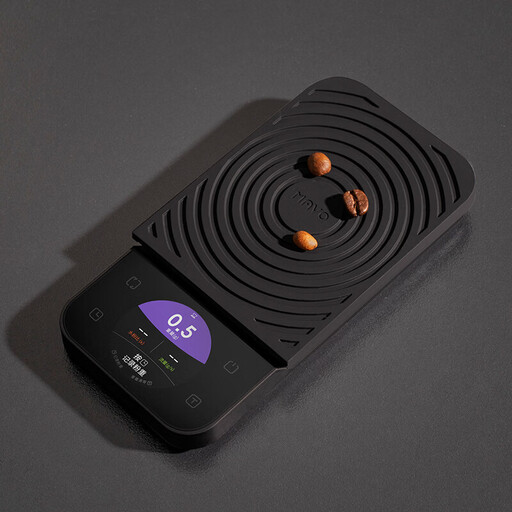
The product name describes this model as a coffee and kitchen scale. Check whether its features and controls suit the way you weigh granola ingredients.
 No image available
A removable bowl is a handy option if you want to weigh ingredients in a bowl of your own. Check that its size suits the quantities you need and the way you work.
Place a bowl intended for food contact on the scale, tare it and add honey until you reach the desired weight. If you want to weigh other ingredients separately in the same bowl, you can tare it again; the total load must remain within the model’s maximum capacity.
No. These figures describe the display increments and, on their own, don’t prove the scale’s actual measurement accuracy. To establish the measurement error, the specific model needs to be tested across the relevant weighing range.
Only if the instructions for that specific model say you can. GEFU explicitly states that the SCORE is not dishwasher-safe; an easy-to-clean surface doesn’t mean it can go in the dishwasher.
Materials intended for food contact must meet EU requirements. Germany’s Federal Office of Consumer Protection and Food Safety recommends checking for a statement or label confirming that the item is intended for this use. For tableware that is clearly intended for food contact, the glass-and-fork symbol does not also have to be displayed. A bowl placed on the scale does not make the scale itself a surface that comes into contact with the honey.
In Germany, electrical waste must not be put in household rubbish. The Federal Environment Agency recommends removing batteries from the device before disposal, where possible, and disposing of them separately.