Adding muesli ingredients
If you add dried fruit and other ingredients to the same bowl one after another, the tare function makes it easier to weigh each one separately. Soehnle and Tefal list this feature on selected models.


If you weigh dried fruit and other ingredients one after another into the same bowl, digital kitchen scales with a tare function are a good place to start. Then check that the bowl and the total mixture are within the scales’ capacity, and that you can still see the display with the bowl in place. Manufacturers’ stated increments and weighing ranges are not independent proof of measurement accuracy.
If you add dried fruit and other ingredients to the same bowl one after another, the tare function makes it easier to weigh each one separately. Soehnle and Tefal list this feature on selected models.
For a larger bowl to share, look for a suitable weighing surface, enough capacity and a display that’s easy to see. Soehnle and Tefal list these features for selected kitchen scale models.
If you regularly measure very small amounts of ingredients as well as dried fruit, a separate precision scale may be worth considering. ADE describes the Isabella KE2354 as having a separate precision weighing surface.
| Feature | What to look for | Who is it important to? |
|---|---|---|
| Weighing ingredients one after another | Check whether you can tare the scales with the bowl in place, and include the weight of the bowl and its contents in the maximum load. | If I want to weigh several ingredients in the same bowl without doing the maths in my head, a tare function is essential. Around 40% of consumers put this feature first. |
| Bowl size and total weight | Compare the base of your bowl with the weighing surface and check that it won’t obscure the display. Remember to include the bowl in the total weight. | If I’m preparing a larger portion to share, I need a stable surface and a display I can still read with the bowl in place. Around 30% of consumers prioritise the bowl and total weight. |
| Small amounts of ingredients | Consider whether your recipe calls for increments smaller than 1 g, and check that the precision range covers the amount you need. | If I regularly measure very small amounts of additional ingredients, I want to know whether a precision surface is really necessary for the quantities I use. Around 20% of consumers prioritise very small amounts. |
| Power supply | Check the battery type and what’s included, or consider whether you’d prefer to activate a battery-free model before weighing. | If I want to avoid changing batteries, the way a battery-free scale works matters to me. If I choose a battery-powered model, I’ll plan for replacements. Around 10% of consumers put the power supply first. |
A figure such as 1 g or 0.1 g describes the display increments. It doesn’t automatically tell you the actual measurement deviation under your usage conditions.
Choose the increments to suit the smallest amounts in your recipes, and don’t assume that a smaller increment guarantees greater accuracy.
A bowl may be unstable on a small surface or hide the display. Its weight also counts towards the total load, along with its contents.
Compare your bowl’s base with the weighing surface and add together the weight of the bowl and ingredients before deciding how much capacity you need.
According to the manufacturer, you need to turn an energy wheel before weighing with the CASO KitchenEnergy. Battery-powered models instead need their batteries changed from time to time. Used batteries must not go in household waste.
Think about your weighing routine and decide whether you’d prefer a preparation step or an occasional battery change. The German Environment Agency recommends returning used batteries to collection points in shops or local authority collection points.
Soehnle describes the Page Compact 300 as compact kitchen scales for everyday weighing.
According to Tefal, the Optiss BC50U0 combines a larger glass surface with a backlit display.
Beurer describes the KS 19 Ice Cream as flat glass scales for household ingredients.
According to ADE, the Isabella KE2354 combines a main weighing surface with a separate precision surface.
According to CASO Design, the KitchenEnergy is a digital scale that runs without batteries.
The digital kitchen scales below may suit weighing dried fruit and other ingredients in portions. Look for a tare function and sufficient capacity, and check whether the bowl will obscure the display.
 No image available
The listed tare function is useful when weighing ingredients one after another in the same bowl.
The product title states a maximum capacity of 5 kg, 1 g increments and app connectivity. According to the product description, the app requires 2.4 GHz Wi-Fi.
 No image available
The tare function mentioned in the product title is useful for weighing several ingredients in the same bowl.
The title states a maximum capacity of 5 kg, 1 g increments and automatic shut-off.
 No image available
The tare function listed in the title is useful when adding more ingredients to the same bowl.
The product title states a maximum capacity of 10 kg, 1 g increments and dimensions of 21 × 15.5 × 2.9 cm. Check that your bowl fits on the surface and that the display remains visible.
 No image available
The removable bowl is an alternative if you’d like to weigh ingredients in the bowl supplied.
The product description states a maximum capacity of 5,000 g and battery operation.
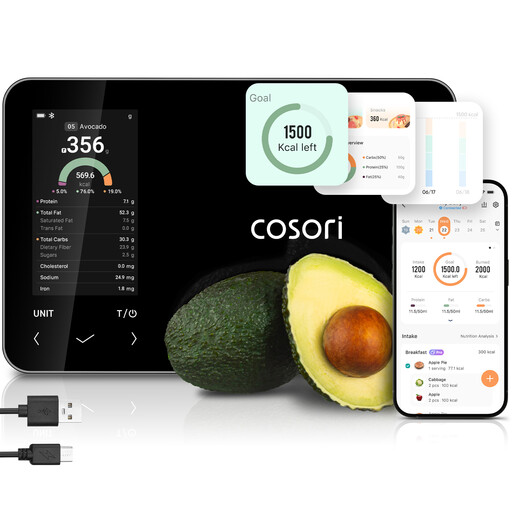 No image available
The app features may suit you if you’d like to access digital food information while weighing ingredients.
The product title mentions calorie counting, AI scanning, tracking 19 nutrients and a food database.
Place the bowl on a stable part of the scales and tare them before adding anything. You can tare them again before adding the next ingredient. Always keep the scales’ maximum capacity in mind, including the bowl and its contents.
No. The stated increments describe the display, not the actual measurement deviation. ADE lists a separate precision surface for the Isabella KE2354. Whether it’s useful for your recipe depends on the smallest amount you want to weigh.
The statutory warranty from the seller is different from a voluntary manufacturer’s guarantee, as the consumer advice centre explains. For battery-powered models, check which battery type they use. According to the German Environment Agency, used batteries should be taken to collection points in shops or local authority collection points.
The requirements described by Germany’s National Metrology Institute for commercial and official purposes, and for measurements in the public interest, do not establish a calibration requirement for the private food preparation discussed here. If you sell ingredients by weight or weigh them for another regulated purpose, this private use case isn’t enough to guide your choice of scales.
In Germany, electrical waste must not go in household rubbish. Take it to a suitable local authority collection or take-back point. Remove any easily accessible batteries and take them separately to a battery collection point. The German Environment Agency provides information on returning electrical waste through collection points.