What should you look for when buying?
First, decide whether you need to weigh less than 1 g of yeast. Then make sure the maximum capacity, weighing platform and tare function suit your bowls and the way you work.
| Buying criterion |
What to check |
Who should pay particular attention? |
| Small amounts of yeast |
Check the minimum weight and increments for the platform you’ll use; don’t assume 0.1 g increments prove the scale is accurate. |
If I weigh less than 1 g of yeast, I need a specified weighing range that covers this amount. Around 36% of consumers are likely to prioritise weighing small amounts of yeast when choosing a scale. |
| Bowl and batch size |
Compare the combined weight of the bowl and ingredients, and the dimensions of the weighing platform, with the model’s maximum capacity. |
When I’m making several loaves, my filled bowl needs to fit on the platform and stay within its weight limit. Around 29% of consumers are likely to prioritise this. |
| Adding ingredients one at a time |
Check that the tare function is available on the platform you need and that you can still read the display with your bowl in place. |
If I’m adding lots of ingredients to one bowl, I want to reset the weight easily between each one. Around 21% of consumers are likely to prioritise an easy process for adding ingredients by weight. |
| Purchase and aftercare |
Decide whether a dual scale or two separate scales better suits your needs; check what’s included, the power supply and any voluntary warranty terms. |
I want to cover the weighing ranges I need without using more scales than necessary, and understand the warranty terms. Around 14% of consumers are likely to make this their main consideration. |
Related products at Joybuy
This selection at Joybuy includes digital kitchen and precision scales for weighing ingredients, including models with a tare function and specified 0.1 g or 1 g increments.
 No image available
Digital kitchen scale with removable bowl
For weighing ingredients directly in the removable bowl; the description lists a maximum capacity of 5,000 g.
View at Joybuy
 No image available
TIMEMORE Black Mirror Basic 2 Pour-Over
The stated 0.1 g increments may be useful for weighing small amounts of ingredients; check that the minimum weight suits the amount of yeast you need.
The title lists a capacity of 2,000 g and 0.1 g increments. The description mentions timer and tare buttons, as well as a flow-rate display.
View at Joybuy
 No image available
Digital kitchen scale, 5 kg
For recipes where whole grams are enough; the specified 1 g increments won’t show fractions of a gram.
The description lists a maximum capacity of 5 kg, 1 g increments and a tare function.
View at Joybuy
 No image available
Digital kitchen scale with stainless steel platform, 5 kg
For weighing ingredients in whole grams; the specified 1 g increments don’t show fractions of a gram.
The title lists a capacity of up to 5,000 g, 1 g increments, a tare function and the units g, ml, oz, lb and fl.
View at Joybuy
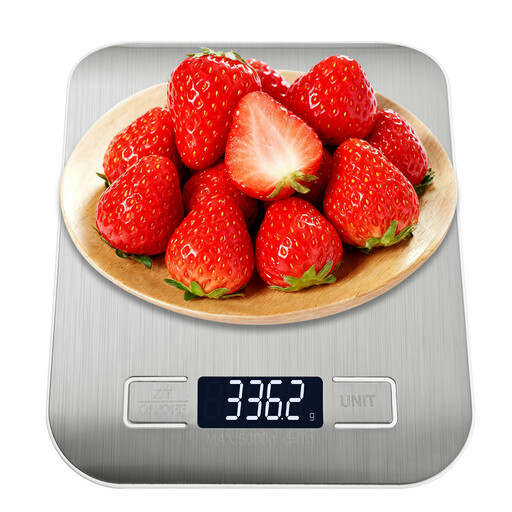 No image available
Vivreal CFC-03White kitchen scale
For weighing whole grams; the specified 1 g increments won’t show fractions of a gram.
The title lists a maximum capacity of 5 kg, 1 g increments and a stainless steel surface; the description mentions tare and several units of measurement.
View at Joybuy
Frequently asked questions
How do I scale the amount of yeast for several loaves?
Scale the ingredients using the same basis as the recipe. With baker’s percentages, ingredient quantities are based on the total amount of flour, as The Perfect Loaf explains in its guide to baker’s percentages. Then weigh the calculated amount of yeast on a platform with a specified range that covers it.
How should I set up and clean a precision scale?
Place the scale on a firm, level surface and follow the instructions for the specific model. GEFU recommends cleaning the PREZISO with a soft, slightly damp cloth and warns that no water must get into the device. Ooni says its dual scale is not dishwasher-safe.
Do I need an officially verified scale for home bread-making in Germany?
You don’t need an officially verified household scale for ordinary weighing at home. The Physikalisch-Technische Bundesanstalt distinguishes household scales from scales covered by legal regulations. This doesn’t establish what requirements apply if measurements are used for sales or other regulated purposes.
Who should I contact if the scale develops a fault?
If there’s a defect, you can generally exercise your statutory consumer rights with the seller. A manufacturer’s warranty is an additional voluntary service with its own terms. Verbraucherzentrale describes a general two-year period for statutory rights, and a one-off 12-month extension for certain purchases made from 31 July 2026 if you choose a repair when making a claim.
How should I dispose of an old digital scale and its batteries?
In Germany, electrical waste must not go in household rubbish. The Umweltbundesamt lists recycling centres and suitable collection points; removable batteries should be taken separately to battery collection points.


