What to look for when buying
First decide whether you need timers to run at the same time or one after another. Then consider the type of signal and where to place the timer so you can easily see or hear it.
Digital dual timer
Best for: Two portions or dishes with different finish times that need to be tracked at once. TFA Dostmann and ADE describe models that display two countdowns simultaneously.
Things to consider: Compare how you set each time and whether the alarm and display suit your cooking station.
Single timer with memory
Best for: Preparing portions one after another for the same amount of time, and recalling the last setting. TFA Dostmann lists a memory function for the 38.2021.01.
Things to consider: A single countdown can’t track two different finish times at once.
Single timer with flexible placement
Best for: When you mainly need a clearly visible countdown at your chosen cooking station. The GEFU CONTARE has a magnet and a clip, while the Silit Attimo combines a touchscreen display, magnet and stand.
Things to consider: When you’re cooking several portions at once, these single timers can’t replace two separate countdowns.
| Priority |
What to check when buying |
Who it matters to |
| Keeping two times separate |
Look for two countdowns that can run at the same time, not just a countdown and a stopwatch. |
When I’m preparing two portions at once with different finish times, I want to track each time separately. Around 36% of consumers put this need first. |
| Reusing a time |
Check whether a memory function saves the last setting; it isn’t a second countdown. |
When I’m preparing batches one after another, I don’t want to set the same time again each time. Around 29% of consumers prioritise this. |
| Noticing when the time is up |
Compare audible and visual alerts, as well as volume settings. If the alarm is muted, you’ll need to keep an eye on the display. |
If I can’t keep looking at the timer while I’m cooking, I need a signal I can notice at my workstation. Around 21% of consumers focus mainly on this. |
| Placement and operation |
Check for a magnet or stand, and whether batteries are included with the specific model. |
If I want to position the timer differently depending on the task, how it attaches and whether it’s ready to use are important. Around 14% of consumers prioritise these points. |
Joybuy products for individual cooking times
The products below are designed for individual cooking times, when you need to see or hear a countdown at your chosen cooking station.
 No image available
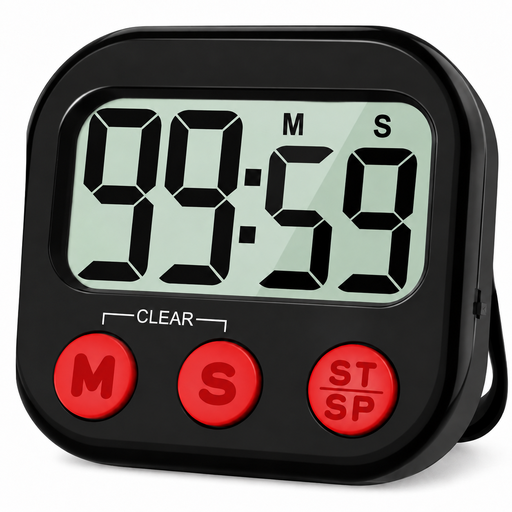
Digital interval timer with stopwatch, 99 min 59 sec
As a single timer, it’s suitable for individual cooking tasks with a set duration and countdown.
The timer counts up and down, and you can adjust the alarm volume. A magnet, stand and hanging hook give you different ways to position it. The display is described as large and easy to read.
View at Joybuy
Frequently asked questions
When blanching, when should I use the timer and when should I cool the vegetables?
Set the countdown according to the vegetable, the size of the pieces and how you plan to use them afterwards. The German Federal Centre for Nutrition recommends boiling vegetables for freezing for a few minutes, then cooling them in iced water. This isn’t a fixed time that applies to every type of vegetable and portion size.
Is a short blanching countdown enough to make fresh green beans safe to eat?
No. Brief blanching is not the same as cooking them thoroughly. The German Federal Institute for Risk Assessment recommends boiling fresh pulses for at least 30 minutes as a general rule, and highlights the lectin phasin in beans.
What should I check about batteries and cleaning?
Check the battery type and what’s included with the specific model: two AAA batteries are not included with the TFA Dostmann 38.2025, while one AAA battery is included with the 38.2021.01. GEFU states that the CONTARE is not dishwasher-safe. You should also follow the care instructions for the Silit Attimo, as its product details say it is not dishwasher-safe.
Can an old digital timer and its batteries go in general waste?
No. Section 10 of the German Electrical and Electronic Equipment Act (ElektroG) requires waste electrical and electronic equipment to be collected separately from unsorted municipal waste. Used batteries must also be collected separately; the German consumer advice centre recommends returning them separately.


