For hosts managing several dishes at once
You want separate alerts to coordinate eggs, side dishes or batches started at different times. Technoline’s instructions describe the KT 300 as having three independent countdown timers.


If you want eggs and side dishes to be ready at the same time, choose a timer with several independent countdowns. For repeated batches of eggs, a single adjustable countdown with a memory function is often enough. Preset times are easy to start, but limit your choice. Also check that you’ll be able to hear or see the alert where you plan to place the timer, and whether the required batteries are included. A timer tells you when time is up; it doesn’t confirm that an egg has been heated sufficiently.
You want separate alerts to coordinate eggs, side dishes or batches started at different times. Technoline’s instructions describe the KT 300 as having three independent countdown timers.
You cook eggs one batch at a time and want to restart a time you’ve chosen yourself, or switch between an adjustable countdown and preset options. TFA Dostmann lists a memory function for model 38.2021.01; the CUBE-TIMER 38.2041.07 offers four preset times.
You want to keep track of cooking over the noise of the kitchen or from another worktop, and to position the timer where you can see it. For the TFA 38.2024, the manufacturer lists three volume levels, an LED warning light, a magnet, a stand and a hanging loop.
First, consider whether different dishes need to finish at the same time. Then look for a choice of timings that suits you and an alert you’ll notice from where you work in the kitchen.
| What you need | What to look for | Who is this especially important for? |
|---|---|---|
| Keep track of several tasks separately | Check how many countdowns can run at once, and whether each can be set and displayed separately. | If I want eggs and side dishes to be ready at the same time, I need separate alerts rather than just one saved time. Around 36% of consumers put managing tasks in parallel at the top of their list. |
| Repeat batches of eggs with the right timing | Check the difference between an adjustable time that can be saved and preset times. | If I’m cooking several batches one after another, I want to restart the same suitable time quickly. Around 29% of consumers prioritise being able to repeat a cooking time they’ve chosen themselves. |
| Notice the alert during kitchen activity | Look for adjustable alerts, visual indicators and a position where you can see the display. | If I’m not standing next to the pan all the time, I need to be able to notice the alert from wherever I choose to place the timer. Around 21% of consumers pay particular attention to having an alert they can notice. |
| Keep setting it up as simple as possible | Compare the available timings and the steps involved with the way you plan to use it. | If I want to make as few adjustments as possible while preparing food, preset times could work for me, as long as one is suitable. Around 14% of consumers put ease of use first. |
A saved time makes it easier to repeat a countdown, but it doesn’t replace separate alerts for dishes cooking at the same time.
If you’re cooking several dishes at once, check exactly how many countdowns can run independently.
The TFA CUBE-TIMER offers four preset times. However, a countdown can’t tell you whether the egg has reached a sufficient core temperature.
Choose preset times only if they suit the way you cook. For guests who are particularly vulnerable, follow the German Federal Institute for Risk Assessment’s guidance on heating food sufficiently.
What’s included varies by model, even within the same brand.
Before buying, check which type of battery is required and whether it’s included.
For models supplied without batteries, you’ll need to have suitable AAA batteries ready separately.
The KT 300 is a multi-timer for hosts who want to keep track of several tasks separately.
The models range from an adjustable countdown and a timer with an additional alert to preset egg-cooking times.
Model 00002954 is an adjustable single timer with a stopwatch, designed for the kitchen and cooking eggs.
The CONTARE 12330 is a compact single timer with a countdown, stopwatch, magnet and stand.
The Triple Timer is designed to keep track of three kitchen timings at once.
This selection features digital kitchen timers, including models with adjustable alerts or different positioning options.
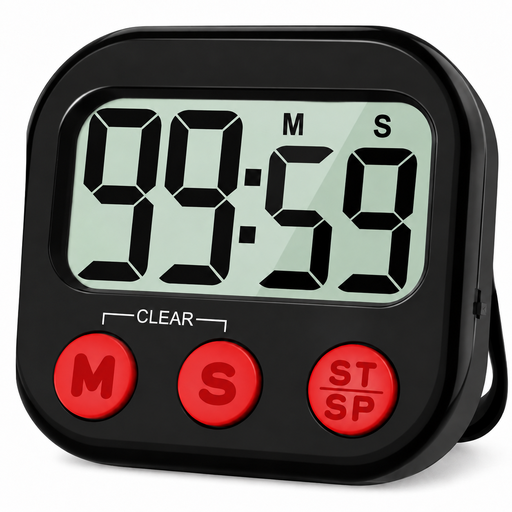 No image available
An option for eggs and other kitchen tasks if you’d like to adjust the alarm volume.
The product name lists an adjustable time of up to 99 min 59 sec and adjustable volume.
The description lists an LCD display, stopwatch, stand, magnet and hanging loop.
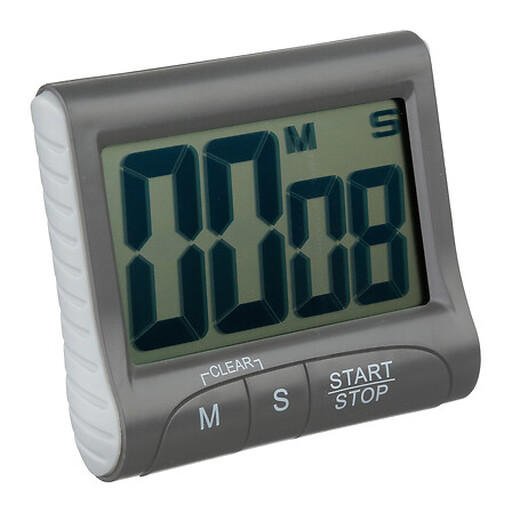 No image available
An option for a kitchen countdown if you want to stand or hang up the timer.
The product description lists a digital display, a countdown with an alert when time is up, and an integrated hanging loop.
According to the product description, one AAA battery is included. Keep the device away from water and extreme heat, and keep small parts and batteries out of reach of young children.
If your device has separate countdown timers, assign a countdown to each dish or batch. The Technoline KT 300 instructions describe using the T1, T2 and T3 buttons, and setting the hours, minutes and seconds.
No. Depending on the model, you can stand it up or attach it to a suitable surface. The Technoline KT 300 has a stand and magnet, according to the manufacturer, while the TFA 38.2024 also has a hanging loop. Choose a spot where you’ll notice the alert, and use the device as described in its instructions.
No. A timer measures time, not core temperature. The German Federal Institute for Risk Assessment gives at least two minutes at a core temperature of at least 70 °C as a baseline for heating food sufficiently; the timer’s alert doesn’t confirm that this temperature has been reached.
Check what’s included with the specific model. According to the manufacturer, the two required AAA batteries are not included with the TFA 38.2024, while the TFA 38.2021.01 comes with one AAA battery. The consumer advice centre distinguishes the seller’s statutory responsibility for faulty goods from a voluntary guarantee; if there’s a fault, the first step may be to request a repair or replacement.
No. Under § 10 ElektroG, end users must dispose of old electrical equipment separately from unsorted municipal waste. Where the law requires it, removable used batteries must be taken out without damaging the device before it is handed in; the German Environment Agency points out that used batteries can be returned free of charge at collection points.