Weekday routine keepers
If you often cook eggs to the same routine before work or school, saving your preferred time can save you from setting it again each morning. TFA Dostmann lists this memory function for model 38.2021.01.


For a consistent egg routine, a timer with a memory function is handy; if your timings vary, a countdown that’s easy to set will do the job. Choose the alarm and where to place the timer based on whether you’ll be able to hear or see the alert from your spot in the kitchen. Two independent countdowns are only useful if you regularly time another dish as well. A timer measures time, not the egg’s internal temperature: for the pathogens covered in its advice, the Federal Institute for Risk Assessment recommends at least two minutes at an internal temperature of at least 70 °C.
If you often cook eggs to the same routine before work or school, saving your preferred time can save you from setting it again each morning. TFA Dostmann lists this memory function for model 38.2021.01.
If your kitchen is noisier at some times of day, or an audible alarm might be disruptive, look for a suitable alarm and a clearly visible position. TFA Dostmann lists two volume levels and a silent mode with an LED warning light for model 38.2056.04.
If you regularly prepare other food alongside your eggs, two independent countdowns could come in handy. ADE lists this feature for the TD2100.
For eggs in a weekday lunchbox, the key things are a cooking time you can repeat quickly, an alarm you’ll notice and a timer that’s easy to reach. Two timers are most useful when you’re preparing something else at the same time as the eggs.
| What matters to you | What to look for | Who it matters to |
|---|---|---|
| Repeating a cooking time | Check whether the model can save a countdown time you’ve used before and start it again. | If I usually cook my eggs for the same time before work or school, I want to start the timer without entering it again. Around 36% of consumers put being able to repeat a cooking time quickly first. |
| Noticing the alarm | Look for adjustable volume levels, a possible silent mode and a light signal you can see from where you plan to put the timer. | If an alarm might be disruptive in my kitchen or easy to miss, I need one that suits me there. Around 29% of consumers prioritise an alarm they can notice in everyday use. |
| Display and placement | Compare the display and mounting options with the spot where you plan to use the timer. | If I want to check the time left while preparing a lunchbox, I need to be able to see the display from my place in the kitchen. Around 21% of consumers pay particular attention to readability and placement. |
| Timing two things | Check whether the two countdowns really do run independently of each other. | If I regularly cook a second dish or carry out another task alongside the eggs, I want to keep track of both times separately. Around 14% of consumers put timing two things at once first. |
A timer can measure a cooking time without saving it for the next morning. If you use it every day, you may have to enter the time again each time.
If you often use the same duration, check that the specific model has a memory function.
A visual alert is only helpful if you can see the timer from where you’re sitting or working.
Consider the type of alert and where you’ll put the timer together. If needed, compare the volume levels and LED alerts for the spot where you plan to use it.
The AAA batteries required for the TFA Dostmann 38.2056.04 and the Technoline KT 200 are not included, according to the manufacturer or product information. A voluntary manufacturer’s warranty is also not the same as your statutory rights.
Check the battery type and what’s included with the specific model, and distinguish a warranty from your statutory rights against the seller.
A timer shows how much time has elapsed, but not the egg’s internal temperature. Good hygiene and suitable storage and transport are separate considerations.
Consider your choice of timer separately from how you prepare eggs hygienically and store them for when you’re out and about.
The documented 38.2021.01 and 38.2056.04 models cater for different priorities: saved timings, or an adjustable or visual alert.
The KT 200 is a straightforward digital countdown timer and stopwatch for timing one cooking task.
The TD1600 is designed for keeping track of a single countdown, while the TD2100 is made for timing two things at once.
The ACCURA digital kitchen timer is another option, with large digits and magnetic attachment.
This selection includes digital kitchen timers for a single egg countdown, with audible or adjustable alarms and a choice of ways to position them.
 No image available
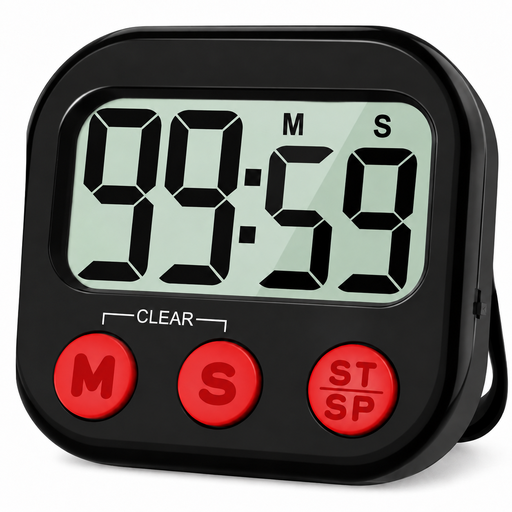
For timing a cooking task with adjustable volume; the product title lists a countdown of up to 99 min 59 sec and a stopwatch.
A countdown measures time, not the egg’s internal temperature. Hygiene and suitable storage and refrigeration for transport should be considered separately.
 No image available
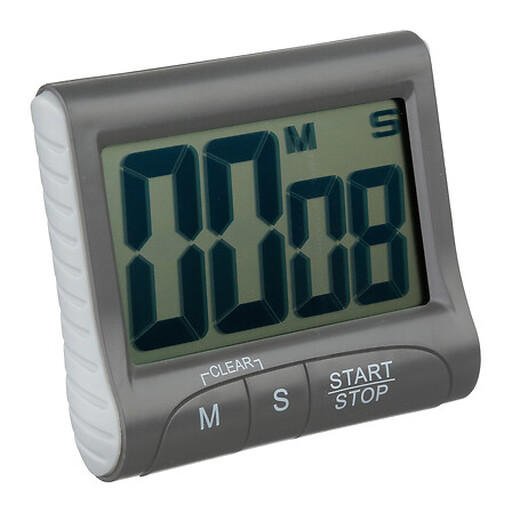
For a single egg countdown with an audible alarm; according to the product description, you can stand the timer up or hang it from its built-in hook.
An AAA battery is included, according to the product information. The timer should not be exposed to water or extreme heat.
The countdown shows the time, not the egg’s internal temperature. Hygiene and suitable storage and refrigeration for transport should be considered separately.
No. A timer measures time, not the temperature inside the egg. For the pathogens covered in its advice, the Federal Institute for Risk Assessment recommends at least two minutes at an internal temperature of at least 70 °C; a particular cooking time alone does not prove that this requirement has been met.
Pay attention to kitchen hygiene and suitable storage and transport conditions too. The Federal Institute for Risk Assessment notes that inadequate refrigeration can allow harmful bacteria to multiply in perishable foods. Advice on commercially treated eggs cannot necessarily be applied to eggs you’ve cooked yourself for a lunchbox.
It depends on the model: according to Technotrade’s product page, the Technoline KT 200 can be stood up or attached magnetically, and requires an AAA battery that is not included. Check that the attachment method suits your kitchen and see which battery, if any, is included.
The consumer advice centre explains that online consumer purchases generally come with a 14-day right to cancel; the start of the period and any exceptions should be checked for your specific circumstances. Your statutory rights if a product is faulty are separate and do not depend on a voluntary manufacturer’s warranty.
No. According to the German Environment Agency, electrical and electronic waste must be disposed of separately from household waste. Removable batteries should be taken separately to a battery collection point.