Choose a timer with a range that covers when you plan to check your dough. If you need more than 99 minutes and 59 seconds, look for a model that explicitly offers an hours setting. TFA Dostmann lists these ranges for individual models, and the 38.2025 can time two things at once. An alarm reminds you to check, but it can’t tell you whether the dough is ready: according to Plötzblog, this also depends on the dough’s condition and temperature.
Which kitchen timer is right for you?
For bakers with long proving times
You want to set a later time to check your dough after the weekly shop, even if it falls outside the range of some minute timers. The alarm reminds you to check, but doesn’t tell you whether the dough is ready; Plötzblog recommends judging the dough’s condition for that.
For bakers who like a straightforward kitchen routine
You need a clear countdown to remind you when to check, and want to look at the timer’s range, controls and placement before buying. Display, mounting options and battery requirements vary by model and manufacturer.
For bakers juggling several tasks
You want to keep track of another kitchen task while your dough proves, so you may need two displays running at the same time. TFA Dostmann describes this feature on its digital 2-channel timer 38.2025.
What should you look for when buying?
First, check that the model’s range covers the time you plan to leave the dough before checking it. Then make sure its controls, alarm and placement suit your kitchen routine.
| What to consider |
What to look for |
Who will find this useful? |
| Timer range |
Compare your planned proving time with the model’s maximum setting. TFA Dostmann lists timers with ranges measured in hours. |
If I want to leave the dough to prove for longer, I need a countdown that reaches the time I plan to check it. Around 36% of consumers put a long timer range first. |
| Setting and reading a single timer |
Check that the display and controls are easy for you to use, and that the timer can stand or hang where you plan to put it. |
If I mainly want to keep track of one time to check the dough, straightforward controls matter. Around 29% of consumers prioritise being able to set and read a single timer easily. |
| Two timers running at once |
Look specifically for two separate displays that can run at the same time. TFA Dostmann says the 38.2025 offers this feature for up to 99 hours, 59 minutes and 59 seconds. |
If I want to time another kitchen task as well as proving dough, I need separate countdowns. Around 21% of consumers put simultaneous timers first. |
| Noticing the alarm |
Check the volume settings, light signal and whether you can see the timer from where you’ll place it. TFA Dostmann lists these options for models 38.2056.04 and 38.2049.02. |
If I want to avoid an audible alarm but still notice when it’s time to check, I need to keep the timer somewhere visible. Around 14% of consumers prioritise a discreet alarm they can still notice. |
Common mistakes when choosing a kitchen timer
-
Assuming the alarm means the dough is ready
The time running out doesn’t, on its own, confirm that the dough has proved enough. The dough’s temperature and condition can affect when you should check it.
Set a time to check, then look at how much the dough has risen and its texture. Plötzblog also suggests gently pressing the dough with a finger as a possible indicator, if its surface is suitable.
-
Buying a minute timer for a longer, uninterrupted proving time
The minute timers listed here go up to 99 minutes and 59 seconds at most, so they won’t cover a longer interval set in one go.
Before buying, compare the time you plan to leave the dough with the longest countdown available on the specific model.
-
Confusing saved times with two simultaneous countdowns
Saving several times isn’t the same as having two timers run at once with separate displays.
If you want to time proving dough and another task at the same time, look specifically for two simultaneous timers.
-
Overlooking the battery and where you’ll put the timer
According to TFA Dostmann, the AAA batteries required for the TFA 38.2025 aren’t included. Its magnet also needs a suitable surface.
Check what’s included and where you plan to put the timer. A model with a stand may be a good alternative if you don’t have a suitable magnetic surface.
You may need to buy two AAA batteries separately for the TFA 38.2025.
Brands and models to consider
TFA Dostmann
The listed models cover long single countdowns, two simultaneous timers and shorter intervals measured in minutes.
- TFA Dostmann says the 38.2025 can monitor two timers at once for up to 99 hours, 59 minutes and 59 seconds. The 38.2049.02 offers a long single countdown with a pre-alarm.
- The 38.2056.04 has a stated maximum of 99 minutes and 59 seconds. According to TFA Dostmann, the AAA batteries required for the models listed here aren’t included.
Tescoma
The digital PRESTO 636076.00 is an option for timing individual intervals within its minute range.
- Tescoma lists a digital display, audible signal, magnet and included AAA battery. Its range goes up to 99 minutes and 59 seconds.
- Its stated range isn’t long enough for longer proving times set in one go.
GEFU
The digital CONTARE 12330 can be placed or stood upright to time intervals in minutes and seconds.
- GEFU lists a timer range of up to 99 minutes and 59 seconds, a magnet, a stand and an included AAA battery.
- This model isn’t dishwasher-safe. Its stated range is too short for longer proving times set in one go.
Silit
The Attimo 3201003852 is a digital single timer with touch controls and several placement options.
- Silit says the timer counts up or down and has start/stop controls, a magnet and a stand; two AAA batteries are included.
- If you want to set a longer proving time in one go, check the maximum countdown for the specific model before buying.
Digital timers at Joybuy
This selection includes digital timers for setting a single time to check your dough, including a visual option with a 60-minute countdown. If your dough needs longer to prove, check the range of the specific model.
 No image available
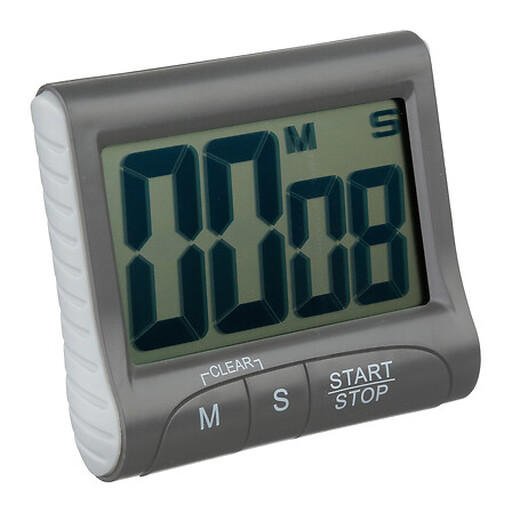
5Five Grey Digital Timer
For a single reminder to check your dough, make sure the countdown range suits your planned proving time. The alarm simply reminds you when to check; it doesn’t confirm that the dough is ready.
View at Joybuy
 No image available
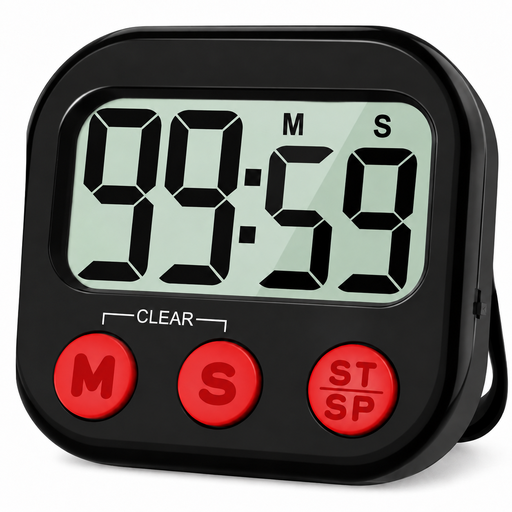
Digital interval timer with stopwatch
The product name specifies a countdown of up to 99 minutes and 59 seconds, with adjustable volume, making it suitable for shorter intervals between checks. For longer, uninterrupted proving times, you’ll need a model with a stated range in hours.
View at Joybuy
 No image available
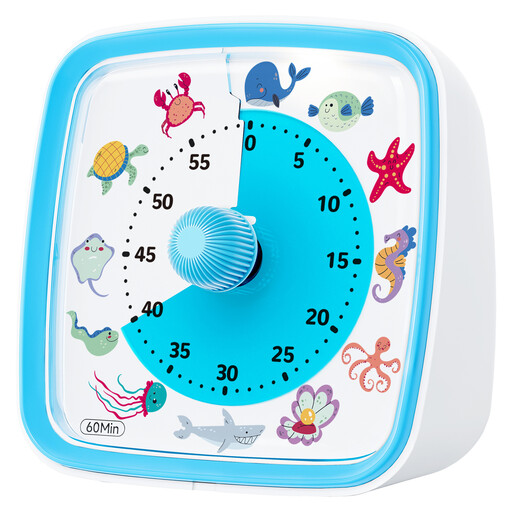
Visual timer for children
If you plan to check your dough within an hour, make sure the timer’s short range suits your schedule. The countdown is limited to 60 minutes, so it won’t cover longer, uninterrupted proving times.
View at Joybuy
Frequently asked questions about kitchen timers
Is the dough ready as soon as the timer goes off?
No. Use the alarm as a reminder to check, then judge the dough for yourself. Depending on how far it has proved and what you’re baking, its increase in volume and, if the surface is suitable, how it responds to a gentle finger press can offer clues. The temperature of the dough and its surroundings can affect how long it needs.
Can I attach a magnetic timer to any kitchen surface?
No. A magnet will only hold on a suitable magnetic surface. GEFU says the CONTARE 12330 can also stand upright, as well as attach with its magnet. Check that the model you choose will work where you plan to put it.
Are batteries included when I buy a timer?
It depends on the model. TFA Dostmann says the 38.2025 needs two AAA batteries, which aren’t included; Tescoma says an AAA battery comes with the PRESTO 636076.00. Check the details for the exact version you choose.
What should I do if my timer is faulty, and how should I dispose of it in Germany?
When you buy from a trader, you’re generally entitled to at least two years of legal protection against faulty goods from the date you receive them, as Your Europe explains. This is separate from any voluntary manufacturer’s guarantee. The German Environment Agency advises against putting electrical appliances in household waste. If possible, remove the batteries before disposal and take the appliance and batteries to suitable collection points separately.


