
Lieferung heute & morgen

Qualitätsgarantie

Willkommens-Angebote freischalten: KOSTENLOSE Lieferung | Bis zu 80 % RABATT | Kostenlose 30-Tage-JoyPlus-Testphase
App herunterladen
A digital kitchen timer should do one thing above all when you are cooking, baking or studying: clearly display the remaining time and reliably signal when the countdown has finished. In practice, however, kitchen timers vary considerably in terms of operation, power supply, display and alarm sound.
If you focus solely on a modern casing or an especially large number of features, it is easy to overlook important details. Three common buying mistakes occur particularly often:
When choosing a timer, it is therefore crucial to consider how and where the electronic timer will be used.
A kitchen timer with a display should show the remaining time in a sufficiently large, high-contrast format. It is not just the screen size that matters, but also the viewing angle, digit height and brightness.
For the kitchen, an easy-to-read LCD or LED display is recommended. If you are placing the timer on a worktop, you should also look for a stable base. A hanging loop is useful if you want to attach the device to a kitchen rail or hook.
With a digital egg timer model or a kitchen countdown timer used across several rooms, a clearly audible alarm is important. In an open-plan living area, however, a switchable or quieter sound function may be more practical.
Before buying, you should check what time range you need:
A classic dial timer can usually be set quickly, as you select the time by turning the dial. Button-operated models often allow more precise input, but require more individual actions. With touchscreen devices, the display should respond well even when operated with dry, clean fingers.
A timer powered by an AAA battery is ready to use straight away if the battery is included. A rechargeable timer reduces the need for disposable batteries, but must be charged in good time. With battery-powered devices, the battery should be removed if the timer is not going to be used for an extended period, to help prevent possible damage caused by leakage.
Easy-care housings made from ABS plastic or stainless steel are suitable for the kitchen. Important: a kitchen timer is generally not waterproof. It should not be placed directly next to the sink or come into contact with water or extreme heat. Depending on the material, clean it with a dry or slightly damp cloth.
Additional functions should also match your actual needs. A timer for cooking and baking does not necessarily need several modes. With a toaster or coffee scale, on the other hand, an integrated timer can offer a tangible benefit.
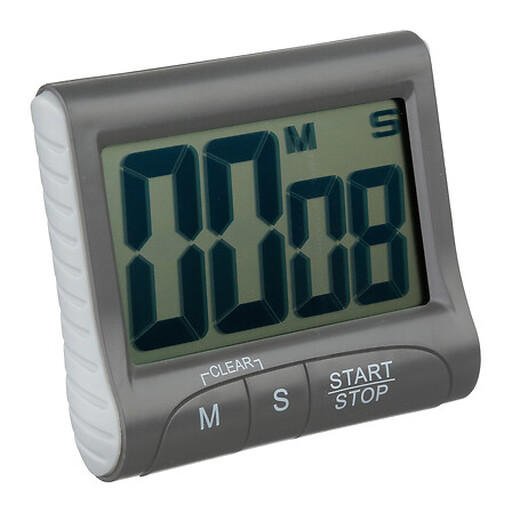
Why this product suits the profile: This compact electronic timer is suitable for everyday countdowns in the kitchen, around the home, while studying or during training.
The buttons are straightforward to use, while the digital display shows the remaining time. A hanging loop allows the timer to be mounted without taking up much space.
ABS casing, dimensions of 8 × 2,7 × 7,5 cm and an AAA battery included.
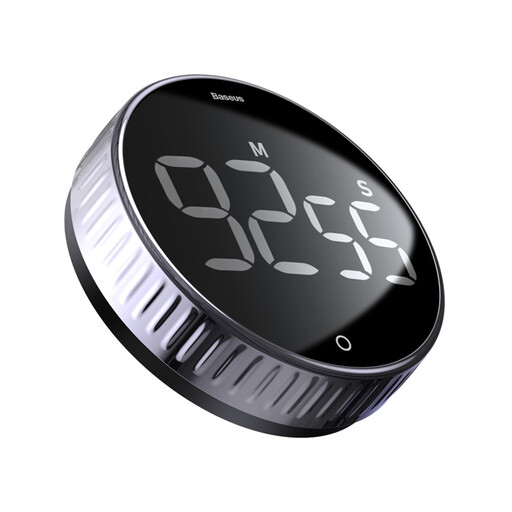
Why this product suits the profile: This timer is designed for users who prefer straightforward operation and a rechargeable power supply.
The rotary dial reduces the number of individual inputs. The countdown can be set from 1 to 60 minutes and is shown on the LCD display.
Integrated rechargeable battery, large LCD display and an audible alert when the countdown ends.
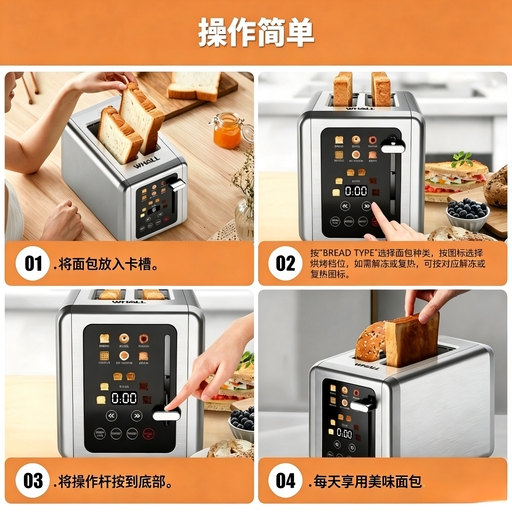
Why this product suits the profile: Ideal for households that want to integrate a timer directly into a kitchen appliance they use regularly.
Progress is shown via a countdown. Six browning levels, six bread modes, as well as defrost, reheat and cancel functions allow you to choose the setting that suits the task.
Two wide 1.5-inch slots, memory function, removable crumb tray and optional alarm sound.

Why this product suits the profile: Combining scales and a timer, this device is suitable for coffee preparation, portioning ingredients for recipes and controlled baking.
If you want to control both time and quantity, you do not need a separate device. The product description specifies a timer function and switchable units.
Electronic kitchen scales with timer function and the option to switch between ounces and kilograms.
We have put together a complete, regularly updated list of products that fully meet these strict selection criteria and the safety regulations applicable in the EU.
First, select the desired duration using the buttons, touchscreen or rotary dial. Depending on the model, you may then need to start the countdown separately. Before using the timer for the first time, it is advisable to check the instruction manual, as the start, pause and reset functions may be arranged differently.
Battery life depends on the battery type, display, alarm sound and frequency of use. If you use the timer frequently, it is worth keeping a spare battery to hand. With a rechargeable timer, the charge level is the key consideration instead. A dimming display or quieter alarm sound may indicate that the power supply is running low.
Compared with larger kitchen appliances, a simple battery-powered countdown timer uses only a small amount of energy. Exact consumption depends on the model. Devices with a permanently illuminated display, touchscreen or integrated additional functions may require more power. If you only use the timer occasionally, a simple model without permanent display lighting will often be the most suitable choice.