
Lieferung heute & morgen

Qualitätsgarantie

Willkommens-Angebote freischalten: KOSTENLOSE Lieferung | Bis zu 80 % RABATT | Kostenlose 30-Tage-JoyPlus-Testphase
App herunterladen
A digital thermometer is a useful addition to many home medicine cabinets. Families, parents, older people and carers need a thermometer that’s easy to use, has a clear display and can be cleaned hygienically. However, models on the market vary considerably in terms of measuring time, probe tip, memory function and alarm.
If you focus only on a particularly quick reading or a low price, it’s easy to overlook important details. The points below will help you choose a digital thermometer for home use that suits your everyday needs.
A claim such as ‘10 seconds’ describes the measuring time specified by the manufacturer under certain conditions. What matters is whether the reading is taken orally, under the arm or rectally, and whether the probe is positioned correctly. Movement, incorrect positioning or taking a reading straight after a hot drink can affect the result.
So, taking a temperature quickly is convenient, but it doesn’t replace the instructions in the user manual.
On many models, only the probe or flexible tip is water-resistant. The display and battery compartment must not be fully submerged in water. Before you buy, check which parts can be cleaned or disinfected.
A waterproof thermometer isn’t necessarily suitable for cleaning under a strong jet of water or for prolonged immersion.
A thermometer with a fever alarm sounds when a set temperature range is reached. The threshold varies by model. A colour display is also only there to provide a quick indication; it isn’t a medical diagnosis.
If symptoms persist or seem unusual, follow the instructions in the user manual and seek medical advice.
A typical digital thermometer covers a range of approximately 32 °C to 42.9 °C. A resolution of 0.1 °C makes changes in temperature visible on the display. However, resolution and measuring accuracy aren’t the same thing: a device may display readings in 0.1-degree increments, while the permitted margin of error varies depending on the temperature range.
According to the product specifications, the Treesmile T11 has a margin of error of approximately ±0.1 °C between 37.0 °C and 39.0 °C. Different tolerances apply across other ranges. These technical details are more informative than general claims about accuracy.
A flexible-tip thermometer may be a good choice for children or anyone who would benefit from added comfort. A flexible tip can adapt more easily when taking a reading under the arm or orally. However, never leave the device unattended with young children.
Before you buy, make sure you know which methods the thermometer is designed for:
A mercury-free thermometer avoids the need to handle mercury and is a practical alternative to older glass thermometers for home use. Models with a wipe-clean or water-resistant probe tip are easier to clean.
A thermometer with a memory function often stores only the last reading. This is useful for comparing it directly with a previous reading, but it isn’t a substitute for keeping a temperature record over several days. Also check the battery type, whether the device switches off automatically and whether a storage case is included. If the display becomes dim, replace the battery according to the instructions.
The °C/°F switch may be useful if you use both temperature scales. For everyday use in the UK, Celsius is usually the obvious choice.
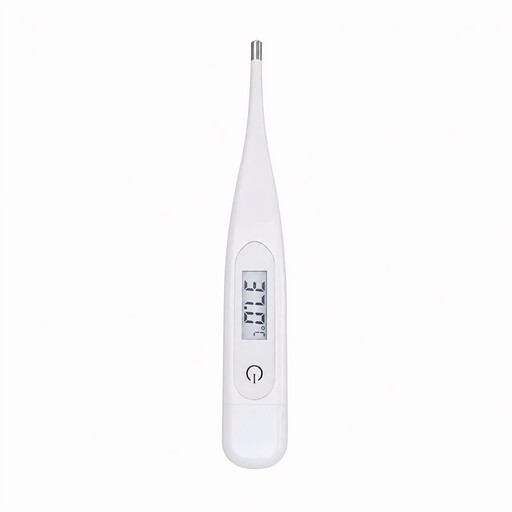
Why it suits this type of user: Its compact pen-style design is made to fit in a home medicine cabinet or travel bag. The display covers a range of 32.0 °C to 42.9 °C and can be switched between Celsius and Fahrenheit.
The manufacturer’s specifications state that it has a mercury-free design, a resolution of 0.1 °C and an audible signal when the reading is complete, rather than making broad claims about accuracy.
Mercury-free design, 0.1 °C display and °C/°F switch.
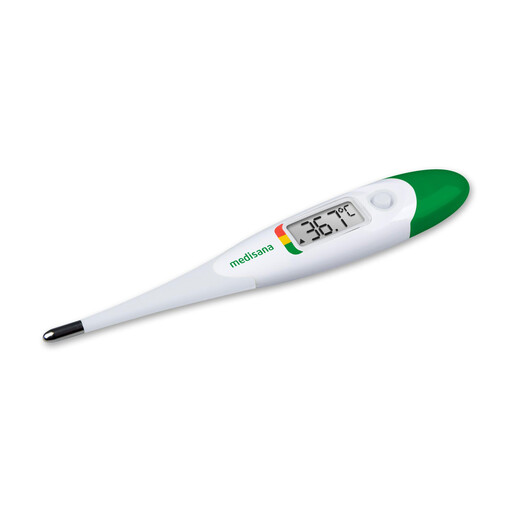
Why it suits this type of user: This model is designed for oral, underarm and rectal readings. According to the product description, it displays the result after around 10 seconds.
The product information distinguishes between the water-resistant tip and the rest of the casing. This helps ensure it’s cleaned only as intended.
Flexible tip, colour display, audible alarm and last-reading memory.

Why it suits this type of user: A flexible tip, memory function, protective case and battery make this a useful option for households where several people use the thermometer regularly.
The product information says the probe can be cleaned, while also advising that the main casing must not be fully submerged.
Flexible tip, fever alarm, memory function and protective case.
Before each reading, make sure your hands are clean and clean the probe tip according to the manufacturer’s instructions. For readings that are easy to compare, try to use the same method and take them at a similar time of day. If taking an oral reading, leave enough time after drinking anything hot or cold.
Store the device somewhere dry and safe, out of the reach of young children. Button batteries can be dangerous if swallowed. Dispose of used batteries at a designated collection point, not in your household waste.
We’ve put together a complete, regularly updated list of products that meet these strict selection criteria and fully comply with the safety regulations in force in the EU.
Battery life depends on the battery type, how often the thermometer is used and whether it switches off automatically. Many models use an LR41 or AG3 button cell. If you won’t be using the device for a long time, removing the battery according to the instructions can reduce the risk of leakage.
Clean or disinfect the probe tip after every use, following the instructions in the user manual. This is especially important if several people in your household use it. Depending on the model, water-resistant probes may be rinsed; the display casing should generally only be wiped with a suitable cloth.
No. The alarm responds to a temperature set by the manufacturer. Body temperature can vary depending on where it’s measured, the time of day and the individual. If a raised temperature persists or you have other symptoms, seek medical advice.