
Lieferung heute & morgen

Qualitätsgarantie

Willkommens-Angebote freischalten: KOSTENLOSE Lieferung | Bis zu 80 % RABATT | Kostenlose 30-Tage-JoyPlus-Testphase
App herunterladen
A digital thermometer is part of the medicine cabinet in many households. The choice ranges from classic stick thermometers and non-contact forehead thermometers to versatile 3-in-1 thermometers for body temperature, milk and bathwater. However, not every advertised extra feature is equally useful in everyday life.
Claims such as ‘measurement in one second’ usually refer only to the display time. To obtain a reliable reading, you also need to use the correct distance, measurement site and surroundings. With an infrared thermometer, sweat, cold skin, direct sunlight or an incorrect angle can affect the temperature reading.
That is why clear instructions, a distance indicator or positioning guide, and an unmistakable display of the measurement mode are important.
A non-contact thermometer or forehead thermometer can be practical for taking readings at night or for small children. However, you should always take the measurement according to the manufacturer’s instructions. Depending on the model, a specific distance from the forehead may be required. Holding the thermometer too far away or too close can change the reading.
If you regularly take a baby’s temperature, you should also check whether the device has a silent mode. An audible fever alarm is useful during the day, but can be disruptive at night.
A 3-in-1 thermometer can measure body, object and room temperature. This is useful, for example, if you also want to check milk or bathwater. For body temperature alone, however, a simple medical thermometer with an easy-to-read display is often sufficient.
Also check whether the object mode measures surfaces only. Displaying the temperature of liquids does not replace an accurate measurement inside the liquid unless this is expressly provided for in the instructions.
A colour-coded display using green, orange or red can make readings easier to interpret. However, it is only a guide and does not replace medical assessment. A fever alarm should ideally be configurable or interpreted according to the instructions, as temperature thresholds may depend on the measurement site and the individual.
Memory slots are useful when you want to record temperature trends within the family. Depending on the model, 32 or 35 readings may be available, for example.
Check whether the probe can be wiped clean or is only partially waterproof. Many devices must not be fully immersed in water. Depending on the model, the probe on stick thermometers may be cleaned under running water, while the casing must remain dry.
Look for information about the CE marking, the manufacturer and the responsible person in the EU. The CE marking is not a seal of quality; it indicates conformity with the relevant EU requirements. Claims such as ‘clinically tested’ should be attributed to the relevant manufacturer or product documentation. According to a clinical study by Braun, certain measurement functions of the relevant model may have undergone clinical assessment; the specific manufacturer’s information and instructions for use remain decisive.
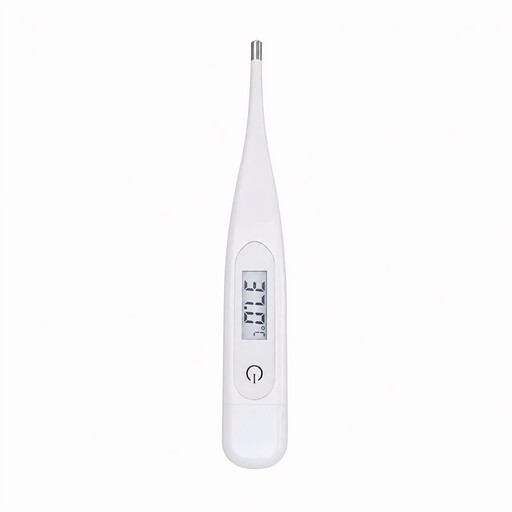
Why this product suits this profile: This pen-style thermometer focuses on classic body temperature measurement and requires an LR41 battery. It offers a resolution of 0.1 °C and lets you switch between Celsius and Fahrenheit.
It avoids unclear multiple modes and makes the intended measurement range transparent. The measurement deviation is broken down by temperature range in the product information.
Compact design, mercury-free casing and an audible signal when the measurement is complete.
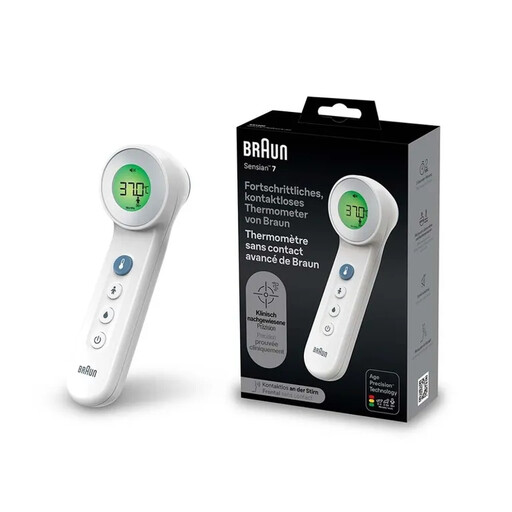
Why this product suits this profile: This model combines non-contact and contact forehead measurement, an age-based display and a silent mode. The PositionCheck function helps ensure correct alignment.
Positioning is not left solely to guesswork. The age groups also differentiate the fever indications according to the product information.
Measures in around two seconds, colour-coded LCD and object mode for liquids, food and bathwater.
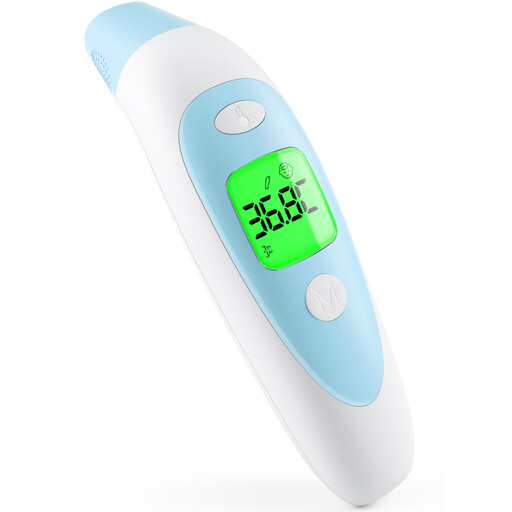
Why this product suits this profile: The AILE model combines ear, forehead and object modes. It can store up to 32 readings and is suitable for taking temperatures of children and adults, as well as measuring milk, food and room temperature.
The three measurement modes can be switched directly on the device. Silent mode reduces disruptive beeps when taking readings at night.
Three modes, memory for 32 readings, Celsius/Fahrenheit switching and a storage pouch.
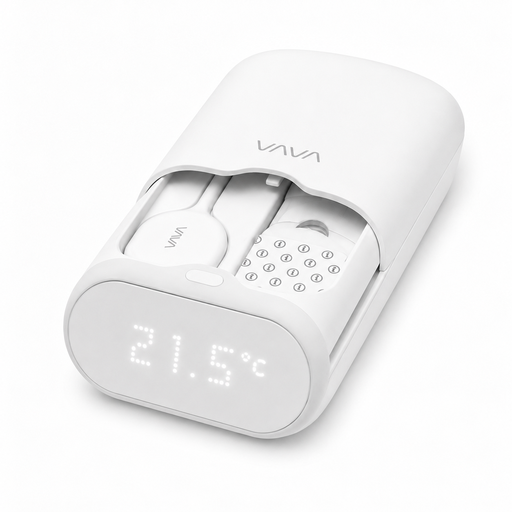
Why this product suits this profile: The underarm sensor sends readings wirelessly to a separate LED display. This makes the system suitable for longer monitoring periods during rest, without having to take a reading directly from the baby each time.
The temperature is not marketed as a one-off instant reading, but is transmitted for monitoring. The manufacturer points out that the readings should not be used as the sole basis for medical decisions.
Up to 24 hours of sensor operation, separate display, audible and visual warnings, and USB-C charging.
We have put together a complete, regularly updated list of products that fully meet these strict selection criteria and the safety regulations applicable in the EU.
A thermometer provides a reading for guidance. If you have health concerns, are monitoring a very young infant or notice an unusual general condition, contact a medical professional.
Its service life depends on the batteries, cleaning, storage and mechanical stress. A stick thermometer with few functions can be used for a long time if handled properly. With infrared models, the sensor, display and measurement function should be checked regularly for damage. The battery needs replacing as soon as the display becomes dimmer or measurements no longer start reliably.
For battery-powered devices, the main costs are replacement batteries. Models with an LR41 button cell and devices with AAA batteries differ in battery type and operating time. A rechargeable system such as the VAVA VA-IH008 requires regular USB-C charging instead; additional replacement sensor patches may also be needed during use.
A non-contact thermometer may be suitable for babies provided the manufacturer specifies this use. The key factors are the correct distance, a steady measurement position and the guidance for the relevant age group. The colour display or a fever alarm is for guidance only and does not replace medical assessment.