
Lieferung heute & morgen

Qualitätsgarantie

Willkommens-Angebote freischalten: KOSTENLOSE Lieferung | Bis zu 80 % RABATT | Kostenlose 30-Tage-JoyPlus-Testphase
App herunterladen
When it comes to safety-critical fasteners on vehicles or delicate carbon components, precision isn't an option—it's a necessity. A digital torque wrench offers a modern and accurate solution, but the market is crowded and confusing. Many users invest in a tool that later proves to be unreliable or impractical. This guide will show you what to look for to avoid a bad purchase and find the right tool for your needs.
As your Joybuy Product Recommendation Officer, I filter the essential information for you, helping you make informed decisions based on facts, not marketing hype.
Purchasing an unsuitable tool not only leads to frustration but can also cause costly damage to components. Pay special attention to these three pitfalls:
To avoid these traps, you should focus on objective technical specifications. These three parameters are indispensable for professional and safe use.
The most important factor is the covered torque range in Newton-metres (Nm). A tool for delicate work on a bicycle requires a low-range torque wrench (e.g., 1–20 Nm), while an automotive torque wrench for tasks like tightening lug nuts requires a model with up to 200 Nm or more.
Look for a certified accuracy of ±2% or better clockwise. This value indicates the maximum permissible deviation from the set target torque. Higher accuracy minimises the risk of damage from over-tightening or under-tightening.
The drive size (e.g., 1/4-inch, 3/8-inch, or 1/2-inch) determines which sockets you can use.
A smart alternative is a digital torque adapter. This compact device fits between an existing ratchet and the socket, turning your standard tool into a precise measuring instrument. This not only saves money but also space in your toolbox.
A good electronic torque wrench should offer at least two work modes:
For professional use, a triple alert system consisting of an acoustic signal (beep), visual signal (LED), and haptic signal (vibration) is highly recommended. This combination ensures that you reliably notice when the target torque is reached under all working conditions—whether it's loud, dark, or hard to see.
Based on the criteria above, we have identified several models that represent a considered choice for specific user profiles.
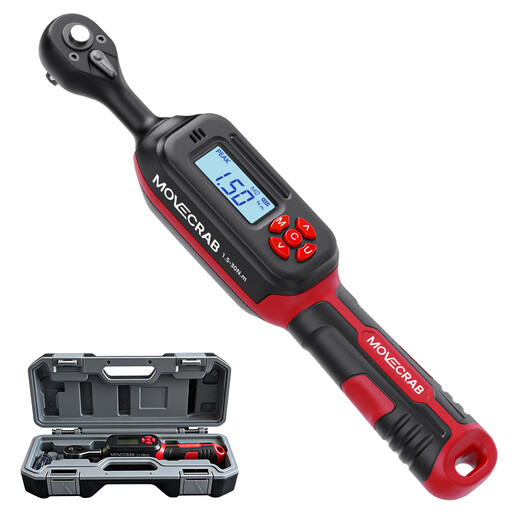
Why This Fits Their Persona: Ideal for bicycle mechanics and ambitious hobbyists working on sensitive carbon components, stems, or derailleurs. The very low torque range is specifically designed for these delicate parts.
The triple alert system with vibration, sound, and LED reliably prevents over-tightening, which bypasses the pitfall of an inadequate alert system at critically low torque values.
Specialised torque range of 0.6–12 Nm and a high accuracy of ±2%, which is essential for sensitive materials like carbon.
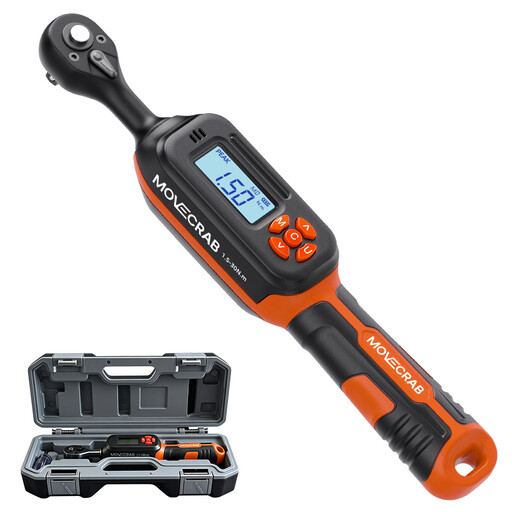
Why This Fits Their Persona: A workhorse for the auto shop and the ambitious DIY enthusiast. The 4.2–85 Nm torque range covers a wide variety of automotive applications, from engine and transmission work to suspension components.
With 10 presets and data storage for 500 values, this model addresses the problem of clunky operation. Repetitive jobs become significantly more efficient.
A practical torque range with a 3/8-inch drive and useful software features like presets that speed up professional workflows.
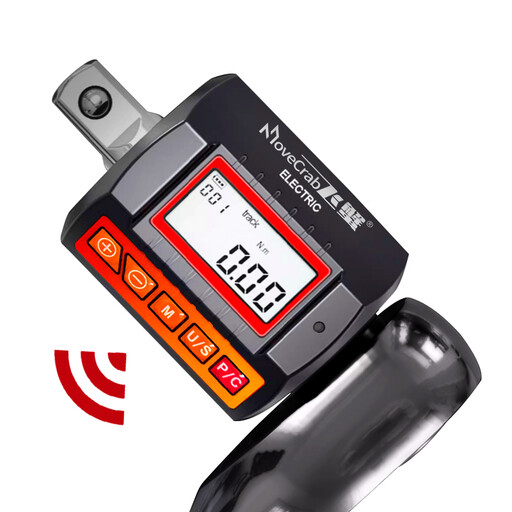
Why This Fits Their Persona: The economical solution for anyone who already owns a good set of ratchets and wants to upgrade them with digital precision. Ideal for users who need flexibility for different drive sizes.
This adapter solves the problem of inaccurate measurement by bringing a certified accuracy of ±2% to any standard ratchet. It turns a basic tool into a precision instrument.
Maximum flexibility thanks to included adapters for 1/4", 3/8", and 1/2" drives. A wide torque range of 10.2–340 Nm covers almost all common automotive applications.
We've compiled a complete, up-to-date list of products that fully meet these strict selection criteria.
Unlike mechanical models, digital torque wrenches are lower-maintenance because they don't have mechanical wear parts like a spring. For professional use, an annual calibration check is recommended. For private use, or if the tool hasn't been dropped, it will typically maintain its accuracy for many years and thousands of cycles. Always follow the manufacturer's instructions.
Although most models have a ratcheting mechanism for both directions, they are primarily precision measuring instruments for tightening. Using high force to loosen stuck bolts can damage the internal sensor. It is recommended to use a rigid breaker bar or a standard ratchet for loosening and to use the digital wrench only for the final, torque-accurate tightening.
Track mode (also real-time mode) displays the currently applied torque live on the screen. This is useful for observing the application of force. Peak mode (peak hold mode) is the standard for tightening: it captures and holds the highest torque value reached. This allows you to check after tightening that the target value was hit exactly.