
Lieferung heute & morgen

Qualitätsgarantie

Willkommens-Angebote freischalten: KOSTENLOSE Lieferung | Bis zu 80 % RABATT | Kostenlose 30-Tage-JoyPlus-Testphase
App herunterladen
By Joybuy Product Recommendation Officer, August 29, 2026
For precision fastening on vehicles or machinery, exact torque values are essential. A digital torque wrench promises high accuracy and simple operation. However, the market is flooded with models whose performance claims often don't hold up in practice. Incorrectly tightened bolts can not only damage components but also pose a significant safety risk.
This guide reveals the most common purchasing pitfalls and explains the key technical features to look for, ensuring you find a reliable and durable tool for your specific needs.
Many users invest in a tool that later proves to be inadequate or impractical. These three problems are especially common:
To make an informed decision, you should focus on objective, technical criteria. The following three aspects are crucial for the performance and longevity of a digital torque wrench.
Choosing the right drive size and the appropriate torque range is fundamental to correctly sizing the tool for its intended purpose.
Check the manufacturer's specified torque values for your most common applications and choose a model whose working range safely covers these values.
The high accuracy is the main advantage of a digital torque wrench. Look for a specified tolerance of ±2% to ±3%. A higher deviation is not recommended for safety-critical fasteners. Reputable manufacturers include an individual calibration certificate with the product, which documents the measurement results of the specific device. This is an important quality feature.
A good tool must be convincing in practice. A clear LED display that is easily readable even from an awkward angle is essential. The ability to switch between different units (e.g., Nm, ft-lb, in-lb) increases flexibility.
For professional use, a triple alert system of sound, vibration, and LED light is a sensible feature. It ensures that reaching the target torque is reliably perceived under all working conditions—whether in a noisy workshop or a poorly lit area. Functions like a “Peak” mode (shows the highest value reached) and a “Track” mode (shows the value in real-time) are also useful tools for controlled application.
Based on the criteria mentioned above, we have identified some models that represent a considered choice for specific requirement profiles.
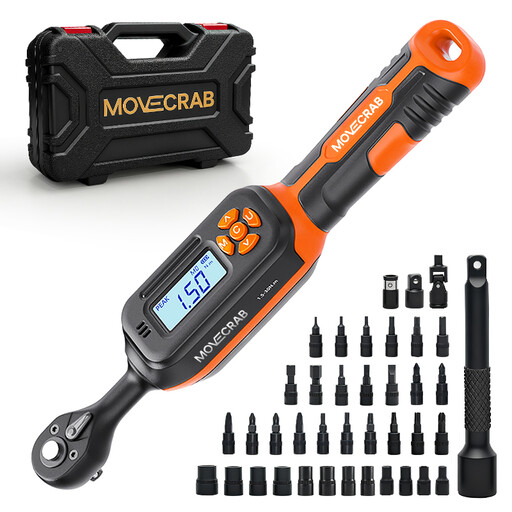
Why This Fits Their Persona: Ideal for enthusiast DIY mechanics working on bicycles or motorcycles. The low torque range of 1.5-30 Nm is perfect for sensitive components like carbon handlebars or stems. The extensive accessory set makes it a practical, all-in-one solution for beginners.
The specified accuracy of ±2% addresses the problem of unreliable measurements. Audible and visual alerts ensure the target torque is not missed, even when focused on the task.
Comprehensive torque wrench set with 40 pieces; memory for 10 presets and 500 readings; Peak and Track modes for full control.
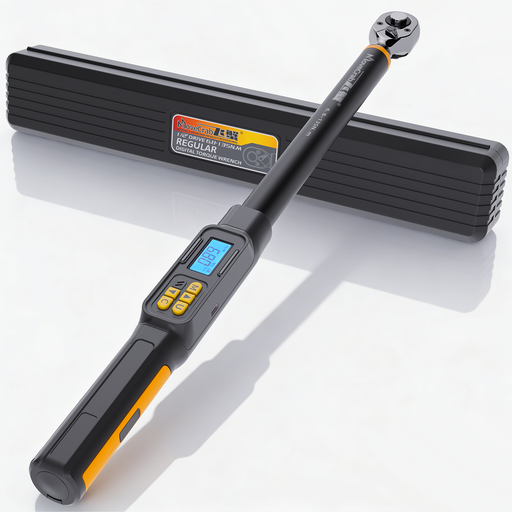
Why This Fits Their Persona: Designed for daily workshop use. The 1/2-inch drive and torque range up to 135 Nm cover the most common jobs on a car, from wheel changes to suspension components. The robust construction is designed for durability.
The triple alert system with vibration, sound, and light is specifically designed for noisy environments and reliably prevents overtightening. The high accuracy of ±2% ensures safety-critical precision.
Triple alert system; 10 memory slots for preset values speed up recurring tasks; ergonomic handle for fatigue-free work.
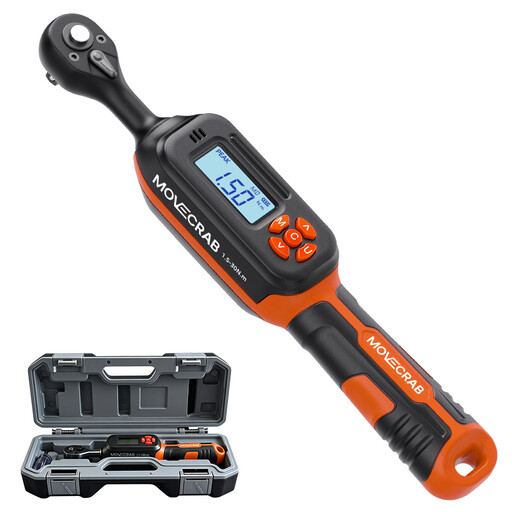
Why This Fits Their Persona: This model with a 3/8-inch drive bridges the gap between precision mechanics and heavy-duty jobs. The 4.2-85 Nm range makes it an extremely flexible tool for a wide array of tasks on cars, motorcycles, and in industrial maintenance.
Offers the same professional features as the larger model, including the triple alert system and ±2% accuracy. The preset and memory modes counteract the lack of functionality found in simpler devices.
Very wide and practical torque range; professional alert and memory functions; the 3/8-inch drive offers high compatibility with common socket sets.
We have compiled a complete, up-to-date list of products that fully meet these strict selection criteria and safety standards.
For professional use with high accuracy requirements, annual calibration or calibration after approximately 5,000 load cycles is recommended. For occasional home use, calibration every few years is sufficient, unless the tool has been dropped or overloaded. In that case, an immediate check should be performed.
Although many models have a reversing switch, they are primarily designed as measuring tools for precise tightening. Loosening seized bolts creates high, uncontrolled force spikes that can damage the internal sensor and affect the calibration. It is recommended to use a conventional ratchet or an impact wrench for loosening.