
Lieferung heute & morgen

Qualitätsgarantie

Willkommens-Angebote freischalten: KOSTENLOSE Lieferung | Bis zu 80 % RABATT | Kostenlose 30-Tage-JoyPlus-Testphase
App herunterladen
A digital torque wrench displays the torque being applied and can alert you with a sound, a visual signal or vibration when the target value is reached. That’s useful, but it doesn’t replace checking the technical specifications. The key factors are the measurement range, drive size, ease of use and stated accuracy.
When shopping online, three common pitfalls can lead to the wrong purchase:
The target value shouldn’t just fall within the measurement range in theory; ideally, it should sit comfortably within it. These guidelines may help for common applications:
Always follow the torque values in your car, motorbike or bicycle handbook. Never use the wrench beyond its maximum capacity. For the MoveCrab models described here, users are advised not to exceed 120 per cent of the maximum value.
A 1/4-inch torque wrench is compact and often suitable for smaller bolted connections. A 3/8-inch torque wrench offers a versatile middle ground, for example for car and motorbike maintenance. The 1/2-inch drive is designed for larger sockets and higher torque values.
Also check for:
A digital torque adapter can be used with an existing ratchet. Make sure the adapter, ratchet and socket fit together correctly. An adapter doesn’t automatically replace a fully calibrated torque wrench for every application.
A specification such as ±2 per cent accuracy should be treated as a manufacturer’s claim and checked against the product documentation. It describes the permitted deviation under the specified test conditions, not necessarily every real-world situation. For quality-critical work, check details such as measurement direction, calibration, storage and repeat testing.
Useful features on an electronic torque wrench include:
A torque wrench with an LED display is especially useful in poor lighting. In a noisy workshop, a combination of a beep and vibration may be more practical than a single alert.
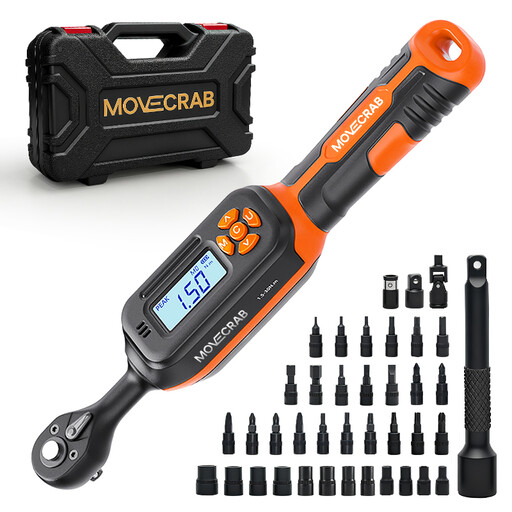
Why it suits this user: The compact 1/4-inch drive and included accessories cover common jobs on bicycles, motorbikes and smaller vehicle components.
Its clearly defined range of 1.5 to 30 Nm is easier to work with for smaller fastenings than an unnecessarily wide measurement range.
According to the product description: ±2 per cent accuracy, LED display, beep and 40 accessories in the case.
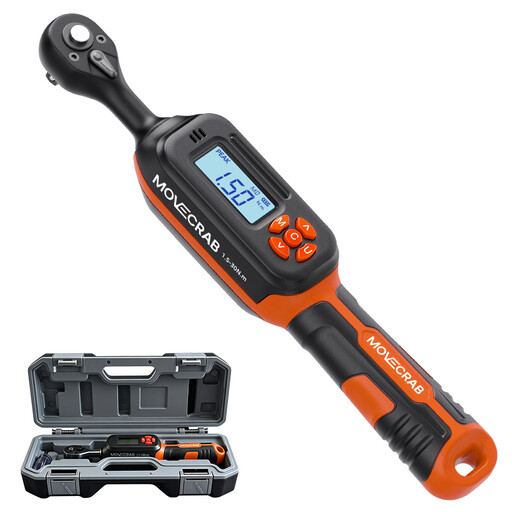
Why it suits this user: The mid-size drive is suitable for a wide range of maintenance jobs, while its display and memory functions help you work with control.
The 4.2 to 85 Nm range and switchable units make it easier to choose the right setting for different jobs.
According to the product description: ±2 per cent accuracy, Track and Peak modes, ten preset values, and LED, sound and vibration alerts.
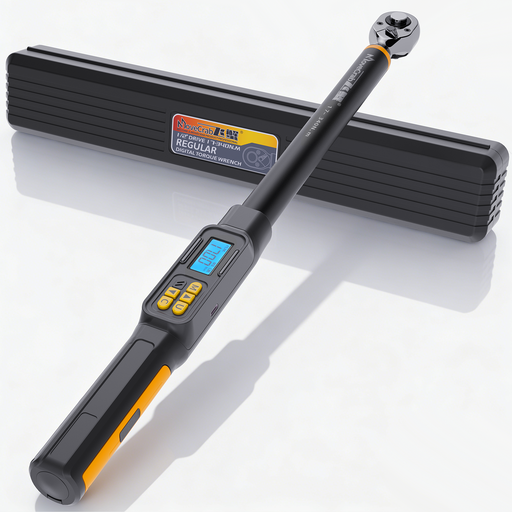
Why it suits this user: Its wide measurement range is designed for higher torque values, making it suitable for more extensive work on vehicles and machinery.
The drive size and clearly stated range help prevent a smaller wrench from being used for high torque values.
According to the product description: measurement range of 17 to 340 Nm, four units, ten preset modes, and Peak and Track modes.
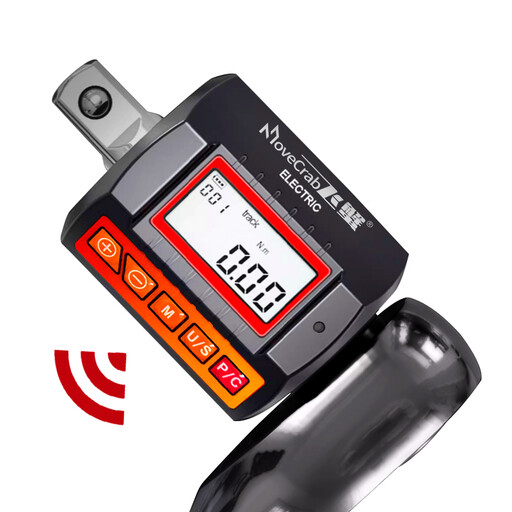
Why it suits this user: This adapter may appeal to users who already own ratchets and want to use a digital measuring module with different drives.
The included 3/8- and 1/4-inch adapters reduce the risk of being unable to use your existing sockets because the drive doesn’t fit.
According to the product description: ±2 per cent in clockwise operation, ±2.5 per cent in anticlockwise operation, three working modes and memory for up to 1,000 values.
We’ve put together a complete, regularly updated list of products that meet these strict selection criteria and fully comply with the safety regulations in force in the EU.
Before tightening, set the target value in the appropriate unit and fit the socket fully. Apply force steadily and stop when the warning signal sounds or appears. A digital torque wrench isn’t an impact tool and shouldn’t be used to loosen seized bolts unless the manufacturer explicitly says otherwise.
To help it last longer:
It depends on the job. A 3/8-inch model with a range of around 4.2 to 85 Nm may suit smaller maintenance tasks. Wheel bolts and higher torque values often require a 1/2-inch model with a suitable measurement range. Always follow the vehicle manufacturer’s torque specifications.
For many applications, a manufacturer-stated tolerance of ±2 per cent is a useful point of comparison. Also check whether the specification applies to clockwise and anticlockwise operation, and whether calibration information or a test certificate is provided. An alarm function alone doesn’t prove that the reading is accurate.
Its lifespan depends on how it’s used and stored, as well as whether it’s overloaded, exposed to moisture and checked regularly. Storing the wrench in a dry place, avoiding using it as a lever or impact tool, and following the maintenance instructions can help reduce common wear risks. For safety-critical work, check its accuracy at the recommended intervals.