
Lieferung heute & morgen

Qualitätsgarantie

Willkommens-Angebote freischalten: KOSTENLOSE Lieferung | Bis zu 80 % RABATT | Kostenlose 30-Tage-JoyPlus-Testphase
App herunterladen
A digital torque wrench displays the applied torque on a screen and can also provide an audible, visual or vibration alert when the target value is reached. This is particularly useful when bolted connections on bicycles, motorcycles, vehicles or machines need to be tightened to the manufacturer’s specifications.
However, not every model is suitable for every application. Three common purchasing mistakes often lead to the wrong choice:
The measuring range should cover the required torque values not just at the very edge, but ideally around the middle of the range. For a bicycle torque wrench, typical applications are often in the lower Nm range. Stems, handlebars, seat posts and brake callipers may have different specifications depending on the component.
A motorcycle torque wrench is also used for jobs requiring low to medium torque values. A car torque wrench, on the other hand, often needs to cover a considerably higher range, for example for suspension components or wheel fixings. Always refer to the vehicle or component’s operating instructions or manufacturer’s specifications for the exact values.
The drive size determines which sockets are suitable:
An adapter can extend compatibility, but it does not change the permissible measuring range of the torque wrench. Before buying, also check whether the required bits, sockets and extensions are included.
A digital torque wrench with display should show the unit clearly. Common options include Nm, ft·lb, in·lb and kgf·cm. Converting units directly on the tool helps to reduce transfer errors, but you should still check that the correct unit has been selected.
A torque wrench with audible signal and LED may also indicate that the target value has been reached through vibration or light. This is useful in a noisy workshop or in poor lighting. It remains important to apply force steadily and stop tightening once the signal is given.
An electronic torque wrench offers an easy-to-read display, preset values and, depending on the model, Track or Peak modes. The MoveCrab models also list multiple units, ten memory positions and the ability to store measured values. These features can be useful for recurring jobs or documented maintenance procedures.
A mechanical torque wrench works without batteries. Its scale can be read directly on the handle, while reaching the set value is usually indicated by a click. This design is straightforward for occasional jobs. After use, the setting on many mechanical models should be returned to the specified minimum value.
When you see a specification such as torque wrench ±2 per cent, you should also check whether it applies in both directions of rotation, which measuring range it covers and whether a calibration note or certificate is included. The product specifications are the deciding factor.
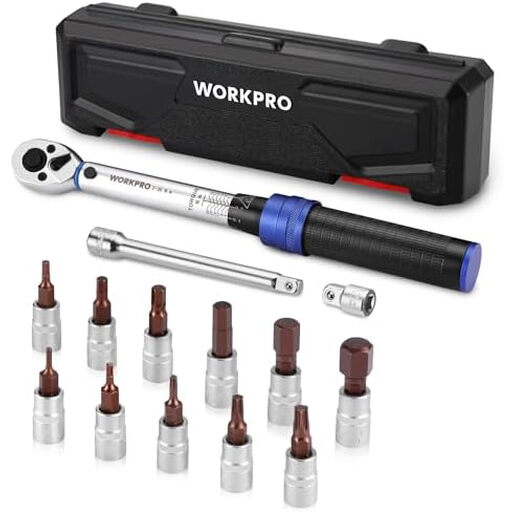
Why this product suits this profile: The 2–26 Nm range and included bits cover many bicycle maintenance jobs and smaller DIY tasks.
The defined measuring range helps prevent choosing a tool that is too large for fine bicycle bolts. A click indicates the set value has been reached.
1/4-inch drive, 72-tooth ratchet, 14 accessories and a stated torque deviation of ±3 per cent.
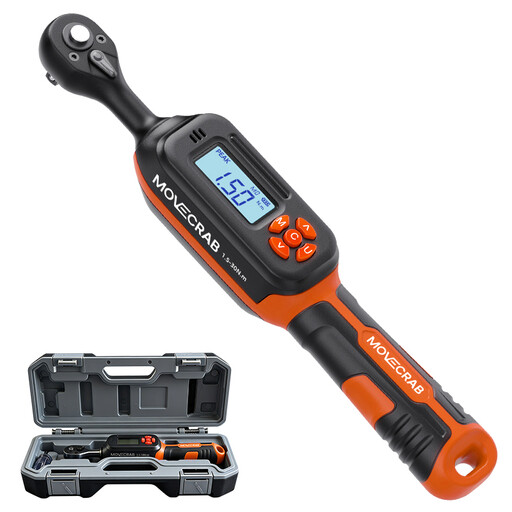
Why this product suits this profile: The display, multiple units and Track and Peak modes make repeatable work on bicycle and motorcycle components easier.
The digital display eliminates the need to read a scale. According to the product specifications, vibration, an audible signal and an LED indicate that the target value has been reached.
Stated accuracy of ±2 per cent, ten memory positions and storage for up to 500 measured values.
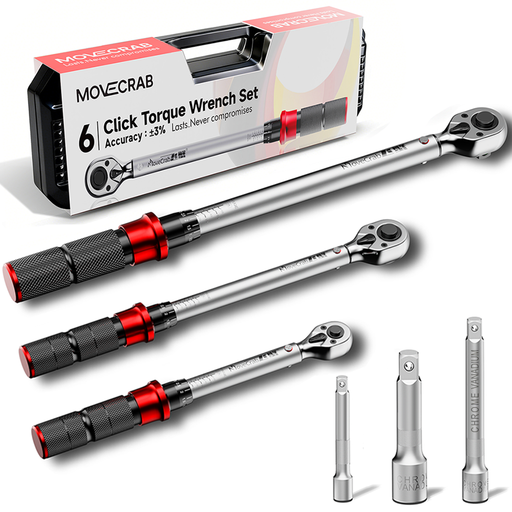
Why this product suits this profile: Three wrenches and extensions cover different drive sizes and torque ranges for bicycle, motorcycle, car and repair work.
The split between 1/4-, 3/8- and 1/2-inch drives helps avoid using a range that is too small for larger bolted connections.
Range of 5–220 N·m, three extension bars and a stated deviation of ±3 per cent.
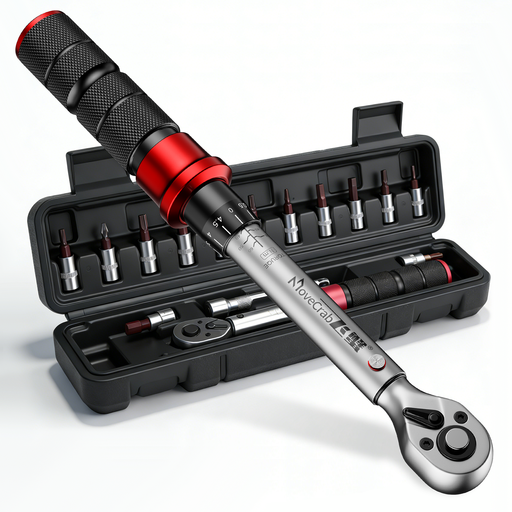
Why this product suits this profile: The 2–20 Nm range and included hex, Phillips and Torx bits are designed for a wide range of bicycle maintenance tasks.
The clearly defined range is suitable for fine bolted connections and reduces the risk of using an automotive tool that is too heavy-duty.
72-tooth ratchet, clockwise and anti-clockwise rotation, fine adjustment in 0.2 Nm increments and stated Cr-V material.
We have put together a complete, regularly updated list of products that fully meet these strict selection criteria and the safety regulations applicable in the EU.
Before using the tool for the first time, set the target value according to the component’s specifications. With digital models, check the unit and measuring mode. Apply force slowly and steadily, and stop once the signal is given.
A few practical rules will help to ensure a long service life:
For bicycles, a low measuring range of around 2 to 20 Nm and a 1/4-inch drive are usually a good choice. It is important that the required hex and Torx bits are included and that the range matches the specifications of the fitted components.
A stated deviation of ±2 per cent or ±3 per cent can be an important selection criterion. However, you should check the specification in the product data sheet, particularly with regard to direction of rotation, measuring range and calibration conditions. For safety-critical work, you must also follow the vehicle or component manufacturer’s specifications.
Service life depends on use, storage, overloading and care. Electronic models require batteries and should be protected from moisture. A mechanical wrench is less dependent on a power supply, but it must still be stored correctly and calibrated when necessary, particularly if used frequently.