
Lieferung heute & morgen

Qualitätsgarantie

Willkommens-Angebote freischalten: KOSTENLOSE Lieferung | Bis zu 80 % RABATT | Kostenlose 30-Tage-JoyPlus-Testphase
App herunterladen
A digital torque wrench can tighten threaded connections more consistently than a basic hand tool. However, it is not just the display or advertised accuracy that matters. For bicycle parts, motorcycles, vehicles and general repairs, the measurement range, drive size and signalling must suit the intended application.
If you focus only on a low price or a long list of extra features, it is easy to buy a tool that does not really meet your needs. Three common pitfalls occur particularly often.
A 1/4-inch torque wrench with a range of up to 20 or 30 Nm is mainly suitable for smaller threaded connections. This range is not sufficient for car wheel nuts or heavily loaded motorcycle components. If a tool is regularly used outside its intended range, measurement deviations and damage may occur.
Before buying, note down the torque values from the relevant vehicle, bicycle or component manual and compare them with the tool’s measurement range.
The ±2% accuracy specification is a manufacturer’s indication of the possible deviation under certain conditions. It does not mean that every reading has been independently tested or will remain identical over time. Storage conditions, overloading, impacts and a lack of maintenance can affect measurement accuracy.
A digital torque wrench should therefore not be used as an impact tool. The Movecrab model, for example, advises avoiding loads of more than 120% of the maximum torque.
A torque wrench with a display is only practical if the reading is easy to see and a clear signal is given when the target value is reached. In a noisy workshop, an audible signal may go unnoticed. In poor lighting, an LED-only display may not be sufficient.
Vibration, audible and visual signals can make operation easier in different environments. However, they do not replace steady tightening or checking that the correct target value has been set.
The measurement range in newton metres (Nm) should cover the intended working range. Lower values are relevant for delicate bicycle components, while work on motorcycles or cars often requires a wider range.
A tool with a range of 1.5 to 30 Nm is not automatically suitable for every bicycle or motorcycle task. The component manufacturer’s specifications remain the deciding factor.
Depending on the model, an electronic torque wrench can display readings in Nm, ft.lb, in.lb or kgf.cm. Switching between units is useful when technical documentation uses different measurement systems.
Also look for:
A presettable torque wrench with several memory slots can simplify your workflow. Even so, the saved values should be checked before every use.
Digital measuring tools should be stored in a dry, clean place protected from direct sunlight. Moisture, dust, sand, high temperatures and magnetic environments can affect their operation. Do not use organic solvents such as alcohol or thinner for cleaning unless the manufacturer expressly permits this.
If you use the tool regularly in a workshop, it is advisable to follow the manufacturer’s instructions on calibration and checking. The accuracy stated by the supplier is not a guarantee for every subsequent measurement.
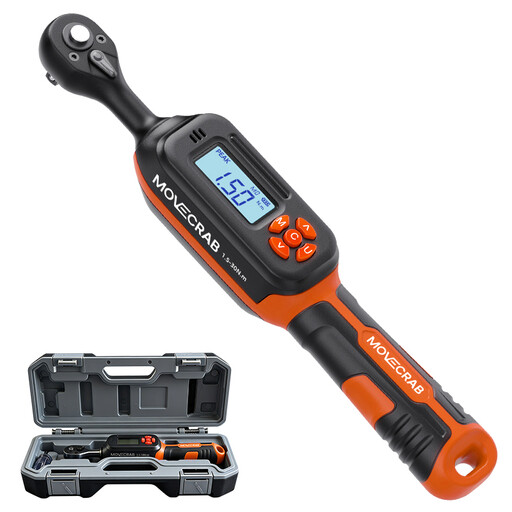
Why this product suits this profile: The compact 1/4-inch drive and range of 1 to 20 Nm are designed for smaller repair jobs, such as work on bicycles, motorcycles and household items.
The clearly stated measurement range helps prevent a small tool from being used accidentally for high torque settings on a car. Readings can be displayed in several units.
According to the product specifications: ±2% accuracy, LED display plus vibration, audible and visual signals.
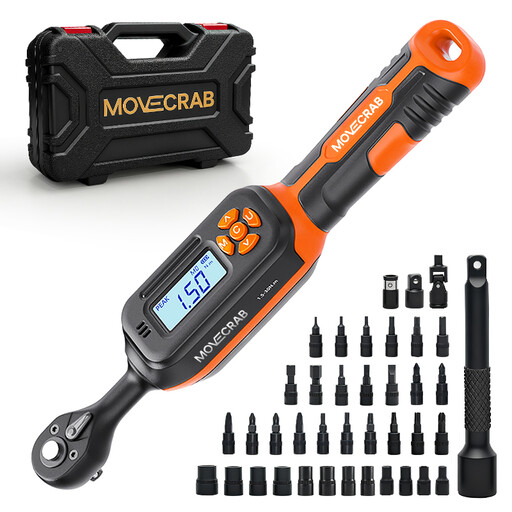
Why this product suits this profile: The included bits, sockets and adapters are ideal for anyone looking for a versatile professional repair tool for bicycles, motorcycles and a range of maintenance tasks.
The extensive set does not replace checking the measurement range, but it makes additional individual purchases for suitable smaller threaded connections less likely.
According to the product specifications: 1.5 to 30 Nm, ±2% accuracy, 10 presets, Track and Peak modes, and storage for up to 500 readings.
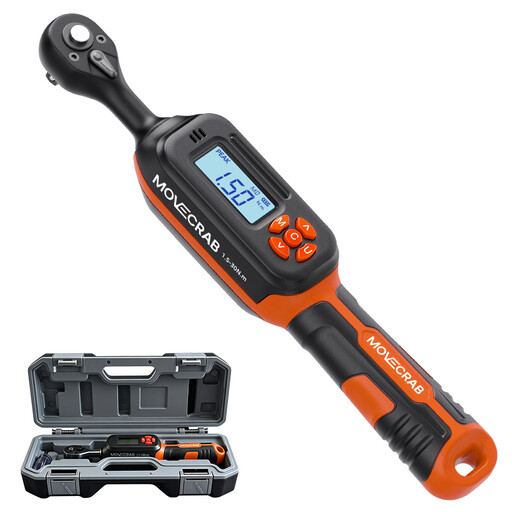
Why this product suits this profile: The 3/8-inch drive and extended range are well suited to users who regularly switch between finer and medium torque tasks on motorcycle or vehicle components.
The clearly specified range makes it easier to choose than an undersized bicycle tool. For even higher values, a 1/2-inch model is still required.
According to the product specifications: ±2% accuracy, switchable units, LED display, and audible, visual and tactile warnings.
We have put together a complete, regularly updated list of products that fully meet these strict selection criteria and the safety regulations applicable in the EU.
For safety-critical components such as brakes or suspension, the vehicle or component manufacturer’s specifications are decisive. A torque wrench is not a substitute for professional assembly.
For many bicycle repairs, a 1/4-inch model with a low measurement range is suitable. The relevant values often fall within the lower to medium Nm range. The decisive factor is the torque specification for the individual component, not simply the size of the tool.
Its service life depends on how it is used and stored, battery changes, moisture and overloading. A digital model should not be dropped, used as a lever or impact tool, or subjected to loads outside its intended range for extended periods. With frequent workshop use, regular functional and calibration checks are advisable.
Power consumption is low compared with motorised tools and depends mainly on the display, signalling functions and battery type. Automatic shut-off can help preserve battery life. Before starting longer jobs, check the battery level and display so that the signal can be noticed reliably while tightening.