
Lieferung heute & morgen

Qualitätsgarantie

Willkommens-Angebote freischalten: KOSTENLOSE Lieferung | Bis zu 80 % RABATT | Kostenlose 30-Tage-JoyPlus-Testphase
App herunterladen
A digital torque wrench can provide precise control over tightening torque when working on bicycles, motorcycles, cars or in the workshop. However, a large display is not the only factor that matters. If you focus solely on advertising claims such as “high precision” or an extensive range of features, you may end up buying a tool whose measuring range is not suitable for your application.
As a Joybuy Product Recommendation Officer, I filter the relevant product information using clear, verifiable criteria. The following points will help you compare an electronic torque wrench objectively and avoid common purchasing mistakes.
A torque wrench does not automatically work equally effectively across its entire advertised range. Sensitive bicycle components often require low torque settings, while wheel fasteners or certain vehicle repairs demand considerably higher values.
A 1–20 Nm torque wrench, for example, is more suitable for bicycle components, smaller assembly jobs and selected motorcycle applications. A model with a range of 4.2–85 Nm, on the other hand, covers higher torque requirements but does not start at very low values. Before buying, check the torque specifications provided by the vehicle, bicycle or component manufacturer.
The specification ±2% accuracy sounds clear-cut, but it only applies within the stated measuring and operating range. The direction of rotation may also be relevant. For several models on offer, the accuracy is expressly stated for clockwise tightening. A bi-directional torque wrench may be designed for both directions of rotation, but this does not automatically mean that identical accuracy is guaranteed in both directions.
You should therefore check:
A torque wrench with LED and vibration alarm plus an audible signal can make it easier to recognise when the target value has been reached. Vibration is useful in a noisy workshop, while the LED display can help in poor lighting. Even so, force must be applied steadily. An alarm does not prevent you from continuing to turn after reaching the target value.
According to the product descriptions, Movecrab models use a triple warning system consisting of vibration, an audible signal and an LED display. These signals should be viewed as an aid to operation, not as a replacement for the manufacturer’s specifications or correct working practices.
The drive size determines which sockets and adapters can be used. A 3/8-inch torque wrench is practical for many motorcycle, car and machine repairs, provided your existing sockets are compatible. For smaller bicycle fasteners, a 1/4-inch model with a low measuring range may be a better fit.
Do not focus solely on the maximum figure:
The areas of use listed above are intended as a guide. The torque values specified for the individual component remain decisive.
A digital torque wrench with display should show the current value clearly. Switching between Nm, ft.lb, in.lb and kgf.cm is useful when working from different instructions or data sheets.
Two modes are particularly relevant to the way you work:
According to the product information, several Movecrab models also offer a Preset mode. Depending on the version, up to ten frequently used values can be saved; the model with interchangeable heads is specified as having six presets. This function can save time during recurring tasks, but it should be checked before every use.
Digital torque tools contain electronic components and sensors. According to the product information for the Movecrab models, overloading by more than 120% of the maximum value should be avoided. The tool is not designed for use as an impact tool. Moisture, high temperatures, direct sunlight, dust and magnetic environments can affect its operation.
After use, we recommend:

Why this product suits this profile: The low measuring range is designed for bicycle work and more delicate assembly tasks. The digital display and multiple units of measurement make it easier to get started.
The 1–20 Nm range clearly shows which tasks the tool is designed for, rather than putting an unsuitable maximum performance figure centre stage.
According to the product information: ±2% accuracy clockwise, bi-directional 72-tooth ratchet head, ten preset values, plus Track and Peak modes.
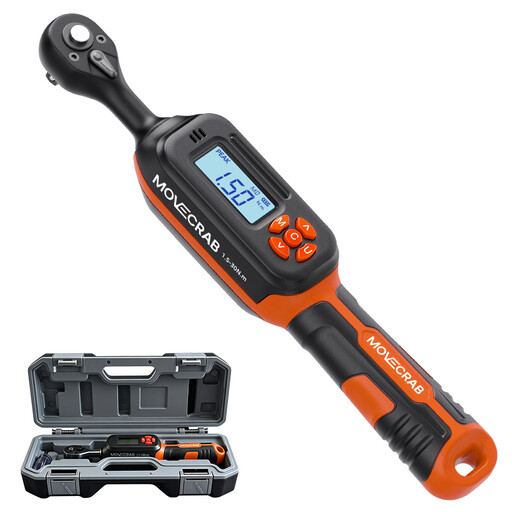
Why this product suits this profile: The medium-to-high measuring range is suitable for many jobs involving motorcycles, cars and machinery, provided the required values fall within this range.
The key technical specifications clearly state the measuring range, drive size and warning system. This makes it possible to check before buying whether the tool is compatible with your existing socket set.
According to the product information: 4.2–85 Nm, ±2% clockwise, switching between four units, plus LED, vibration and audible warnings.
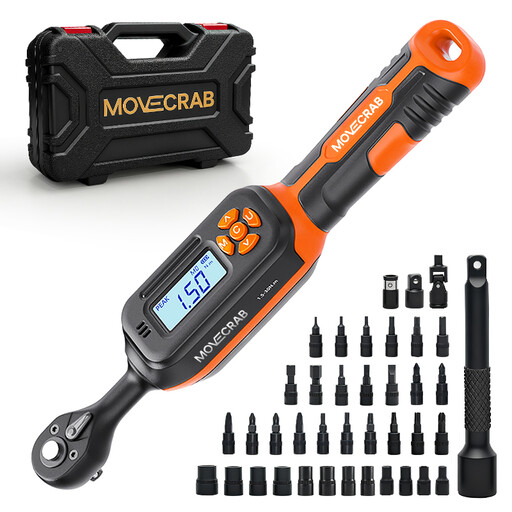
Why this product suits this profile: This set is aimed at users who need multiple bits, sockets and adapters for bicycle, motorcycle and selected car repairs.
The contents are clearly specified as 23 bits, twelve sockets and four adapters. This makes it clear in advance whether any additional accessories are required.
According to the product information: 1.5–30 Nm, ±2% accuracy, 72-tooth ratchet, ten preset modes and memory for up to 500 measurements.
We have put together a complete, regularly updated list of products that fully meet these strict selection criteria and the safety regulations applicable in the EU.
For many bicycle jobs, a range of 1–20 Nm or 1.5–30 Nm is closer to typical requirements than a model with a high minimum value. The specifications for the individual component are what matter, for example those for the stem, seat post or braking system. A low measuring range prevents small target values from sitting at the lower limit of an unsuitable tool.
This depends on use, storage, overloading and maintenance. It is not possible to give a reliable general lifespan. The tool should not be loaded beyond the stated maximum value, used as an impact tool or stored in damp conditions. For regular workshop use, calibration testing in line with the manufacturer’s instructions or workplace requirements may be advisable.
The two designs have different characteristics. A digital model displays the value directly and, depending on the version, can provide warnings via LED, vibration or an audible signal. A mechanical model does not require a battery and is often simpler in design. The choice should therefore be based on where and how you intend to use it, the required accuracy, measuring range, readability and maintenance requirements – not simply on the design.