
Lieferung heute & morgen

Qualitätsgarantie

Willkommens-Angebote freischalten: KOSTENLOSE Lieferung | Bis zu 80 % RABATT | Kostenlose 30-Tage-JoyPlus-Testphase
App herunterladen
A digital torque wrench can make tightening threaded fasteners more straightforward, provided its torque range, drive size and controls suit the task. Bike components have different requirements from car wheel nuts, though. If you focus only on a high torque rating or a prominent LED display, you could end up with a tool that’s of little practical use day to day.
A 1/2-inch torque wrench with a range of, say, 17 to 340 Nm is suitable for many jobs on a car, but not for delicate bike components. With small fasteners, the torque you need may fall outside the tool’s precise working range. For bikes, electronic equipment housings or smaller motorbike components, a 1/4-inch torque wrench is usually a better choice.
The 1/4, 3/8 or 1/2-inch measurement refers to the square drive for sockets. It doesn’t, on its own, tell you how accurately the tool works or what torque range it covers.
Adapters can extend compatibility, but they don’t change the tool’s measurement range.
A torque wrench with an LED display is easy to read in poorly lit areas. A vibration alert, beep and light signal also make it easier to spot when you’ve reached the target value. However, the stated specifications, correct settings and proper use remain essential. Claims such as ±2 per cent accuracy should be understood as the manufacturer’s stated figure. They don’t replace regular checks or calibration when the tool is used in a professional workshop.
First, check the torque values in the fitting instructions for your bike, motorbike or vehicle. The target value should fall within the tool’s working range, rather than being used consistently at the very bottom or top of that range.
Here are some examples from the available selection:
An electronic torque wrench that switches between Nm, ft.lb, in.lb and kgf.cm can be useful when manufacturers specify values in different units. Check that you can set the target value clearly using the buttons.
A three-part warning system combining vibration, a beep and an LED display can help when working in a noisy workshop or where visibility is limited. Even so, treat it only as a prompt to stop tightening. Once you reach the set value, don’t apply any extra force.
A torque tool with preset values saves time if you regularly work on similar fasteners. According to the product description, Movecrab models offer ten memory slots. They also have a Track mode for live readings and a Peak mode that records the highest value reached. The product description states that up to 500 readings can be stored.
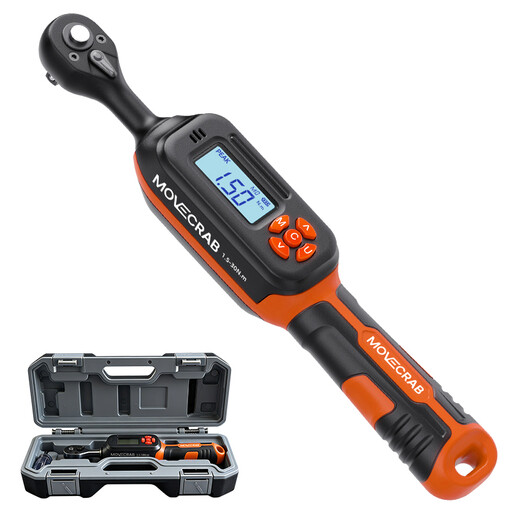
Why this product suits this user: Its low range is designed for delicate fastening jobs and, according to the product description, makes it suitable for bikes, motorbikes and confined workspaces.
Its limited measurement range means you won’t have to set a low bike torque value on a tool designed for much higher forces.
1/4-inch drive, multiple unit displays and an accuracy rating of ±2 per cent, according to the supplier.
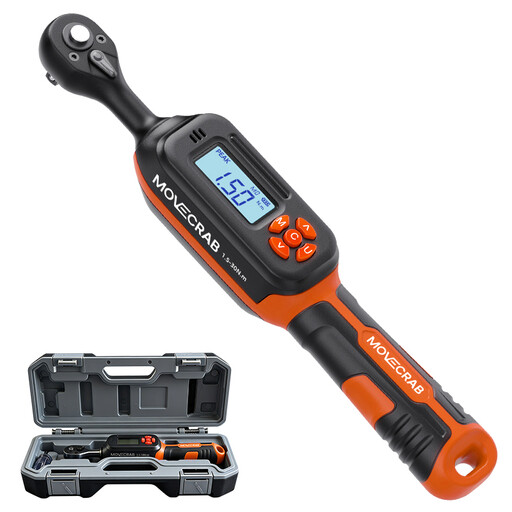
Why this product suits this user: Its wider 1/4-inch range covers more common fitting values without compromising on compact dimensions.
The ten preset values make it easier to repeat settings and reduce the need to guess each time you use a frequently needed value.
LED, audible and vibration alerts, plus Track and Peak modes, according to the product description.
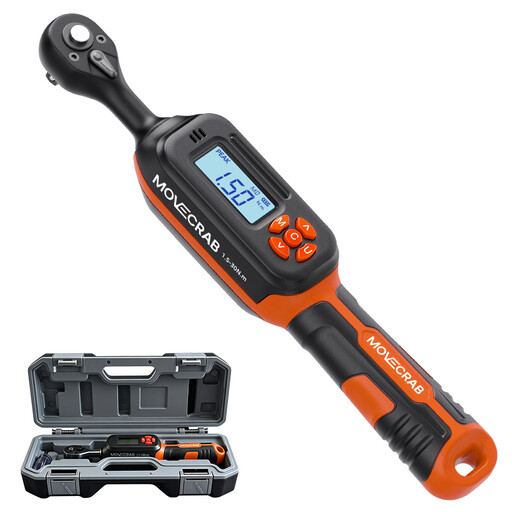
Why this product suits this user: The mid-size drive will appeal to anyone looking to cover bike, motorbike and selected automotive jobs with one tool.
Its 4.2 to 85 Nm range sits between typical fine-torque and high-torque tools, making it easier to choose a tool for a mix of jobs.
3/8-inch drive, four selectable units and an accuracy rating of ±2 per cent, according to the manufacturer.
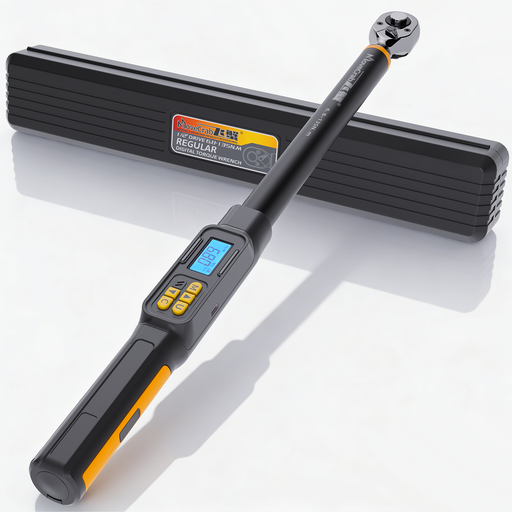
Why this product suits this user: Its 1/2-inch drive and wider range are aimed at car enthusiasts and anyone who needs higher torque values.
Its higher measurement range is clearly stated, making it easier to check whether the tool suits the specified torque values for your vehicle.
1/2-inch ratchet head, Peak storage and a three-part warning system, according to the product description.
Before using the tool for the first time, check the batteries, display and direction switch. Set the unit of measurement and target value, then apply steady pressure. A digital torque wrench is no substitute for the fitting instructions provided by the vehicle or component manufacturer.
After use, we recommend that you:
We’ve put together a complete, regularly updated list of products that meet these strict selection criteria and fully comply with the safety regulations in force in the EU.
Many bike fitting values are low. A 1/4-inch torque wrench with a suitable Nm range is therefore often a better choice than a 1/2-inch model designed for higher forces. The values in the instructions for the specific component are what matter.
Its lifespan depends on how it’s used and stored, the condition of the batteries and whether it’s overloaded. Keep the tool dry and don’t exceed its stated maximum range. If you use it regularly in a workshop, plan to check its measurement accuracy in line with your workplace’s procedures.
As well as the purchase price, you may need to pay for batteries and, where applicable, inspection or calibration. The cost depends on how often you use the tool and whether you need documented accuracy checks. For occasional jobs, battery availability and straightforward controls are the main things to consider.