
Lieferung heute & morgen

Qualitätsgarantie

Willkommens-Angebote freischalten: KOSTENLOSE Lieferung | Bis zu 80 % RABATT | Kostenlose 30-Tage-JoyPlus-Testphase
App herunterladen
Anyone looking for dimmable 230V LED recessed spotlights 3CCT IP44 will usually want to meet several requirements at once: a slim design, flexible light colours, protection against splashing water and straightforward integration into the existing ceiling. In practice, however, unsuitable purchases are often caused not by the LED technology itself, but by incompatible cut-out dimensions, unsuitable dimmers or unrealistic expectations of the IP rating.
This selection guide from the Joybuy Product Recommendation Officer explains which details matter before buying and which model may suit different usage situations.
A spotlight with a diameter of 113 mm will not automatically fit an existing 113 mm opening. The key measurement is the specified ceiling cut-out, meaning the area into which the light is installed. Depending on the model, this may be significantly smaller than the outer diameter.
You should therefore measure the following before buying:
For renovations where there is little cavity space, slim LED recessed spotlights with an installation depth of around 25.5 to 34 mm are particularly relevant.
A dimmable light requires a suitable dimmer. With dimmable LED recessed spotlights, you should check whether the existing or planned dimmer is suitable for LED loads and for leading-edge or trailing-edge control. An unsuitable dimmer can cause flickering, buzzing or a limited dimming range.
The specification “10 to 100 per cent” describes the product’s intended brightness range, but does not guarantee compatibility with every wall dimmer. The technical specifications of the light and dimmer should be compatible.
IP44 means protection against solid foreign objects of 1 mm or larger, as well as splashing water from various directions. IP44 recessed lights are therefore typically suitable for damp indoor areas such as bathrooms or kitchens, provided that the installation situation and the applicable installation zones are taken into account.
IP44 does not protect against:
Correct positioning is also crucial in bathrooms. In Germany, the electrical connection should be carried out by a suitably qualified electrician.
Models with a direct connection to 220–240 V AC generally do not require a separate transformer. This can simplify planning, but does not replace checking the existing electrical installation. Before installation or maintenance, the relevant circuit must be isolated at the circuit breaker.
With 3000K 4000K 6500K LED recessed lights, the colour temperature can usually be selected using a switch on the light:
With many 3CCT models, the selection is made before installation. If you would like to change it regularly later on, you should consider how accessible the switch will be.
A model with 10 W and 1050 lumens provides a high total luminous flux when six lights are used. However, whether the lighting feels comfortable also depends on the size of the room, ceiling height, wall colours and the beam angle. An angle of 120 degrees spreads the light widely and can help provide even general illumination.
Wattage alone says little about the actual brightness. You should therefore always compare wattage and lumens together. For living rooms or bedrooms, the dimming function may also be more important than the highest possible luminous flux.
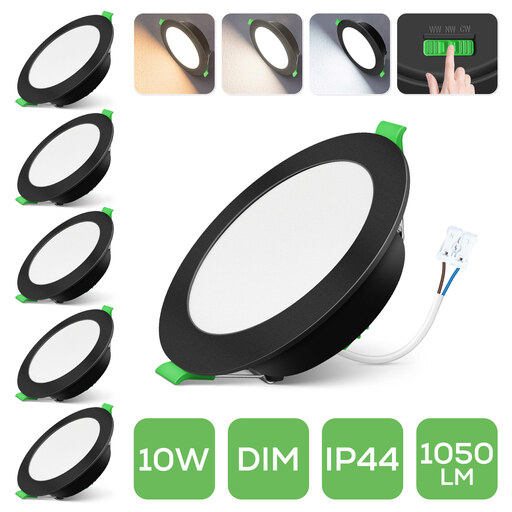
Why this product suits this profile: This six-piece set combines a direct 230 V connection with three selectable colour temperatures, making it suitable for shoppers looking for flexible basic lighting for several indoor spaces.
The specifications state a ceiling cut-out of 90–100 mm and an installation depth of 34 mm. This makes it easier to check compatibility with the existing ceiling.
10 W, 1050 lumens per light, 3000/4000/6500 K, dimming from 10–100 per cent and IP44 according to the product specifications.
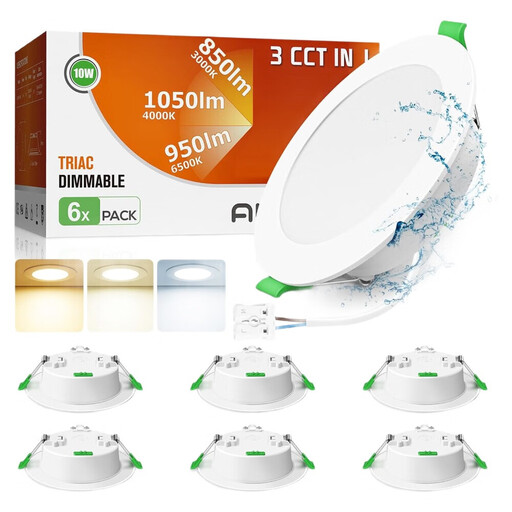
Why this product suits this profile: Shoppers who prioritise material specifications get a model made from aluminium and polycarbonate, with stated heat dissipation properties and a slim housing.
The technical description clearly states the required cut-out of 90–100 mm. It also specifies the use of a compatible trailing-edge dimmer.
Aluminium and polycarbonate construction, 34 mm depth, 120-degree beam angle and an average service life of 30,000 hours according to the product specifications.
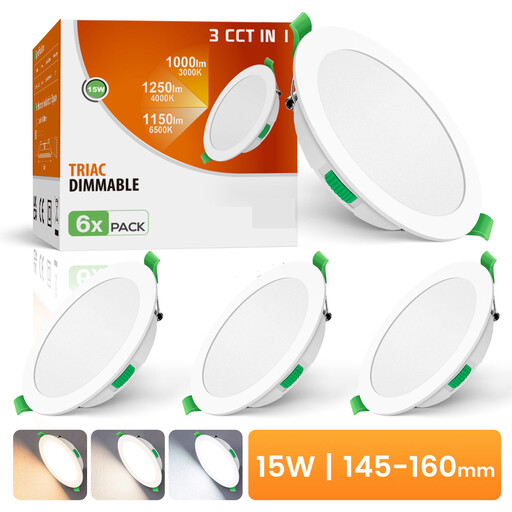
Why this product suits this profile: This model is aimed at users with existing larger ceiling cut-outs of 145–160 mm who want to choose the light colour flexibly for each room.
The unusually large required cut-out is listed in the technical specifications. This prevents the lights from being selected based solely on their outer diameter.
175 mm diameter, 32 mm overall height, 1200 lumens per light, 3000/4000/6500 K and dimmability according to the product description.
We have put together a complete, regularly updated list of products that fully meet these strict selection criteria and the safety regulations applicable in the EU.
With a set of 6 LED recessed spotlights, you should first mark the positions on the ceiling and check whether cables, supports or insulation material are in the way. The direct 230 V connection must only be made with the power switched off and in accordance with the applicable electrical regulations. If you are unsure, consult a qualified electrician.
Total wattage is the key factor when calculating electricity costs. Six lights rated at 10 W each require 60 W in total. Used for four hours a day, this equates to 0.24 kWh per day. The actual cost depends on your individual electricity tariff and usage time. Dimming reduces the brightness output, while the exact power consumption may vary depending on the model and dimmer.
You should also ensure adequate heat dissipation. Dust should be removed with a dry, soft cloth. Cleaning products, direct jets of water and covering the lights can impair heat dissipation.
Models with a direct connection to 220–240 V AC are generally designed to operate without a separate transformer. However, the connection type must still match the existing installation. In Germany, the electrical connection should be carried out by a qualified electrician.
Depending on how the bathroom is used, 3000 K, 4000 K or 6500 K may be suitable. 4000 K is often chosen for practical illumination, while 3000 K creates a warmer lighting effect. With a 3CCT model, you can adjust the selection to the room before installation. IP44 only protects against splashing water, not jets of water or immersion.
The product specifications for many models state an average service life of around 25,000 to 30,000 hours. This figure is not a guarantee of a specific service life in each individual case. Ambient temperature, mains quality, installation, heat dissipation and daily operating time all affect actual longevity.