
Lieferung heute & morgen

Qualitätsgarantie

Willkommens-Angebote freischalten: KOSTENLOSE Lieferung | Bis zu 80 % RABATT | Kostenlose 30-Tage-JoyPlus-Testphase
App herunterladen
Choosing the right lighting is crucial for the atmosphere and functionality of any room. Dimmable 230V LED recessed spotlights, in particular, offer a modern and energy-efficient solution. However, the market can be overwhelming, and several common misconceptions often lead to the wrong purchase. Before you invest, you should be aware of the three most frequent pitfalls that occur when selecting dimmable LED spots.
This guide will help you navigate these issues and find the perfect recessed spotlights for your project.
To make an informed decision, it's important to understand a few technical parameters. These three features are essential for the longevity, safety, and functionality of your new lighting.
The IP (Ingress Protection) rating indicates how well an electrical device is protected against the intrusion of foreign objects and water. This is a critical safety feature, especially in damp environments like bathrooms and kitchens.
When planning your recessed lighting for the kitchen or bathroom, always ensure the correct IP classification according to local safety standards for the respective installation zone.
Modern LED spotlights offer more than just on and off. The ability to adjust brightness and light colour significantly enhances living comfort.
Structural conditions are often the limiting factor when choosing recessed spotlights.
Based on the criteria above, we have identified several products that are well-suited for different users and projects.
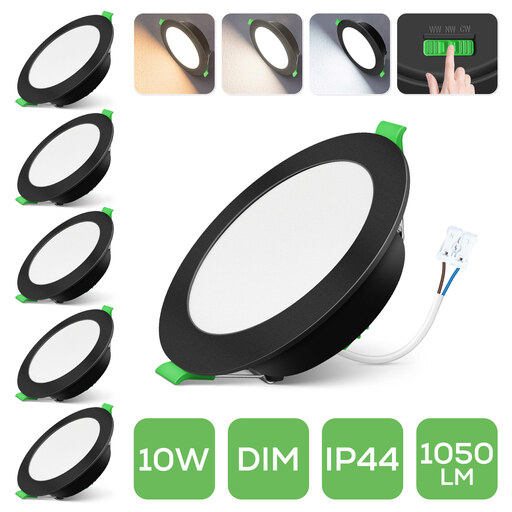
Why it's a match: Ideal for users seeking maximum flexibility and a modern aesthetic. The black design creates a stylish accent, while the high light output and adjustable settings provide the perfect light for any situation, whether in the kitchen, living room, or office.
The IP44 rating makes the spotlight safe for damp rooms. The dimming function is designed for common dimmers, and the slim profile of 34 mm fits into almost any ceiling.
? 3CCT function (3000K/4000K/6500K) for full control over the lighting mood.
? High luminous flux of 1050 lumens with only 10 watts of power consumption.
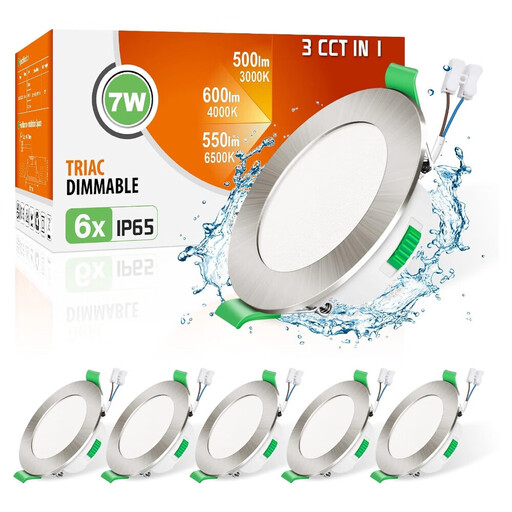
Why it's a match: Perfect for anyone who needs uncompromising safety in the bathroom. The IP65 rating allows for installation even in Zone 1, such as directly above the shower. The nickel finish blends elegantly with modern bathroom fixtures.
With IP65, the trap of an incorrect protection rating is completely avoided. The ultra-slim installation depth of just 29 mm solves any space issues in the ceiling.
? IP65 rating for maximum safety in all wet areas.
? Dimmable and with 3CCT function for flexible lighting design, even in the bathroom.
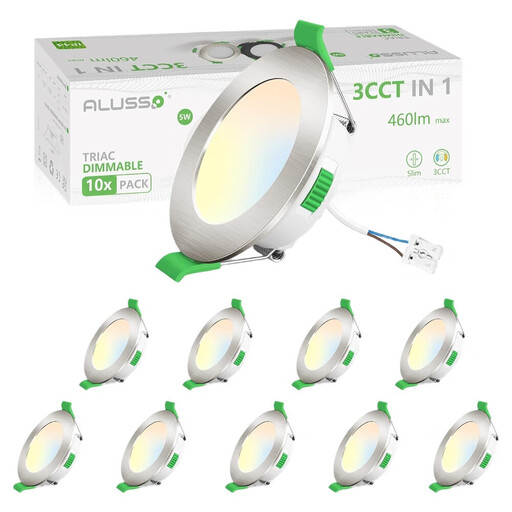
Why it's a match: A solid all-rounder for standard applications like hallways, living rooms, or basements. This model offers all the essential modern features (dimmable, 3CCT, IP44) in a compact and energy-efficient package that is easy to install.
The very shallow installation depth of 29 mm and the standard cutout diameter of 68-78 mm make installation straightforward. The dimmability and IP44 rating cover the most common requirements.
? Very energy-efficient with 5 watts of power consumption.
? Wide beam angle of 120° for uniform room illumination.
We have compiled a complete, up-to-date list of products that fully meet these strict selection criteria and UK safety regulations.
For most dimmable 230V LED recessed spotlights, a trailing-edge dimmer (identifiable by the "RC" symbol) is recommended. These are specifically designed for the low load of LEDs and prevent flickering or buzzing. Always check the manufacturer's specifications for both the spotlight and the dimmer for compatibility. Universal dimmers that can detect both dimming types (leading and trailing-edge) are also a good option.
CCT stands for "Correlated Color Temperature" and refers to the ability to change the colour temperature of the light. A spotlight with a CCT function allows you to choose between different light colours, such as Warm White (approx. 3000K), Neutral White (approx. 4000K), and Cool White (approx. 6500K), using a switch or remote. This allows you to flexibly adapt the lighting to the room's use.
A general rule of thumb for ambient lighting in living spaces is about one spot per 1.5 to 2.5 square metres. However, this is highly dependent on the light output (lumens) of the spot, the beam angle, and the desired brightness. For task areas like a kitchen counter, you will need higher illuminance and should place the spots closer together than in a hallway, for example. It is advisable to create a lighting plan that takes the specific conditions of the room into account.