
Lieferung heute & morgen

Qualitätsgarantie

Willkommens-Angebote freischalten: KOSTENLOSE Lieferung | Bis zu 80 % RABATT | Kostenlose 30-Tage-JoyPlus-Testphase
App herunterladen
Anyone looking for dimmable 230V LED recessed spotlights for the bathroom, kitchen or living areas will find countless products making similar promises: ultra-flat, especially bright, water-resistant and suitable for any ceiling. In practice, however, not every model is suitable for every installation situation. Key factors include technical specifications such as the ceiling cut-out, installation depth, dimmer compatibility and IP rating.
The term “dimmable” does not mean that every existing wall dimmer will work. Many LED recessed spotlights require a compatible trailing-edge dimmer or an LED dimmer specifically stated by the manufacturer. Unsuitable components can cause flickering, buzzing or a limited dimming range.
You should therefore check:
A model with a 3CCT function is only flexible if the desired colour temperature can be selected before installation or via an accessible switch.
An IP44 recessed spotlight is protected against solid foreign objects measuring 1 mm or more, as well as splashing water from various directions. This makes it interesting for many bathroom areas, kitchens and covered balconies. However, IP44 is not designed to withstand a direct water jet or immersion.
For areas with higher humidity or heavier exposure to splashing water, a model with IP65 may be more suitable. The specific installation zone in the bathroom and the applicable installation regulations must be taken into account. Inside a shower, the product description alone is not decisive.
Flat LED recessed spotlights vary considerably in terms of the required ceiling cut-out. A diameter of 113 mm does not automatically mean that an existing 115 mm hole will be suitable. The installation depth must also match the ceiling construction, insulation material and substructure.
Before buying, you should measure:
An LED recessed spotlight with 220–240 V AC is connected directly to the mains and does not require a separate transformer. This simplifies planning, but does not replace professional installation. Work on the fixed electrical installation in Germany should be carried out by a qualified electrician.
Low-voltage models with 12–24 V are a different product category. They require a suitable transformer, which is often not included. Such a model must not be connected directly to 230 V.
The wattage indicates energy consumption, not brightness. The value in lumens is decisive for light output. On paper, a 10 W spotlight with 1,050 lm provides more light than a 9 W model with 720 lm. The required brightness also depends on the room size, ceiling height, beam angle and number of spotlights.
With a 6-piece LED spotlight set, it should be clear whether the stated light output applies to each light or to the entire set. Neutral white light at around 4000 K can be practical for kitchen worktops, while 3000 K often creates a calmer atmosphere in living rooms or bedrooms. 6500 K produces a noticeably cooler light colour and should be used deliberately.
A 3CCT LED recessed spotlight usually offers a choice between 3000 K warm white, 4000 K neutral white and 6500 K cool white. Check whether the setting is changed using a switch on the housing and whether it can be accessed before the spotlight is fitted.
The colour rendering index, CRI or Ra, indicates how naturally colours appear under the light. A value of at least Ra 80 is a common benchmark for many living areas. A higher value may be worthwhile in kitchens, dressing rooms or areas where accurate colour recognition is important.
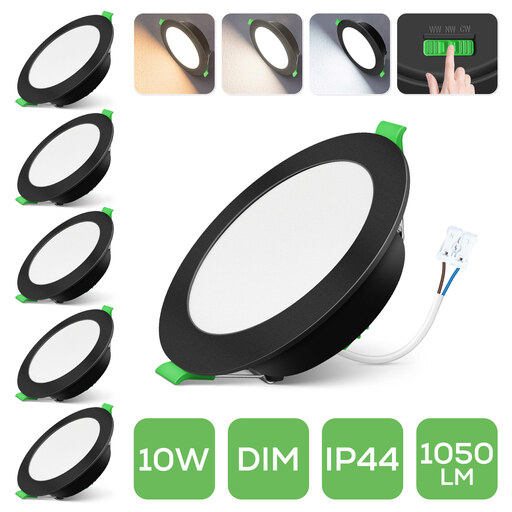
Why this product suits this profile: This 6-piece set combines a direct 220–240 V connection, dimming functionality and three selectable colour temperatures. This makes it suitable for renovations where several matching LED ceiling spots are needed.
The product data specifies a dimming range of 10–100%, the 3CCT selection and the required ceiling cut-out of 90–100 mm. This allows key planning details to be checked before purchase.
10 W, 1,050 lm per light, 3000/4000/6500 K, IP44 and a stated depth of 34 mm.
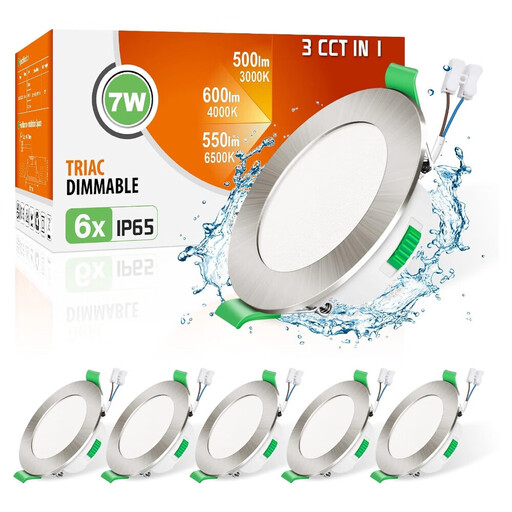
Why this product suits this profile: This model is aimed at buyers looking for a higher stated protection rating and a compact design for humid areas. The nickel finish can also complement modern bathroom and kitchen designs.
The protection rating is specified as IP65, clearly distinguishing it from IP44. A 67–75 mm cut-out and an installation depth of 29 mm are also stated. Nevertheless, the specific installation zone in the bathroom must still be checked.
7 W, 500/550/600 lm, 3000/4000/6500 K, dimming from 10–100% and a direct 230 V connection.
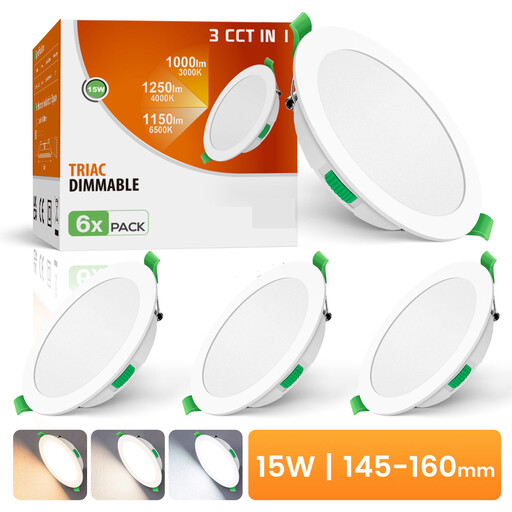
Why this product suits this profile: With 1,200 lm per spotlight, this set is interesting for larger rooms or situations requiring higher light output. However, the large cut-out must be compatible with the existing ceiling.
The product description explicitly states the ceiling cut-out of 145–160 mm, the overall height of 32 mm and the limits of IP44. This helps prevent having to return a spotlight because of incorrect dimensions or unsuitable expectations regarding moisture protection.
15 W, 1,200 lm, 120° beam angle, 3000/4000/6500 K and dimming from 10–100%.
We have put together a complete, regularly updated list of products that fully meet these strict selection criteria and the safety regulations applicable in the EU.
Switch off the fuse before installation and check that the power is off. The ceiling cut-out must not be enlarged without careful consideration if this could affect the fixing or stability of the ceiling. Connection terminals must be securely fitted and must not be under tension.
With dimmable LED spotlights, the light and dimmer should be compatible. For bathrooms, kitchens and covered outdoor areas, remember: IP44 does not protect against a direct water jet, while IP65 is not a blanket approval for every wet zone either. Clean the lights with a soft, dry cloth and do not use aggressive cleaning products.
Models marked 220–240 V AC or 230 V are generally designed for direct connection to the mains. These products normally do not require a transformer. Installation on the fixed electrical system should be carried out by a qualified electrician.
Many of the products mentioned here specify an average service life of 25,000 to 30,000 hours. This is a manufacturer’s figure and depends, among other things, on heat dissipation, operating time, ambient temperature and the electrical installation. Good ventilation around the light remains important.
When dimmed, the light output currently being emitted decreases, and power consumption usually falls as well. However, the exact consumption depends on the light, dimmer and selected brightness level. To compare running costs, consider the power consumption in watts, daily usage time and the number of spotlights installed.