
Lieferung heute & morgen

Qualitätsgarantie

Willkommens-Angebote freischalten: KOSTENLOSE Lieferung | Bis zu 80 % RABATT | Kostenlose 30-Tage-JoyPlus-Testphase
App herunterladen
A dimmable 230V LED recessed spotlight can provide even lighting in your bathroom, kitchen, hallway or living room without the need for an additional transformer. In practice, however, the wrong purchase is often down to unsuitable cut-out dimensions, an incompatible dimmer or an incorrect understanding of the IP rating rather than the colour temperature.
This guide from the Joybuy Product Recommendation Officer explains which technical details to check before you buy and which models suit different needs.
Many LED ceiling spotlights can only be dimmed with a suitable trailing-edge dimmer or a compatible trailing-edge model. Using an unsuitable dimmer can cause flickering, buzzing or a limited dimming range.
So check these three details:
A model with a stated dimming range of 10 to 100 per cent won’t necessarily work with every existing wall dimmer.
An IP44 recessed light is protected against solid objects and water splashes from various directions. However, it is not designed to withstand direct water jets or immersion. In bathrooms, you must also take into account the installation zone, distance from water sources and local electrical regulations.
For areas with higher levels of moisture, an IP65 spotlight can offer extra protection thanks to its design. However, the IP rating alone is no substitute for proper installation.
A low-profile LED recessed light will only fit if there is enough room behind the ceiling for the light fitting, connections and heat dissipation. The exact ceiling cut-out is just as important. A diameter of 90 to 100 millimetres is not interchangeable with a cut-out of 145 to 160 millimetres.
Before ordering, measure:
An LED recessed spotlight without a transformer connects directly to a 220–240 V mains supply. This makes planning simpler, but installation is still not a job for anyone without the necessary training. Work on fixed electrical installations in Germany should be carried out by a suitably qualified electrician.
By contrast, 12–24 V models require a suitable transformer, which is not always included. Never connect a low-voltage spotlight directly to 230 V.
Wattage describes energy consumption, not brightness. For comparison, the lumen rating is more important:
A 10 W LED recessed spotlight with 1,050 lumens can produce a different lighting effect from a 10-watt model with a considerably lower lumen output. The beam angle, number of lights and room colour also affect the result.
A 3CCT recessed spotlight usually offers three selectable colour temperatures:
Some products have a switch on the light fitting for selecting the colour temperature. Set it before installation. An LED ceiling spotlight with warm white, neutral white and cool white settings is particularly useful if the purpose of the room might change later.
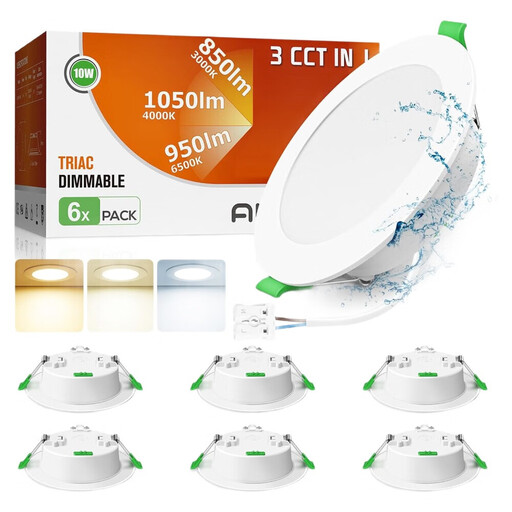
Why this product suits this profile: This model combines a direct 230 V connection, three colour temperatures and a stated light output of 1,050 lumens per light. It requires a cut-out of 90 to 100 millimetres and has a recessed depth of 34 millimetres.
The key dimensions, 230 V specification and compatibility with a suitable trailing-edge dimmer are all clearly stated. This makes it easier to check that the light will fit your space before you buy.
10 W, 1,050 lm, selectable 3,000/4,000/6,500 K, IP44 and dimming from 10 to 100 per cent according to the product specifications.
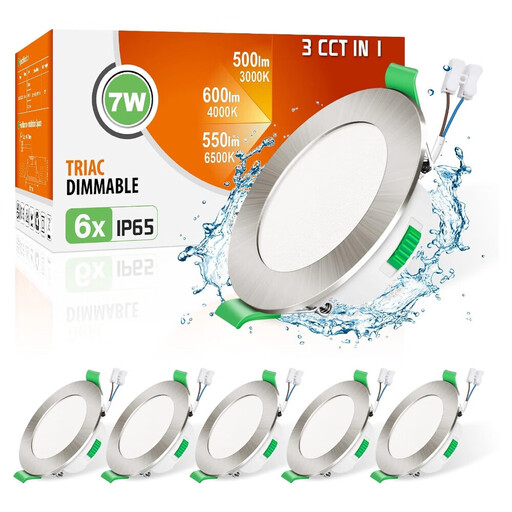
Why this product suits this profile: The lights are designed for direct connection to 230 V and, according to the product description, have a recessed depth of 29 millimetres. The IP65 rating can provide extra protection in suitable damp indoor areas.
As well as describing the dimming function, the specifications include the IP rating, recessed depth, cut-out range of 67 to 75 millimetres and the required dimmer type.
IP65, 7 W, three colour temperatures, dimming from 10 to 100 per cent and a pack of 6, according to the product specifications.
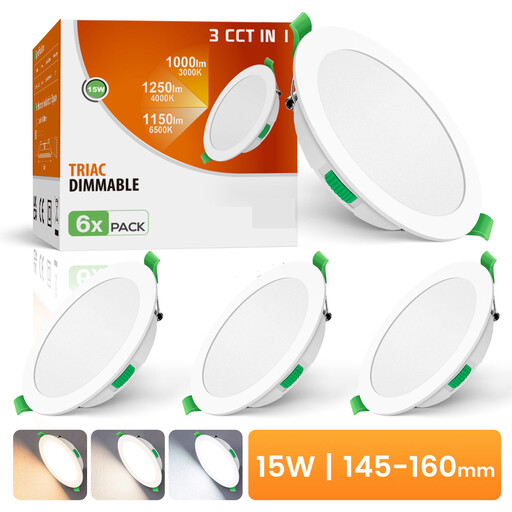
Why this product suits this profile: With a larger cut-out of 145 to 160 millimetres and 1,200 lumens per light, this model is ideal if you want to install high-output lighting in several rooms.
The larger ceiling cut-out and 32-millimetre fitting height are clearly specified, helping you avoid ordering a light designed for a smaller opening.
15 W, 1,200 lm, 120-degree beam angle, 3CCT, IP44 and dimming with compatible phase-control dimmers, according to the product description.
We’ve put together a complete, regularly updated list of products that meet these strict selection criteria and fully comply with the safety regulations in force in the EU.
Before installation, switch off the power at the circuit breaker and make sure it cannot be switched back on. Connection terminals, cable cross-sections and protective earth wiring must be handled in accordance with the applicable requirements. If you’re unsure, have the installation carried out by a qualified electrician.
Heat dissipation and clear space around the fitting are important for its lifespan. Insulation must not cover the light in a way that is not permitted. You can usually clean the surface with a soft, dry cloth. Avoid direct water jets and harsh cleaning products.
No. Check whether the manufacturer specifies a trailing-edge dimmer, leading-edge dimmer or a particular LED dimmer. The dimmer’s minimum and maximum loads must also be suitable for the total output of the installation.
It depends on the size of the room, the number of spotlights, the beam angle and the lighting effect you want. Models with around 690 to 780 lumens may be suitable for general room lighting. A 1050-lumen LED spotlight or a model with 1,200 lumens provides more light per fitting, but should be spaced to suit the size of the room.
The cost depends on the wattage, daily running time and electricity tariff. The simple calculation is:
Wattage ÷ 1,000 × hours of use × price per kilowatt-hour
A 10-watt spotlight used for three hours a day consumes 0.03 kilowatt-hours per day. Add the consumption of any additional lights to work out the total.