
Lieferung heute & morgen

Qualitätsgarantie

Willkommens-Angebote freischalten: KOSTENLOSE Lieferung | Bis zu 80 % RABATT | Kostenlose 30-Tage-JoyPlus-Testphase
App herunterladen
Choosing the right lighting for your bathroom is crucial for both functionality and atmosphere. Modern dimmable 230V LED recessed bathroom spotlights promise a flexible and durable solution. However, the market is confusing, and not every product delivers on its promise. Before you make a decision, it's important to know the common pitfalls that can lead to disappointment and unnecessary costs.
This guide will help you understand the technical features and make an informed choice that perfectly matches your requirements.
Many buyers are swayed by attractive product images or supposed bargains, overlooking critical technical details in the process. These three mistakes are particularly costly:
To avoid the mistakes mentioned above, you should focus on three core parameters. These determine the safety, functionality, and longevity of your new bathroom lighting.
The IP (Ingress Protection) rating indicates how well an electrical device is protected against the ingress of foreign objects and water. For the bathroom, the protection zones are particularly relevant:
For most ceiling installations in the bathroom, recessed lights with an IP44 rating are a safe and compliant choice. For areas that could be exposed to direct water jets, IP65 offers additional security.
The lighting mood has a major impact on well-being. Modern LED spots offer a high degree of flexibility here.
The design of the spots is crucial for installation.
These criteria apply not only to the bathroom but also to LED kitchen spotlights, where robust and flexible lighting is also required.
Based on the criteria mentioned, we have identified some products that represent a suitable solution for different user profiles and installation situations.
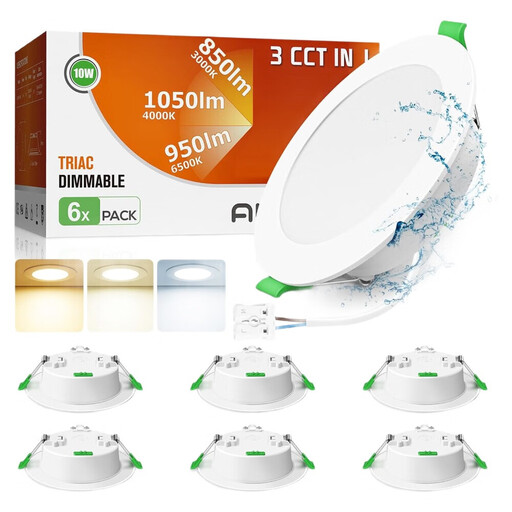
Why This Fits Their Persona: Ideal for anyone looking for a straightforward, all-in-one solution. This LED recessed spotlight set includes six spots that combine all the essential features: dimmability, three selectable colour temperatures, and the necessary IP44 protection for the bathroom.
This set bypasses the most common mistakes: it offers certified IP44 protection, is designed for common dimmers, and connects directly to 230V without a transformer.
High flexibility thanks to 3CCT colour temperature changing (3000K/4000K/6500K) and a high light output of 1050 lumens per spot.
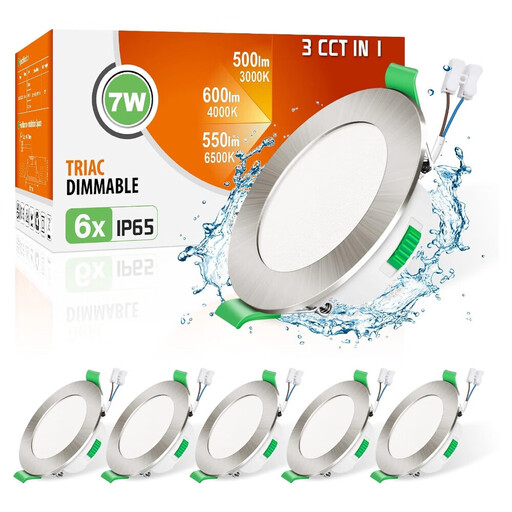
Why This Fits Their Persona: For users who value high-quality materials and maximum safety during their bathroom renovation. The brushed nickel finish has a premium look, while the high IP65 rating also allows for installation in areas near the shower.
With an IP65 rating, this spotlight exceeds the standard requirement (IP44), offering the highest level of protection against water. The aluminium and polycarbonate construction promises durability.
Combines a high protection rating (IP65) with full functionality (dimmable, 3CCT) and an attractive brushed nickel finish.
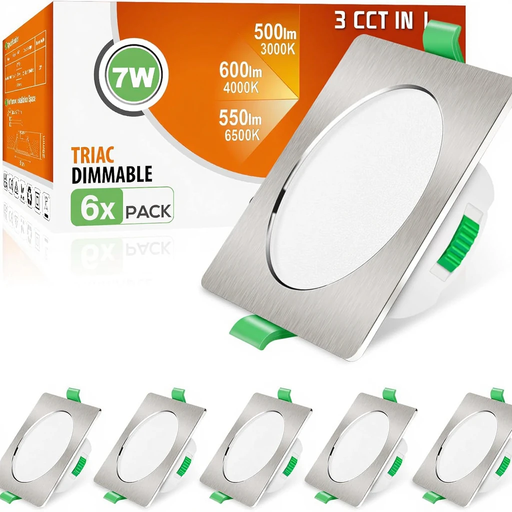
Why This Fits Their Persona: The perfect choice for renovation projects where ceiling space is severely limited. These LED recessed spots are extremely low-profile, requiring only 29 mm of depth without compromising on functionality.
Solves the problem of ceilings with minimal void space where standard spots would not fit. Despite its slim design, it is transformerless and offers IP44 protection.
The very shallow installation depth of 29 mm is the key advantage. The square shape in brushed nickel also offers a modern design alternative.
We have compiled a complete, up-to-date list of products that fully meet these strict selection criteria and German safety regulations.
In Germany, work on 230V electrical installations may only be carried out by a qualified electrician. Even if connecting 230V spots without a transformer seems technically straightforward, hiring a professional is mandatory for safety and insurance reasons.
3CCT stands for "3 Correlated Color Temperatures." It means that with these lights, you can choose between three preset light colours, typically Warm White (approx. 3000K), Neutral White (approx. 4000K), and Cool White (approx. 6500K). The selection is usually made via a small switch on the spot's housing before installation.
A general rule of thumb for ambient lighting is one spot per 1.5 to 2 square metres of ceiling area. For an 8 m? bathroom, 4 to 5 spots would be a good starting point. However, the exact number depends on the ceiling height, the desired brightness (lumens per spot), and the layout of the room. Areas like the vanity may require additional, focused lighting.