
Lieferung heute & morgen

Qualitätsgarantie

Willkommens-Angebote freischalten: KOSTENLOSE Lieferung | Bis zu 80 % RABATT | Kostenlose 30-Tage-JoyPlus-Testphase
App herunterladen
A dimmable LED ceiling light can offer much more than a simple light source, depending on the room: it can adjust brightness, change colour temperature or be integrated into a smart home system. At the same time, unclear product specifications, incorrect installation dimensions and an unsuitable IP rating can quickly lead to the wrong purchase.
This guide explains which technical details are important before buying and which model may suit different living spaces and usage scenarios.
The wattage describes power consumption, not the brightness directly. For comparisons, the luminous flux in lumens is what matters. For example, a 6-watt LED recessed spotlight with 600 lm may be suitable for a hallway or as part of a group, while a central LED ceiling light for a living room requires considerably more luminous flux.
The beam angle also plays a role: an angle of 120° distributes light relatively widely. This is practical for ceiling lights and several recessed spotlights, but it does not automatically replace careful planning of the light positions.
With a dimmable LED ceiling light, you should check how the brightness is controlled. Some models require a compatible trailing-edge dimmer, while others are controlled via an integrated three-stage switch or an app.
According to the product specifications, the Aigostar Smart LED Recessed Spotlight 9W RGB+CCT Bluetooth Mesh is dimmed via the app. An external, wall-mounted dimmer is not compatible with this model. This information helps prevent unnecessary additional costs and potential operating problems.
An IP20 LED recessed spotlight is intended for dry indoor spaces. For bathrooms, kitchen areas exposed to splashing water or covered outdoor areas, different requirements may apply depending on the installation location:
An IP20 model should therefore not be installed in damp or wet areas. When choosing an LED spotlight for a bathroom, the specific position in the room should also be taken into account alongside the IP rating.
First, compare the stated luminous flux. A single light with 2,400 lm may serve a different purpose from several spotlights producing 500 to 600 lm each. For hallways, kitchen worktops or retail areas, positioning is also crucial to prevent dark spots.
The colour rendering index, CRI or Ra, describes how naturally colours appear under the light. For some of the products listed here, the value is Ra ≥ 80. For living spaces and general indoor lighting, this is an important point of reference.
Colour temperature is measured in kelvin:
With a CCT-adjustable light, you can switch between several colour temperatures. RGB+CCT LED models add coloured light to this choice. This is a useful option for scenes and accent lighting, but it is not automatically a substitute for well-planned general lighting.
For LED recessed spotlights, the ceiling cut-out is a non-negotiable parameter. Examples from the product selection include:
During a renovation, the existing cut-out should be measured before ordering. A diameter that is too large or too small may require additional ceiling adjustments.
Installation at 220–240 or 230 V must only be carried out by a suitably qualified electrician with the power supply switched off. Heat build-up caused by insulation material or inadequate ventilation should be avoided.

Why this product suits this profile: This integrated ceiling light provides 2400 lm, 3000 K and three-stage internal dimming. It is therefore suitable for living rooms, bedrooms, kitchens and hallways without the need for additional smart home components.
The dimming function is specified as a three-stage system, so there is no need to choose an unsuitable external dimmer. The fixed colour temperature of 3000 K is clearly stated before purchase.
2400 lm, 24 W, integrated LED and memory function; 35 cm diameter and IP20 for dry indoor spaces.
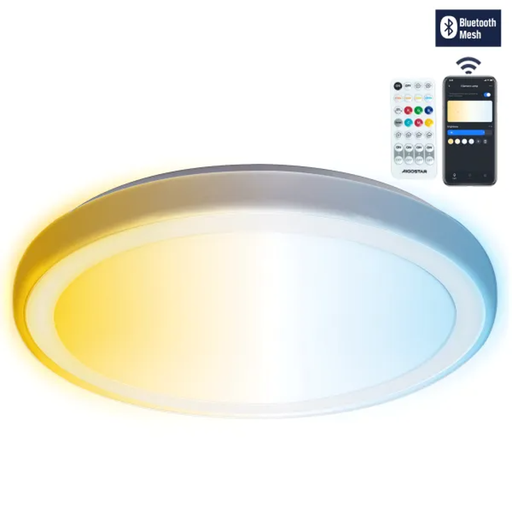
Why this product suits this profile: This central light is designed for living rooms, offices and retail spaces. It combines a luminous flux of 3960 lm with an adjustable colour temperature between 3000 and 6500 K.
The specifications for luminous flux, colour temperature, beam angle and Bluetooth Mesh control are listed separately. IP20 clearly indicates that the product is intended for dry indoor spaces.
3960 lm, 36 W, 120° beam angle, Bluetooth Mesh and CCT control; 49.5 cm diameter.
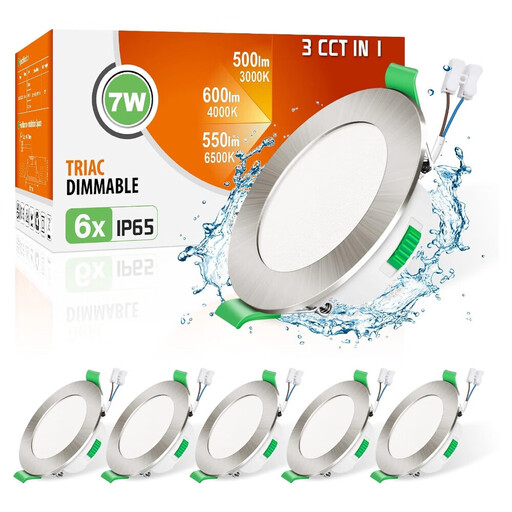
Why this product suits this profile: This six-piece set is intended for damp rooms, kitchens and selected covered outdoor areas. The IP65 rating and 67 to 75 mm cut-out make it easier to determine whether the product is technically suitable.
The IP65 rating clearly distinguishes this model from an IP20 spotlight. The specifications also state 3000, 4000 and 6500 K, as well as dimming from 10 to 100 per cent.
7 W, up to 600 lm according to the product specifications, 3CCT, 120° beam angle, 230-V connection and six-piece pack.
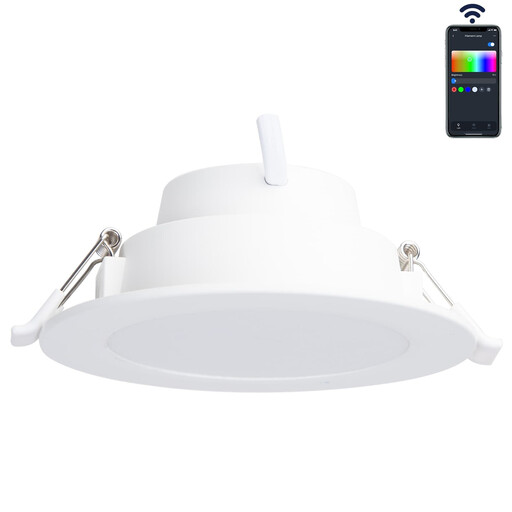
Why this product suits this profile: This LED ceiling spotlight combines Bluetooth Mesh, app and voice control with RGB+CCT. The model is suitable for hallways, rooms or commercial interiors where several lights need to be connected.
The product specifications state that control is via Bluetooth Mesh and that a gateway is required. With IP20, use is limited to dry indoor spaces.
9 W, 780 lm, RGB plus 2700–6500 K, 120° beam angle, 120–130 mm cut-out and a stated service life of 30,000 hours.
We have put together a complete, regularly updated list of products that fully meet these strict selection criteria and the safety regulations applicable in the EU.
Connection to the mains should only be carried out by a qualified electrician. Before installation, the mains voltage, installation method, existing ceiling cut-out and control method must be checked. Smart models may also require a gateway.
The stated service life depends on the product and operating conditions. Product specifications may, for example, state 25,000 or 30,000 hours. These figures are manufacturer specifications and should not be interpreted as a guaranteed period of use. Heat dissipation, switching frequency and correct installation all affect operation.
For a rough calculation, use: power in watts × operating hours ÷ 1000 = kilowatt hours. A 9-W light uses 9 kWh over 1,000 operating hours in theory. The actual electricity cost depends on your individual tariff. Standby consumption should also be taken into account for connected lights; some models are specified as using up to 0.5 W.