
Lieferung heute & morgen

Qualitätsgarantie

Willkommens-Angebote freischalten: KOSTENLOSE Lieferung | Bis zu 80 % RABATT | Kostenlose 30-Tage-JoyPlus-Testphase
App herunterladen
Dimmable LED downlights offer a space-saving ceiling lighting solution for hallways, kitchens, living rooms or bedrooms. In bathrooms, however, additional requirements apply. If you only pay attention to wattage, design or a marketing claim like “waterproof”, you could end up buying a model that doesn’t suit your existing ceiling, dimmer or moisture zone.
An existing ceiling cut-out can’t be used with just any recessed spot. The key factors are:
Flat LED downlights with an installation depth of 25.5 or 29 mm are suitable for shallow ceiling areas. Even so, there must be sufficient room behind the fitting for the connection and the ventilation specified by the manufacturer.
A dimmable LED downlight needs a compatible dimmer. Many 230-volt models explicitly require a trailing-edge dimmer. An unsuitable wall dimmer can cause flickering, humming or a limited dimming range.
With smart models, dimming may only be possible via app or voice control. According to the product information, the Aigostar model with Bluetooth Mesh is not intended for use with an external wall dimmer. This limitation should be checked against your existing electrical installation before purchase.
An IP20 LED downlight is intended for dry indoor spaces and should not be installed in a bathroom. IP44 protects against splashing water from certain directions, but is not designed for direct water jets or immersion. IP65 recessed spots offer higher protection against dust and water jets and may be suitable for more humid areas depending on the installation location.
The IP rating alone does not replace checking the installation zone in the bathroom. A qualified electrician should be consulted for the mains connection and compliance with German electrical regulations.
With a 3CCT downlight, the colour temperature can usually be selected via a switch on the light fitting:
The selection often has to be made before installation. For lights that are difficult to reach, changing it afterwards is impractical. An RGB+CCT LED spot additionally offers coloured light and variable white tones, but requires an app, a compatible gateway or a suitable control system.
Brightness is given in lumens, not directly in watts. A 7-watt spot with 600 lumens can have a different lighting effect than a 10-watt model with 1050 lumens. The beam angle also affects the room’s ambience: an angle of 120 degrees distributes the light widely and is suitable for even general lighting.
With multiple lights, the total output should be calculated. A set of 6 LED ceiling spots with six 10-watt lights, for example, requires a total of 60 watts if all spots are running at full power simultaneously.
Some 230 V recessed spots are connected directly to 220–240 volts and do not require a separate transformer. This simplifies component selection, but does not automatically make safe installation a job for amateurs.
Aluminium can aid heat dissipation, while polycarbonate or PBT are often used for the cover and housing. Information such as “30,000 hours” should be understood as the average lifespan stated by the supplier and depends on factors including operating time, ambient temperature and installation.
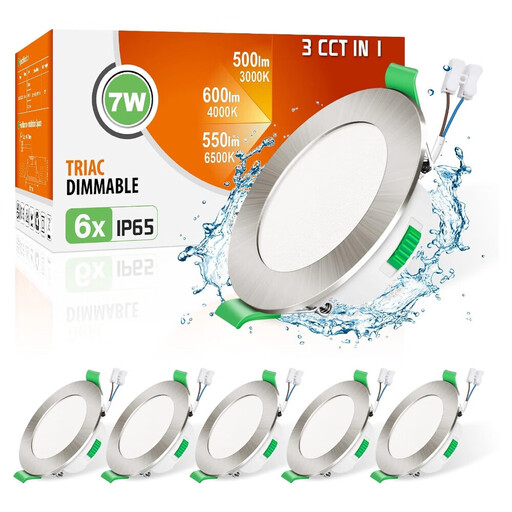
Why this product fits the profile: The 6-pack combines direct 230-volt installation with 3CCT selection and a small cut-out of 67–75 mm. It suits buyers who want to replace several lights uniformly in one room.
The specifications clearly state the installation depth, cut-out size, dimmer type and IP65. This makes it easier to check suitability before ordering.
7 W, up to 600 lumens according to the product information, 3000/4000/6500 K, dimmable from 10 to 100 per cent and 29 mm installation depth.
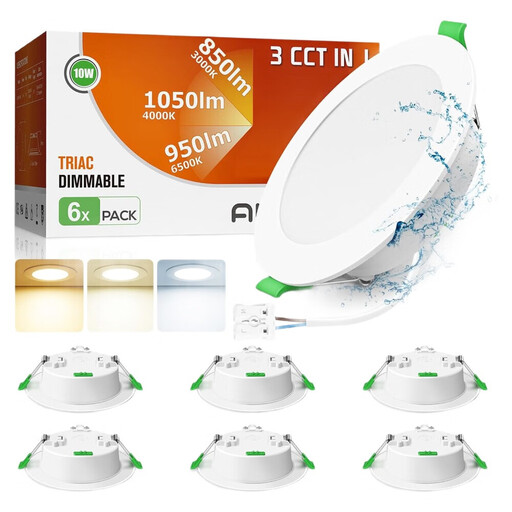
Why this product fits the profile: For renovators seeking higher light output and flexible colour temperature in the kitchen, bathroom or living area, this 6-pack offers clearly stated technical specifications.
The dimming function is tied to a compatible trailing-edge dimmer. This requirement prevents “dimmable” from being confused with universal dimmer compatibility.
1050 lumens per light according to the product information, 10 W, 3CCT, 10–100 per cent dimming range, 34 mm depth and direct 220–240 volt connection.
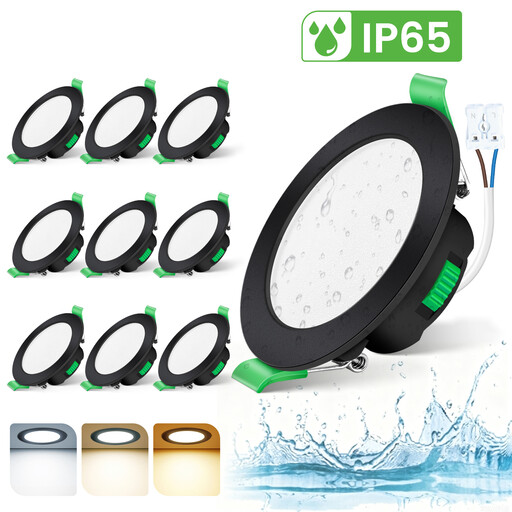
Why this product fits the profile: This model is aimed at users who need a black light fitting aesthetic, small ceiling cut-outs and enhanced protection against dust and water jets.
The IP65 rating and 67–75 mm cut-out are clearly stated. Nevertheless, the installation position in the bathroom must be checked individually; IP65 is not a blanket approval for every moisture zone.
6-pack, 600 lumens according to the product information, 3CCT, 230-volt connection, 29 mm depth and dimmability with a compatible trailing-edge dimmer.
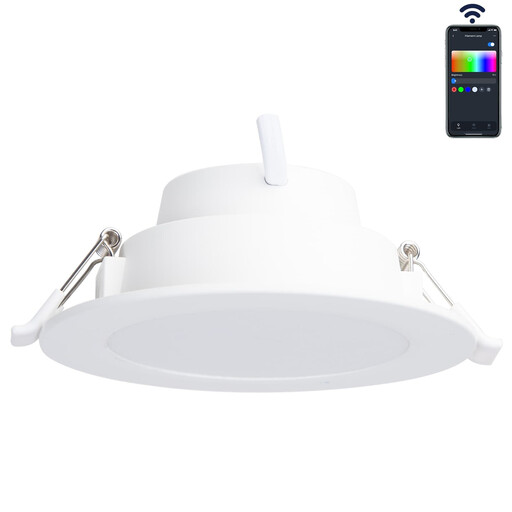
Why this product fits the profile: For rooms with changing lighting moods, the smart spot offers app, Bluetooth Mesh and optional voice control. It is intended for dry indoor areas.
The product information states IP20 and excludes damp or wet locations. This makes it clear that this spot should not be chosen as an LED downlight for the bathroom.
9 W, 780 lumens according to the product information, RGB plus 2700–6500 K, Bluetooth Mesh, app dimming and 120-degree beam angle.
We have put together a complete, regularly updated list of products that fully meet these strict selection criteria and the safety regulations applicable in the EU.
Before purchasing and installing, you should:
No. The model, dimmer type and minimum load must all be compatible. With some smart lights, dimming is only possible via app or gateway. The manufacturer’s specifications should be checked before installation.
For damp indoor areas, IP44 or IP65 LED downlights are commonly available. IP44 protects against splashing water, IP65 against dust and water jets. The specific suitability also depends on the installation zone and mounting position.
The costs depend on the wattage, daily operating time and electricity price. The simple calculation is: wattage ÷ 1000 × operating hours × electricity price. For a 9-watt spot running for three hours a day, this gives a consumption of 0.027 kWh per day per light. For sets, the wattage of all spots operating simultaneously must be added together.