
Lieferung heute & morgen

Qualitätsgarantie

Willkommens-Angebote freischalten: KOSTENLOSE Lieferung | Bis zu 80 % RABATT | Kostenlose 30-Tage-JoyPlus-Testphase
App herunterladen
The selection of portable LED lamps is vast and constantly growing. From the practical rechargeable flashlight for emergencies to the specialised motion-sensor cabinet light, there's a solution for almost every application. However, this variety can also lead to poor purchasing decisions. Many products advertise impressive figures that don't always live up to their promises in practice.
As your Joybuy Product Recommendation Officer, I'll help you distinguish the important features from the trivial ones. This guide will show you the three most common pitfalls when buying LED lights and what you should look for instead to make an informed decision.
Before you decide on a model, you should be aware of these common issues that often only become apparent after the purchase.
To avoid the pitfalls mentioned above, focus on these three objective criteria. They will help you realistically assess the performance and suitability of an LED lamp for your purpose.
The luminous flux, measured in lumens (lm), indicates the total amount of light emitted by the lamp. More isn't always better; the need depends on the application:
The colour temperature, measured in Kelvin (K), determines the light's colour. Warm white light (approx. 2700-3300 K) creates a cosy atmosphere, while neutral white (approx. 3300-5300 K) or daylight white light (over 5300 K) promotes concentration and is suitable for workspaces. A dimmable LED light with adjustable colour temperature offers the greatest flexibility here.
For any battery-powered light, whether it's a cordless clip-on light or an EDC (Everyday Carry) lamp, two values are crucial:
The IP (Ingress Protection) rating is an international standard that defines the protection against the ingress of foreign objects and water. The second digit is relevant for water resistance:
The housing material affects durability. Aluminium alloys are robust and dissipate heat well, which is particularly important for high-performance flashlights. High-quality ABS plastic is lightweight and shock-resistant.
Here are some models that represent a considered choice for specific user profiles based on objective features.
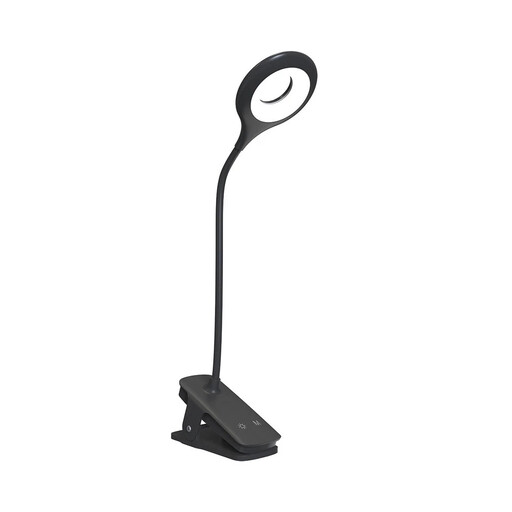
Why This Fits Their Persona: Ideal for anyone looking for flexible, eye-friendly lighting for reading in bed, at a desk, or while travelling. The clip allows for easy attachment to books or furniture.
Avoids "Battery Frustration" with a 1800 mAh battery for up to 32 hours of runtime and a modern USB-C charging port.
Five brightness levels and five colour temperatures (3000–6500 K) offer full control over the light ambiance. The memory function recalls the last setting.
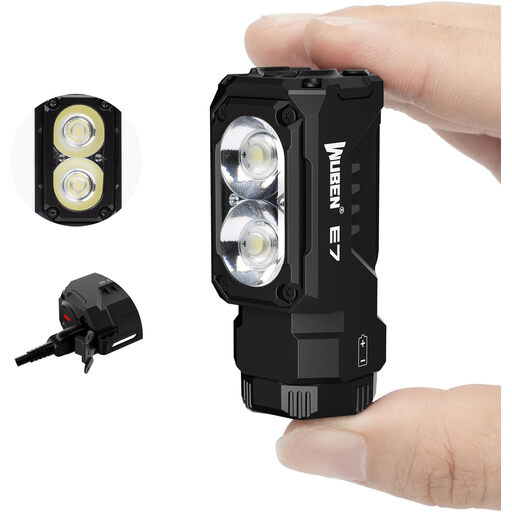
Why This Fits Their Persona: A compact yet extremely powerful lamp for demanding users. Perfect as an EDC lamp, for camping, rescue operations, or as a headlamp (with appropriate accessories).
Evades the "Lumen Trap" with a specified high output of 1800 lumens and bypasses the "false waterproofing" issue with a verified IP68 certification.
Six lighting modes for maximum flexibility and a magnetic tail cap that allows for hands-free work on metallic surfaces. Rechargeable via USB-C.

Why This Fits Their Persona: The perfect solution for anyone who wants to automatically illuminate dark cabinets, drawers, or hallways without cable clutter. The ultra-thin design is discreet.
This is a purpose-built solution that doesn't try to be everything. The PIR motion sensor ensures the 1100 mAh battery is only used when needed, maximising its runtime.
Offers three adjustable colour temperatures (warm, neutral, cool) for different environments. Installation is tool-free via adhesive strips.
We have compiled a complete, real-time updated list of products that fully meet these strict selection criteria and German safety regulations.
The StVZO (Stra?enverkehrs-Zulassungs-Ordnung) is the German Road Traffic Licensing Regulation, which defines the technical requirements for vehicle parts in Germany. A StVZO-compliant bike light has a clearly defined beam pattern that illuminates the road without dazzling oncoming traffic. This is mandatory for legal use on German roads. An example of such a product is the Prophete LED USB Battery Headlight.
A battery's lifespan is measured in charge cycles. Most modern lithium-ion batteries are designed for 300 to 500 full charge cycles before their capacity noticeably degrades. The actual runtime per charge depends heavily on the brightness setting and the battery capacity (mAh). A lamp might last over 30 hours on a low setting but possibly only 1-2 hours at maximum brightness.
For integrated lights, like many cordless table lamps or clip-on lights, the dimming function is already built-in and works smoothly via touch control or a button. If you are buying an LED bulb for an existing fixture (e.g., a ceiling light), you must ensure that both the LED bulb and your external wall switch are marked as "dimmable" and are compatible with each other to avoid flickering or buzzing.