
Lieferung heute & morgen

Qualitätsgarantie

Willkommens-Angebote freischalten: KOSTENLOSE Lieferung | Bis zu 80 % RABATT | Kostenlose 30-Tage-JoyPlus-Testphase
App herunterladen
Choosing the right lighting is crucial for a room's atmosphere. Dimmable LED recessed spotlights offer a modern and flexible solution to adjust the lighting mood as needed—from bright task lighting to a subdued evening ambience. However, the market is confusing and full of technical pitfalls that can quickly lead to bad purchases. As your Joybuy Product Recommendation Officer, I'll help you understand the essential features and make an informed decision.
Many buyers focus on design and price, overlooking technical details that can cause problems later. Here are the three most common and costly mistakes you should avoid.
LED spot for bathrooms requires a higher level of moisture protection than a spotlight in a hallway. Many overlook the IP rating (Ingress Protection). A spotlight with an IP20 rating offers no protection against water and is unsuitable and potentially dangerous for bathrooms or kitchens. An IP44 recessed spotlight is protected against splashing water, while an IP65 is even resistant to water jets.230V ceiling spots, also known as transformerless ceiling spots, can be connected directly to the mains voltage, which significantly simplifies installation.To avoid the mistakes mentioned above, you should carefully check three technical specifications. These determine the functionality, compatibility, and longevity of your new lighting.
The colour of the light has a major impact on the room's ambience. It is measured in Kelvin (K):
A recessed light with adjustable colour temperature (often called 3CCT or CCT-Switch) offers maximum flexibility. With these models, you can usually set the light colour via a small switch directly on the spotlight before installation, allowing you to adapt it to the respective room.
Space is often limited, especially during renovations in older buildings or with suspended ceilings. A low-profile recessed spotlight with a shallow installation depth (e.g., under 35 mm) is often the only solution here. Be sure to measure the available depth in your ceiling before buying. Also, pay attention to the required cut-out diameter to ensure the spotlights fit and are held securely.
As mentioned, 230V ceiling spots are the most straightforward solution. They do not require an external transformer and are connected directly to the mains supply. For dimmable models, always check the manufacturer's specifications for the recommended dimmer type (e.g., "compatible with trailing-edge dimmers") to avoid flickering. An LED recessed spotlight kit is often a practical option, as it includes several perfectly matched components.
Based on the criteria above, we have identified some products that are suitable for specific user profiles.

Why This Fits Their Persona: Ideal for renovating bathrooms, kitchens, or covered outdoor areas where high protection against moisture and dust is essential.
The IP65 rating reliably protects against water jets and avoids the pitfall of inadequately protected lights. The direct 230V connection makes a separate transformer unnecessary.
Extremely slim installation depth of only 29 mm, ideal for ceilings with limited space. Adjustable colour temperature (3000K/4000K/6500K) for flexible lighting design.

Why This Fits Their Persona: Perfect for larger projects like outfitting an entire room or hallway. The 10-pack offers great value for money without compromising on important features.
As a complete LED recessed spotlight kit with a 230V direct connection, it eliminates the search for compatible transformers and the associated extra costs. The IP44 rating is sufficient for all dry living areas and hallways.
Offers adjustable wattages (4W/6W/8W) and colour temperatures (3CCT). Dimmability allows for flexible brightness adjustment.
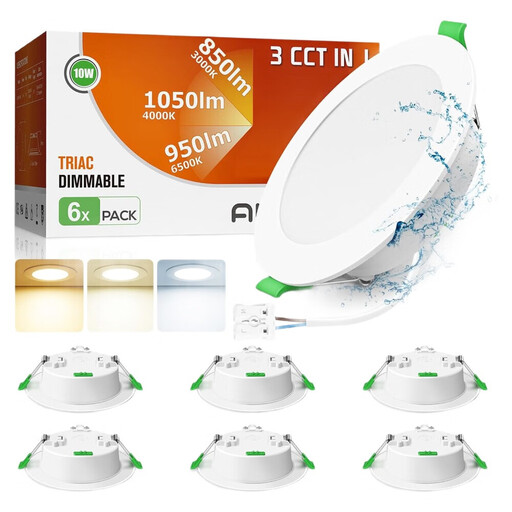
Why This Fits Their Persona: For users who need high light output for high ceilings, large rooms, or targeted accent lighting. The high brightness ensures brilliant illumination.
This model is a powerful 230V transformerless ceiling spot, which simplifies installation. The 3CCT function prevents being locked into an unsuitable light colour.
Very high luminous flux of 1050 lumens per spotlight for intense illumination. Despite the high power, the design remains relatively slim with a 34 mm installation depth.
We have compiled a complete, up-to-date list of products that fully meet these strict selection criteria and UK safety regulations.
For most dimmable LED recessed spotlights, a modern trailing-edge dimmer is recommended. However, it is essential to check the spotlight's product description, as the manufacturer usually specifies the compatible dimmer type there. Using an incompatible dimmer can lead to flickering, buzzing, or a shortened lifespan.
Yes, but only if they have the correct IP rating. The bathroom is divided into different protection zones. For areas that may be exposed to splashing water (e.g., on the wall next to the shower or bath), at least IP44 is required. For areas that may be exposed to direct water jets (e.g., inside the shower cabin), IP65 is necessary. In dry ceiling areas far from water sources, IP20 may be sufficient, but for safety, a minimum of IP44 is generally recommended for the entire bathroom.
A general rule of thumb for basic lighting in living spaces with a standard ceiling height (approx. 2.5 m) is one spot per 1.5 to 2.5 square metres. However, this depends heavily on the brightness (lumens) of the spot, the beam angle, and the desired brightness in the room. In work areas like the kitchen, you should either use spots with a higher lumen count or place them closer together to ensure adequate illumination of the work surfaces.