
Lieferung heute & morgen

Qualitätsgarantie

Willkommens-Angebote freischalten: KOSTENLOSE Lieferung | Bis zu 80 % RABATT | Kostenlose 30-Tage-JoyPlus-Testphase
App herunterladen
Dimmable light seems straightforward at first glance: measure the cut-out hole, choose a spot, and connect it. In practice, however, incorrect measurements, an unsuitable IP rating, or an incompatible dimmer can quickly lead to unnecessary costs. If you're looking to buy dimmable LED recessed spotlights, you shouldn't just focus on wattage and product images.
This guide explains which technical specifications are crucial for living rooms, bedrooms, hallways, kitchens, bathrooms, and covered outdoor areas.
The "dimmable" label simply means the brightness can be adjusted in principle. What really matters is compatibility with your existing wall dimmer. Many LED recessed spots require a leading-edge dimmer or a so-called trailing-edge dimmer.
Before buying, you should check:
An IP44 LED recessed spotlight is protected against solid objects larger than 1 mm and against splashing water. This may be sufficient for many bathroom areas, kitchens, and covered spaces, but it doesn't replace a careful check of the installation zone.
An IP65 LED recessed spotlight offers additional protection against dust and water jets. However, even this type of light cannot automatically be used in every position with direct water jets or be submerged. For bathrooms, you must consider the local installation zones and the mounting instructions.
An LED spot with 600 lumens won't fit into every existing hole. Always check the specified ceiling cut-out, the outer diameter, and the installation depth. Especially during renovations, old halogen openings can be significantly larger than the dimensions of modern slim LED recessed spotlights.
Light colour is measured in Kelvin:
A 3CCT LED recessed spotlight allows you to choose between several colour temperatures. On some models, the setting is made via a switch on the light housing. This is handy if you want to decide on the desired light colour only after installation in the room. Check whether the switching must be done before installation.
The wattage describes the power consumption, not directly the brightness. For the amount of light, the lumen value is decisive. A 7 W LED recessed spotlight with up to 600 lumens can be suitable for smaller zones or even general lighting. A 15 W LED recessed spotlight with 1200 lumens is aimed more at larger cut-outs and areas with higher light requirements.
The beam angle affects the distribution:
Many modern 230 V LED recessed spots can be connected directly to the mains and don't require a separate transformer. This reduces additional components, but doesn't make the connection any less safety-critical.
Before buying, the following details are important:
Work on a 230-volt connection should only be carried out by a suitably qualified electrician. Before installation or maintenance, the circuit must be switched off at the fuse box and the absence of voltage must be verified.
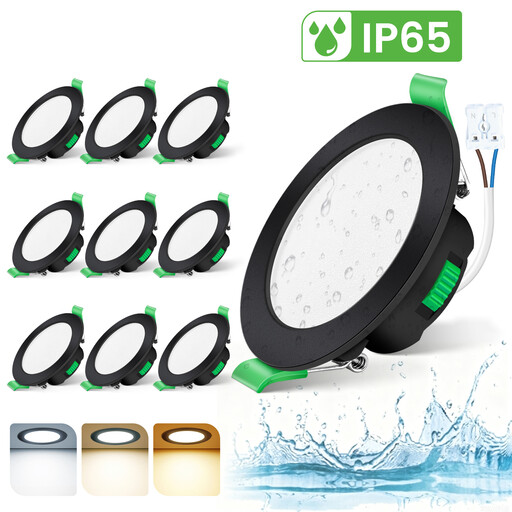
Why this product fits the profile: The 6-pack offers a consistent solution for multiple installation positions. The 67–75 mm cut-out and direct 230-volt connection are relevant for standard renovation projects.
The specifications for IP65, installation diameter, and trailing-edge dimmer compatibility make important selection criteria clear.
7 W, up to 600 lm, 3CCT with 3000/4000/6500 K, dimmable from 10 to 100 per cent, and 6 lights per pack.
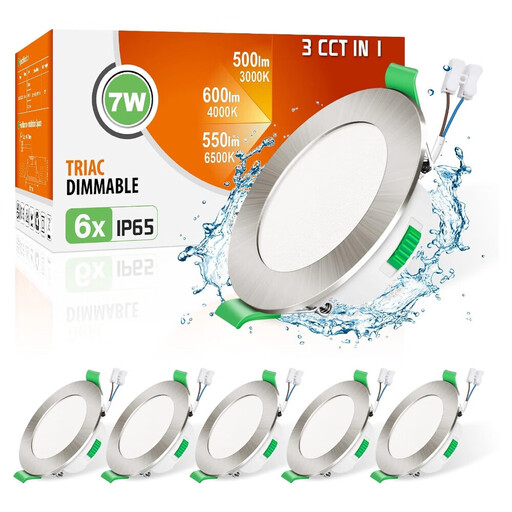
Why this product fits the profile: The combination of aluminium, polycarbonate, slim design, and brushed nickel finish suits users who care about material specifications and discreet ceiling integration.
The 29 mm installation depth and defined 67–75 mm cut-out help identify space issues with shallow ceiling constructions early on.
IP65, 3CCT, 10–100 per cent dimming range, direct AC 230-volt connection, and 3-year warranty according to product information.
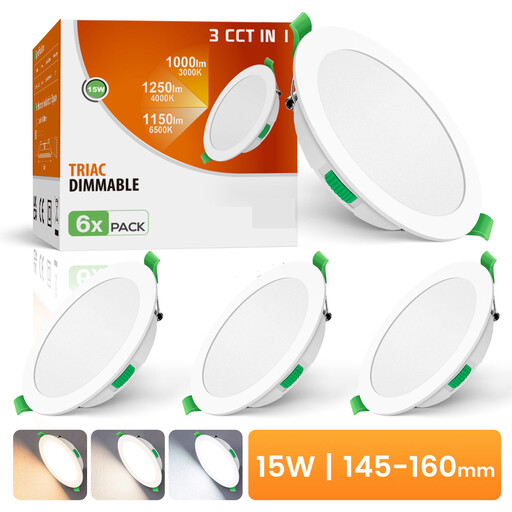
Why this product fits the profile: This set is aimed at larger ceiling cut-outs and rooms where a higher light output per fitting is needed, such as during renovations of living or working areas.
The product specifications explicitly state 145–160 mm cut-out, IP44, and phase-control dimmer compatibility. This prevents selection based on wattage alone.
15 W, 1200 lm, 120° beam angle, 3CCT with 3000/4000/6500 K, and 6 lights per pack.
For a bathroom, IP44 or IP65 LED recessed spotlights are relevant depending on the installation position. For dry indoor rooms, an LED ceiling light without a transformer with IP20 may be sufficient. Smart models like the Aigostar Smart LED Recessed Spotlight 6W work with Bluetooth Mesh, allow colour temperature selection from 2700 to 6500 K, and require a suitable hub for certain remote control functions according to product information. This model specifies a cut-out of 100–110 mm and IP20 for indoor use.
If you need several identical lights, look for a 6-pack of LED recessed spotlights. For electricians, interior fitters, and small commercial businesses, a consistent light colour, the same cut-out, and documented dimmer compatibility can simplify planning.
We've put together a complete, regularly updated list of products that fully meet these strict selection criteria and the safety regulations in force in the EU.
No. Check whether the recessed spotlight is compatible with your existing dimmer type. Leading-edge dimmers are often specified. If in doubt, have the light and dimmer checked by a qualified electrician.
3CCT means three colour temperatures are selectable, typically warm white, neutral white, and cool white. Depending on the model, switching is done via a switch on the housing or a control. Before installation, check when the colour temperature must be set.
The costs depend on the power, daily usage time, and electricity tariff. A 7 W light uses 0.07 kWh over ten hours of operation. For an accurate calculation, multiply this value by the number of lights, the days of use, and your price per kilowatt-hour. The stated wattage should therefore always be considered together with the required lumen value.