
Lieferung heute & morgen

Qualitätsgarantie

Willkommens-Angebote freischalten: KOSTENLOSE Lieferung | Bis zu 80 % RABATT | Kostenlose 30-Tage-JoyPlus-Testphase
App herunterladen
A dish drainer should hold wet dishes securely, direct water away efficiently and keep your worktop dry. In small kitchens, when camping or in commercial kitchens, every centimetre counts too. But not every model suits every sink area. Unclear dimensions, hard-to-reach draining trays and unstable designs are common reasons for choosing the wrong product.
A dish rack with compact external dimensions may still offer little room inside for plates, cups or pans. So it’s not just the length and width that matter, but also how the space is arranged. A two-tier dish rack makes better use of vertical space, but needs enough clearance between the tiers.
Before you buy, measure the free space next to your sink. Also take the tap, the distance from the wall and the space needed to empty the draining tray into account.
A tray needs to catch water reliably and be easy to remove. If it’s too shallow, water may spill over; if it’s fixed in place, cleaning becomes more awkward. So, when choosing a dish drainer with a draining tray, check whether the water is collected, channelled away through an outlet or needs to be removed by hand regularly.
A raised rim is useful too, as it can help prevent water spilling over during normal use. Empty and clean the tray after use to reduce limescale build-up and unpleasant odours.
An stainless steel dish drainer is often chosen for its corrosion-resistant surface. Even so, it’s worth checking exactly which materials are used. Some models combine stainless steel with plastic parts such as PP or ABS. These components can serve a useful purpose, for example in the draining tray or feet, but they should also be sturdy and easy to reach.
The coating matters too when it comes to painted metal racks. Scratches or damaged areas can make cleaning more difficult. For everyday use, look for a sturdy design, smooth surfaces and as few hard-to-reach gaps as possible.
Compare the footprint of the worktop dish rack with the space you have available. A measurement such as 39 × 33.5 × 10.5 cm describes the external dimensions, not necessarily the capacity. Details such as the number of plates, glasses or cutlery compartments make it easier to judge how much it can hold.
A single-tier kitchen dish drainer is often enough for a small household. If you regularly dry pans and plates at the same time, a two-tier model may be a better choice. A folding dish rack can be stored away neatly after washing up, making it a good option for campers too.
Look for a removable tray, a controlled drainage system or a raised design that directs water clearly. An integrated cutlery basket keeps knives, forks and cooking utensils from lying loose between the plates.
Removable components make cleaning easier. If the rack has plastic parts, check the product description to see whether they’re dishwasher-safe. This may apply to certain cutlery drainers, for example, but not necessarily to every part of a complete dish rack.
The rack should stand on a flat, stable surface. With two-tier models, it’s best to place heavier cookware on the lower tier. The upper tier is better suited to plates, cups and smaller items. Always follow the manufacturer’s instructions and avoid loading one side more heavily than the other.
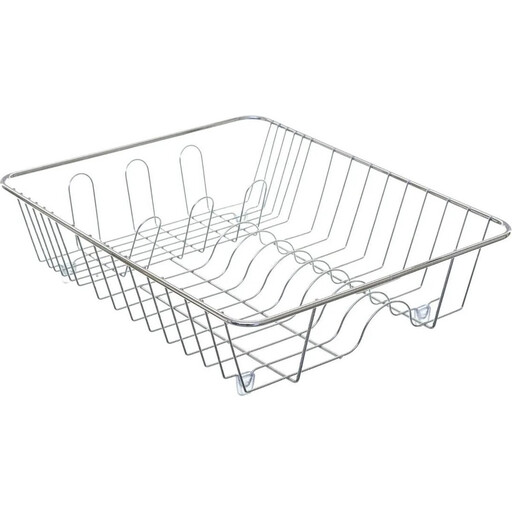
Why this product suits this profile: This single-tier model holds up to 10 plates and comes with a cutlery basket. Measuring 39 × 33.5 × 10.5 cm, it’s designed for a clearly defined space in the kitchen or camping area.
The stated external dimensions and capacity make it easier to plan where it will go before buying. The raised rim is designed to help contain run-off water.
Steel and ABS construction, a cutlery basket, space for up to 10 plates and a weight of 610 g.

Why this product suits this profile: This model combines a stainless steel rack with a PP draining tray and a rotating water diverter. It’s a good choice for households looking for well-directed drainage and easy-to-reach surfaces.
The draining tray is easy to access for cleaning, while the water diverter helps direct water where you want it to go. This makes it easier to assess how the drainage system works before buying.
Stainless steel and PP construction, a large drying area, an integrated draining tray and dimensions of 42 × 29 × 12.7 cm.
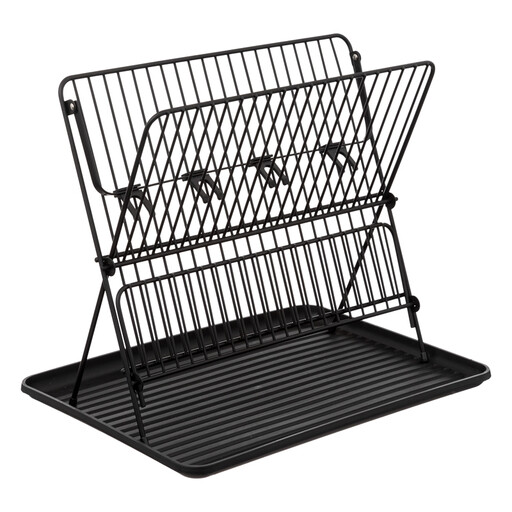
Why this product suits this profile: This two-tier dish rack makes good use of vertical space and folds flat when not in use. It’s a practical choice for small kitchens, households on the move and situations where space is at a premium.
The removable draining tray makes regular cleaning easier. The manufacturer recommends not overloading the top tier, to keep the rack balanced.
Two tiers, steel and PP construction, a removable tray and compact storage when folded flat.
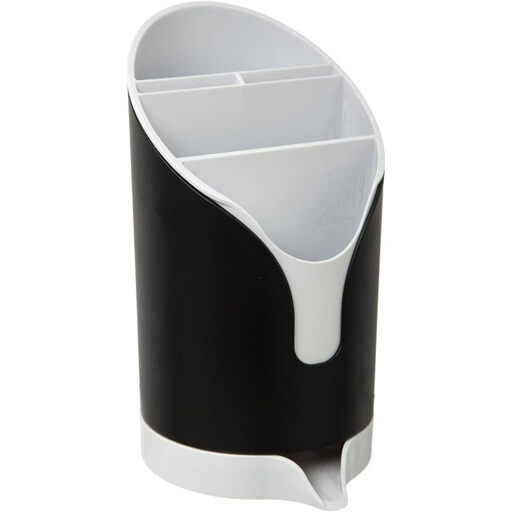
Why this product suits this profile: This separate cutlery drainer keeps kitchen utensils organised in three removable compartments. It’s a useful addition to an existing dish rack or for households that cook regularly.
The compartments are removable and the design includes a drip tray. This keeps cutlery separate and makes it easy to clean by hand.
Three removable compartments, an integrated drip tray and a design that’s stated to be dishwasher-safe.
Place your dish drainer on a flat, sturdy worktop. Stand plates in the slots provided, and position cups and glasses so that water can drain downwards. With multi-tier models, put heavy pans on the lower tier.
Empty the draining tray regularly and wipe down the rack and tray with a suitable cloth. Harsh or corrosive cleaning products can damage surfaces and plastic parts. In commercial kitchens, cafés or restaurants, you should also follow internal hygiene requirements and the recommended cleaning schedule.
We’ve put together a complete, regularly updated list of products that meet these strict selection criteria and fully comply with the safety regulations in force in the EU.
First, measure the available worktop space, allowing a little clearance from the wall and sink. You’ll also need to consider how many plates, glasses and pieces of cutlery you want to dry, as well as the size of your cookware.
Empty the tray after use and clean it regularly with a suitable cleaning product. Then leave it to dry completely. Removable trays and smooth surfaces make this easier.
Stability depends on the design, footprint and how the rack is loaded. Put heavier dishes on the lower tier, distribute the weight evenly and don’t overload the top tier. A folding model should be fully opened and placed on a flat surface.