
Lieferung heute & morgen

Qualitätsgarantie

Willkommens-Angebote freischalten: KOSTENLOSE Lieferung | Bis zu 80 % RABATT | Kostenlose 30-Tage-JoyPlus-Testphase
App herunterladen
A dish drainer should hold washed plates, cups, glasses and cutlery neatly while reliably keeping water off the worktop. In practice, however, looks and price are not the only factors behind the right choice. The key considerations are the available space, the layout and the way water is drained.
As a Joybuy Product Recommendation Officer, I assess market information against transparent criteria and explain what households in the UK should look out for when buying.
A kitchen dish rack may look compact at first glance, while the plate rack, cutlery holder or side shelves take up a considerable amount of room. So do not just check the length and width. Also consider:
A two-tier dish rack makes better use of vertical space, but it needs sufficient clearance above the lower tier. A flat dish drainer may be more suitable for kitchens with low wall cupboards.
A tray collects water, but it does not automatically solve the problem. If water remains under the dishes, limescale marks can form. With a dish drainer with drip tray, you should therefore check whether the tray can be removed and whether it has a spout, channel or rotating water diverter.
For worktop models, it is also important to know whether the water is directed towards the sink or needs to be poured away by hand regularly.
“Metal” does not automatically mean rust-resistant. A stainless steel dish drainer is generally worth considering for damp kitchen environments, but material details and care instructions should still be checked. Coated steel racks may require different cleaning methods from stainless steel constructions.
Plastic models are often lightweight and easy to wipe clean. With bamboo or wooden elements, water should not be allowed to stand for long periods. The manufacturer’s cleaning instructions and guidance on dishwasher suitability are therefore more important than general advertising claims.
Measure the free space beside or behind the sink. Take taps, windows, sockets and the room needed for loading and unloading into account. A compact, space-saving dish rack does not necessarily have to be small: a taller, two-tier model can hold more dishes while taking up a similar amount of floor space.
For single households and couples, a one-tier model with a separate cutlery holder is often sufficient. Families are more likely to benefit from wider shelves or two tiers. The stated capacity should be treated as a guide, as different plate shapes and large cups require different amounts of space.
A sturdy plate rack prevents plates from lying flat on top of one another and restricting air circulation. A separate cutlery holder is practical, particularly if knives, wooden spoons and smaller items need to dry together.
Glasses, on the other hand, need a secure shelf with sufficient spacing. Check whether tall drinking glasses, handled cups or more delicate glass shapes actually fit in the designated sections.
A dish drainer should stand securely and resist tipping wherever possible. Non-slip feet, a wide base and even weight distribution are objectively verifiable features. With a sink dish rack, the fit is an additional consideration.
An extendable dish rack should rest securely on the edges of the sink in both its smallest and largest settings. According to the Maxcook model’s product information, its length can be adjusted from 29 to 44 cm. Before loading it, check that the construction is fully supported and cannot slide into the sink.
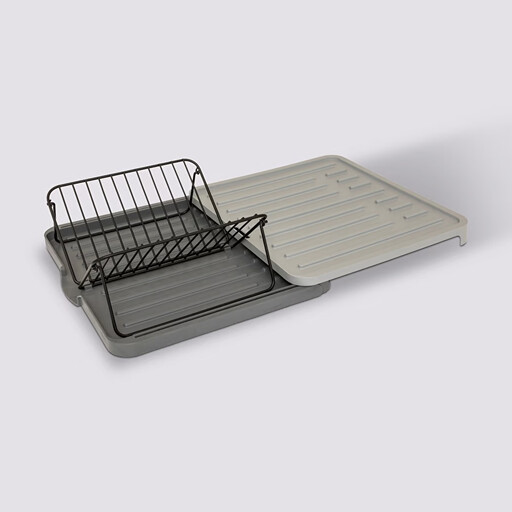
Why this product suits this profile: The one-tier rack is suitable for households that want to dry plates, glasses and cutlery neatly in one organised area.
The stated dimensions of 58.2 × 36.2 × 10.3 cm make it easier to plan the available space. The separate polypropylene tray collects draining water.
Steel rack, polypropylene tray and a stated capacity for six glasses and up to twelve items.

Why this product suits this profile: This model is designed for users who prefer a sturdy stainless steel solution with separate water drainage.
The design combines a stainless steel rack with a PP tray and a rotating water diverter. This allows the drainage to be directed more precisely towards the sink.
Dimensions of 42 × 29 × 12.7 cm, integrated storage sections and, according to the product description, a moisture- and rust-resistant stainless steel construction.
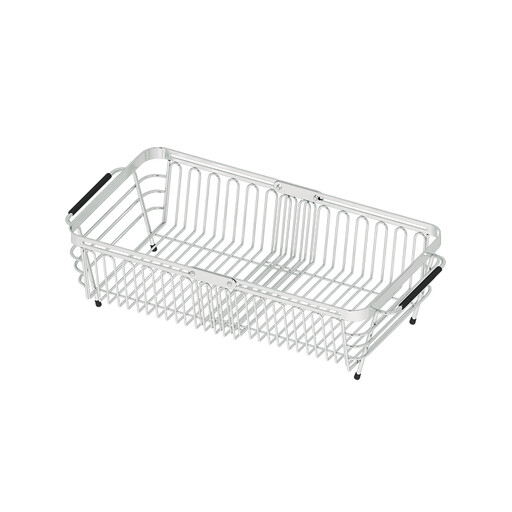
Why this product suits this profile: The extendable dish rack is designed for kitchens with limited worktop space and for users who want to drain water directly into the sink.
Unlike a small collection tray, the water is directed into the sink. Before buying, the adjustment range of 29 to 44 cm should be checked against the width of your sink.
304 stainless steel according to the product information, an extendable frame and use as a dish rack for the sink or as a colander for fruit and vegetables.
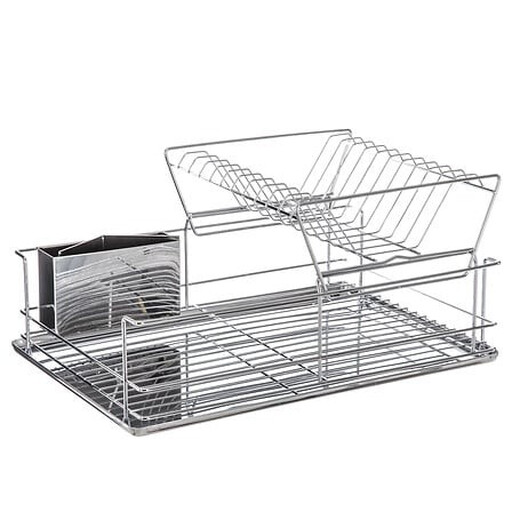
Why this product suits this profile: Two tiers create extra drying space without taking up the entire width of the worktop.
The specific design, measuring 47 × 32.3 × 22.5 cm, makes it easy to assess the space required. The stated layout is intended for plates and cups.
Corrosion-resistant steel and stainless steel according to the product information; stated capacity for up to ten plates and twelve cups.
We have put together a complete, regularly updated list of products that fully meet these strict selection criteria and the safety regulations applicable in the EU.
Empty the drip tray regularly and remove limescale with a mild cleaning product. A soft cloth is usually sufficient for stainless steel; abrasive products can alter the surface. Plastic parts should be cleaned in accordance with the manufacturer’s instructions. Bamboo and wooden elements must not be left standing in water for long periods.
Place the dish drainer on a level surface and position heavy pans as low down as possible. With a hanging or sink model, all support points must be secure. A stated guarantee or your statutory consumer rights do not replace checking the product’s actual load-bearing capacity in everyday use.
Measure the available space and allow extra room for movement at the sides. A compact one-tier model is often sufficient for a single-person household. Families should consider the number of plates, cups, glasses and cookware separately. A two-tier dish rack makes sense if there is enough vertical clearance.
Both materials offer practical benefits. Stainless steel or rust-resistant steel is sturdy and designed for damp environments, while plastic is generally lighter and easier to clean. The deciding factors are the specific material information, the workmanship and the care instructions for the product in question.
Water should not be left standing in the tray for long periods. Empty and dry the drip tray regularly, clean the channels and spouts, and allow the rack to dry sufficiently between washing-up sessions. Models that drain water into the sink can reduce the need for manual emptying.