
Lieferung heute & morgen

Qualitätsgarantie

Willkommens-Angebote freischalten: KOSTENLOSE Lieferung | Bis zu 80 % RABATT | Kostenlose 30-Tage-JoyPlus-Testphase
App herunterladen
A dish drying rack is an essential part of the sink area in many households. It holds plates, cups, cutlery and kitchen utensils while allowing water to drain away in a controlled manner. However, not every model is suitable for every countertop. Inadequate dimensions, a poorly designed drip tray or unstable tiers can make a rack take up more space in everyday use than expected.
This buying guide from the Joybuy Product Recommendation Officer explains which criteria matter when purchasing a dish rack with a drip tray and which designs suit different usage scenarios.
A dish rack can hold plenty of plates and still be unsuitable for a small kitchen. What matters are the actual external dimensions, including the drip tray, cutlery holder and side extensions. With a 2-tier dish rack, height is another important consideration. Before buying, measure the available space beside the sink.
Water needs to be directed into the sink or a suitable collection area. A shallow tray without a gradient may retain residual water. Models with a drainage outlet, spout or swivelling drain attachment are therefore particularly practical. The tray should also be easy to clean without complicated disassembly.
The term “metal” says little about the specific construction. With a stainless steel dish drying rack, the material specifications, coating and care instructions are all relevant. Coated steel components may require different cleaning methods from stainless steel. Plastic parts such as drip trays should also be taken into account, as they need to be emptied and cleaned regularly.
For a dish rack for the countertop, three dimensions are particularly important:
A space-saving dish rack makes use of vertical space instead of extending across the entire countertop. This is especially useful in one- or two-person households with a compact kitchen layout.
An integrated drip tray should be removable or easy to access. For a model with a drainage outlet, check whether the outlet actually aligns with the position of the sink. A short drainage path reduces the risk of water pooling on the countertop.
For many models, a damp cloth and mild cleaning product are sufficient for routine care. Always follow the manufacturer’s instructions. The rack should be allowed to dry completely after cleaning, particularly around joints and underneath the drip tray.
Plates should be placed in the slots designed for them whenever possible. Cups and glasses belong in dedicated holders, if available. With a 2-tier model, it is sensible to place heavier items on the lower level and lighter items above. A stated capacity does not necessarily apply to every possible combination of crockery and kitchen utensils.
Anyone intending to use the rack in a restaurant or commercial kitchen should also consider the requirements of their own operation, cleaning routine and available countertop space.
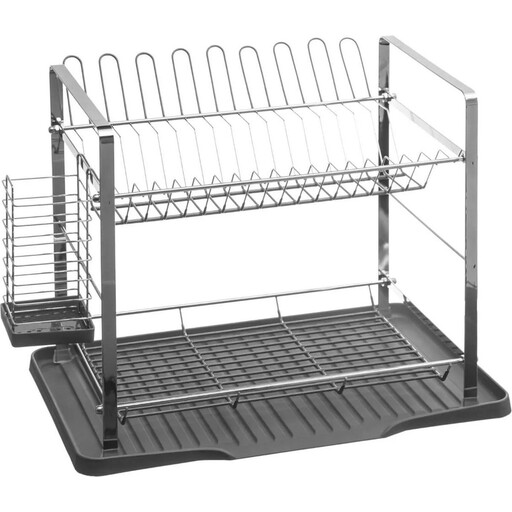
Why does it suit this profile? This model offers two tiers and a stated capacity of up to 17 plates. It is suitable for households that want to dry crockery beside the sink on a regular basis.
The dimensions of 50 × 30.5 × 34 cm make the required footprint clear before purchase. A removable cutlery cassette and drip tray are included according to the product specifications.
2 tiers, anti-slip base, removable cutlery cassette and stated capacity for up to 17 plates.
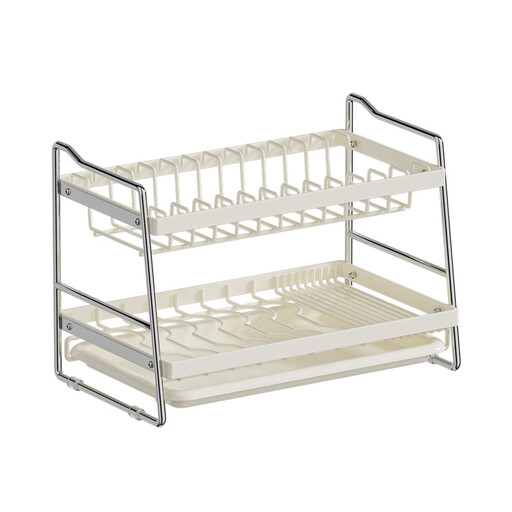
Why does it suit this profile? The 2-tier dish rack makes use of vertical space and measures approximately 40 × 23.6 × 28.7 cm. This makes it a potential solution for compact kitchens with limited depth.
The compact base is complemented by a second tier. According to the product description, the integrated drip surfaces direct water towards the sink or a collection area.
2 tiers, integrated drip trays, freestanding design and assembly of the individual parts required.

Why does it suit this profile? This single-tier stainless steel dish drying rack is designed for crockery, cups and cutlery on the countertop, measuring approximately 42 × 29 × 12.7 cm.
The materials and drainage system are clearly specified: a stainless steel rack, PP drip tray and swivelling drain attachment. This makes it possible to assess care requirements and drainage direction in advance.
Stainless steel, PP drip tray, integrated slots, freestanding design and no assembly required.
A kitchen sponge holder prevents washing-up sponges from sitting directly on a damp countertop. The MyGift Double Sponge Holder has two compartments, non-slip foot pads and a stated size of approximately 5.4 × 4.5 × 2 inches. Tea enthusiasts may also appreciate a separate cup stand such as the “The Floral Collection Rack” for cups and saucers. When choosing one, however, check that its dimensions fit the available niche.
For commercial sinks, stainless steel strainer grids with a diameter of 7 cm may also be useful. They do not replace a dish drying rack, but can serve as supplementary sink accessories.
Explore the full selection of dish organisers and sink accessories in a range of dimensions, materials and configurations.
The ideal size depends on the number of items washed and dried each day, as well as the available countertop space. Before buying, compare the length, width and height of the fully assembled model with the space beside the sink.
Stainless steel is widely used for its easy-care surface. Even so, water residue should be removed regularly and the manufacturer’s care instructions followed. The specific grade of material and any plastic components are detailed in the relevant product description.
The drip tray should be emptied and cleaned regularly. Water should not be allowed to remain underneath the rack or in its slots. After cleaning, allow the dish drying rack to dry completely before using it again.