
Lieferung heute & morgen

Qualitätsgarantie

Willkommens-Angebote freischalten: KOSTENLOSE Lieferung | Bis zu 80 % RABATT | Kostenlose 30-Tage-JoyPlus-Testphase
App herunterladen
A dish drying rack should hold plates, cups and cutlery neatly after washing up while protecting the worktop from water. In practice, however, some models disappoint not because of their design, but because they have insufficient capacity, an ill-fitting drip tray or unstable feet.
That is why it is worth checking the actual dimensions, material combination and water drainage before buying. This makes it easier to choose a dish drying rack that suits both your kitchen and your daily washing-up needs.
A compact kitchen dish rack may take up little space on the worktop but still be too small for your household. What matters is not just the footprint, but also:
A 2-tier dish rack makes better use of vertical space. It is particularly suitable for households that wash up regularly, but it needs sufficient clearance above the worktop.
With a dish rack with drip tray, the tray should either collect all the water or drain it in a controlled direction. Flat plastic trays can overflow more quickly when dealing with large amounts of water. Removable trays that are easy to wipe clean are especially practical.
Some models feature a drainage system or a swivelling spout. Before positioning the rack, check that the spout actually points towards the sink and that the worktop is deep enough for it.
“Metal” can mean coated steel or stainless steel, depending on the design. The following points are relevant in a damp environment:
Measure the available space beside or behind the sink. Take taps, wall clearance and the opening of cupboard doors into account. A model measuring 42 × 29 × 12.7 cm may be more suitable for a smaller worktop than a taller rack with a considerably greater depth.
With taller models, you should also check the clearance beneath wall cupboards. The stated external dimensions should not be confused with the actual usable space.
A draining basket for plates and cutlery should keep plates safely separated. With a 2-tier design, it is also important that the levels are securely connected and that the centre of gravity is not positioned too high.
Manufacturer claims such as “up to 17 plates” refer to a particular arrangement and do not replace an individual assessment. Large plates, frying pans or bowls may reduce the usable capacity.
A dish drying rack should be emptied and dried regularly. Look for:
For some of the following products, the supplied product data explicitly states that they are not dishwasher-safe. In these cases, they are intended to be cleaned by hand with a damp cloth and mild cleaning product.
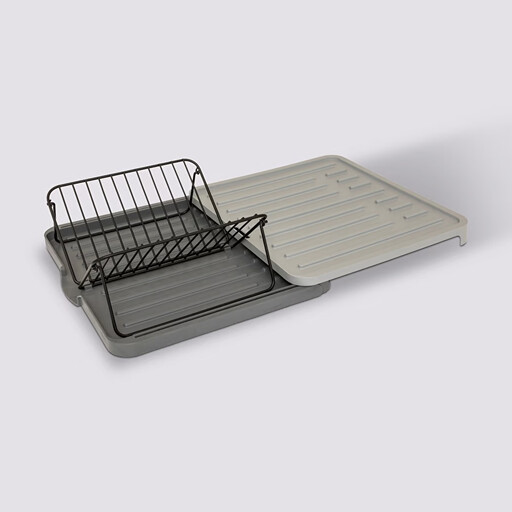
Why this product suits this profile: The low-profile design is ideal for households looking for a simple place to leave dishes from the daily washing-up and with enough space beside the sink.
The drip tray is listed as a separate component. This means water can be collected and the area beneath the rack can be cleaned more easily.
Steel rack, polypropylene tray, dimensions of 58.2 × 36.2 × 10.3 cm and stated capacity for six glasses.
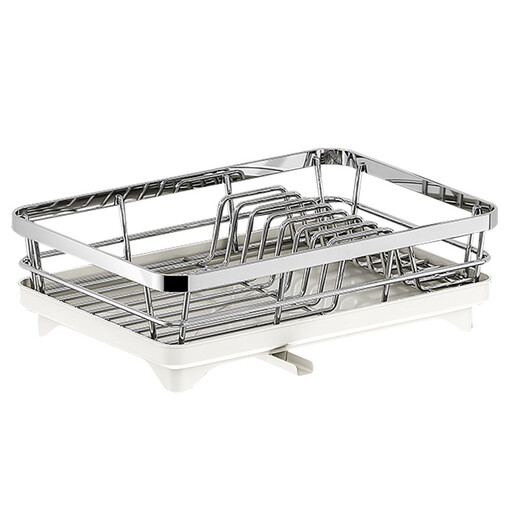
Why this product suits this profile: The combination of a stainless steel rack and PP drip tray is aimed at users who value clearly specified materials and easy cleaning.
The product description mentions a drainage system with a swivelling spout. This supports more controlled water drainage, provided the rack is positioned correctly in relation to the sink.
Stainless steel rack, PP tray, integrated design requiring no assembly and dimensions of 42 × 29 × 12.7 cm.
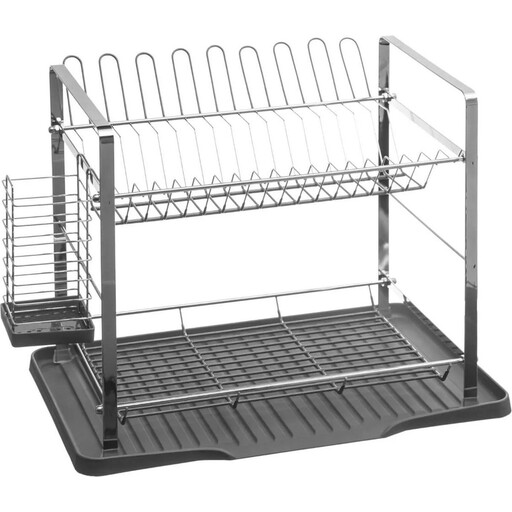
Why this product suits this profile: The 2-tier construction provides vertical storage for households with lots of dishes or limited free worktop space.
The product data states that it holds up to 17 plates and includes a removable cutlery basket, a drip tray and a non-slip base.
Two tiers, dimensions of 50 × 30.5 × 34 cm, steel with PVC-coated fabric and assembly without specialist tools.
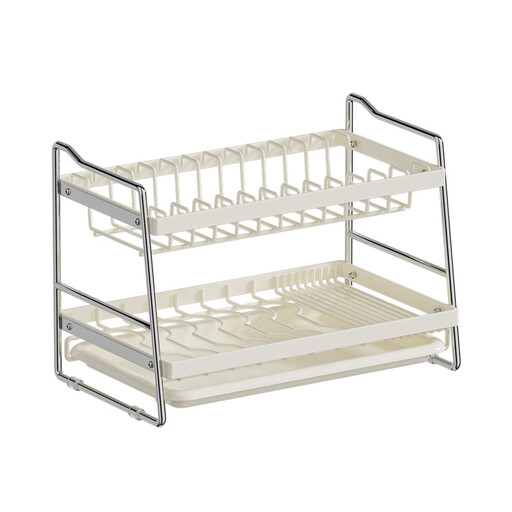
Why this product suits this profile: The stated footprint of 40 × 23.6 cm is well suited to worktops with limited depth where you want to create as much storage space as possible upwards.
The description mentions integrated drip trays and drainage towards the sink or a collection container. Before buying, check that the drainage direction is suitable for your own sink.
Two tiers, dimensions of approximately 40 × 23.6 × 28.7 cm, freestanding design and dedicated space for dishes, cups and kitchen utensils.
We have put together a complete, regularly updated list of products that fully meet these strict selection criteria and the safety regulations applicable in the EU.
Empty the drip tray regularly and wipe away any water left on the rack and worktop. Depending on the material, limescale deposits can be removed with a suitable mild cleaner. Coated surfaces should not be treated with abrasive sponges.
You should also check the feet, joints and coating from time to time. If there is visible damage, moisture can reach metal surfaces more easily. Most of the models in this selection are intended to be cleaned by hand; the information on the relevant product page takes precedence.
That depends on how much washing up you do each day and how much worktop space is available. A single-tier model is sufficient for a few plates and cups. For larger households or more washing up, a 2-tier dish rack can make more efficient use of the available footprint. Before buying, measure the length, depth and height of the intended space.
Stainless steel is not automatically permanently rustproof under all conditions. The specific material grade and workmanship are crucial. Water should not be allowed to stand for long periods; regular drying and gentle cleaning help care for the surface.
Choose a rack with a suitable drip tray or controllable drainage system. The tray must sit completely beneath the rack and must not extend beyond the edge of the worktop. If there is a spout, its position should align with the sink. Any standing water should be removed after washing up.