
Lieferung heute & morgen

Qualitätsgarantie
App herunterladen
Kategorien
Choosing a dishwasher involves analysing technical specifications and matching them to your household's specific needs. Key parameters include the appliance type, dimensions, energy and water efficiency, and special features. This guide provides a framework for selecting the right appliance by explaining objective criteria and their practical implications.
Your choice of model should be based on an objective assessment of key factors. The following technical aspects are fundamental to your selection.
The appliance's integration into your kitchen is determined by its type.
The standard widths for dishwashers are 60 cm and 45 cm.
Since 1 March 2021, the new EU energy label has been in effect, with a scale from A (very efficient) to G (less efficient). An energy-efficient dishwasher reduces running costs. Relevant values on the label are:
An appliance with a high energy efficiency class (e.g., B or C) can lead to significant savings over its lifespan compared to a class F appliance.
For open-plan kitchens or for running the appliance at night, a quiet dishwasher is a major advantage. The noise level is specified in decibels (dB(A)).
Modern dishwashers offer a range of features that enhance user convenience.
Based on an analysis of technical specifications and practical benefits, we present three models with different strengths.
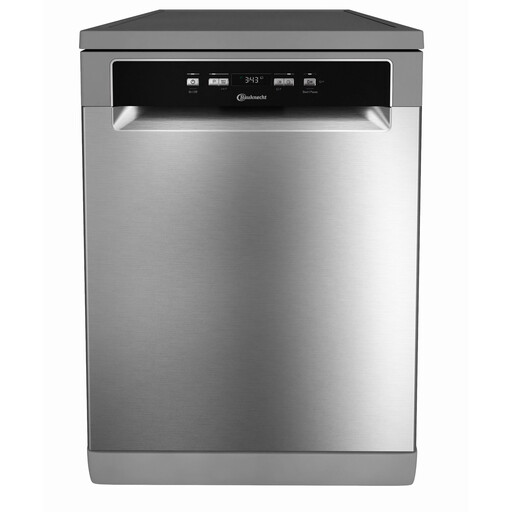
Why we recommend this product: This 60 cm freestanding appliance combines a large capacity of 14 place settings with a B energy efficiency rating. The ActiveDry system, which automatically opens the door at the end of the programme, promotes thorough drying. The MultiZone function allows for washing just one basket, saving resources on smaller loads.
Pros:
Best for: Families and multi-person households looking for a spacious, energy-efficient, and quiet freestanding dishwasher with flexible loading options.
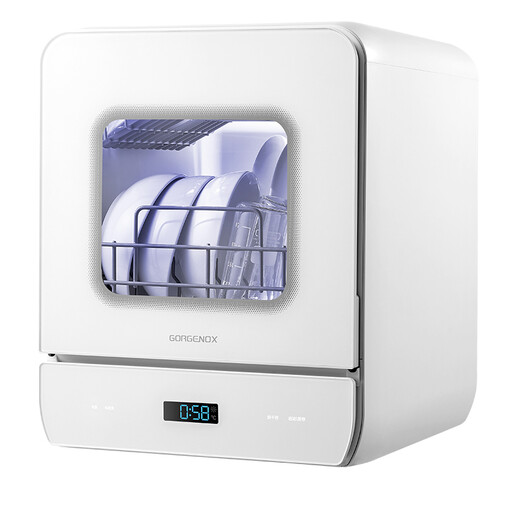
Why we recommend this product: The GORGENOX DW5-D40A is a countertop dishwasher that impresses with its flexibility. It can be operated either via an integrated 5-litre water tank or a fixed water connection. An integrated water softening system prevents limescale deposits, which is a technical advantage in regions with hard water. The 4-in-1 function (wash, disinfect, dry, store) with UV light and hot air drying offers a high standard of hygiene.
Pros:
Best for: Singles, couples in small flats, renters without installation options, camper van owners, or households needing a flexible and hygienic solution for small amounts of dishes.
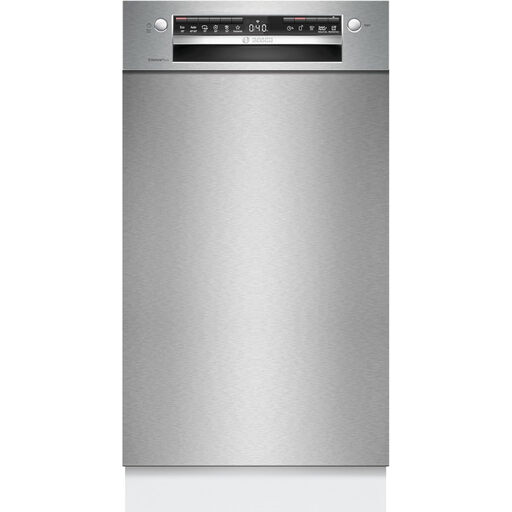
Why we recommend this product: This 45 cm wide built-under unit from Bosch is designed for modern, connected households with limited space. Control via the Home Connect app allows for remote start and activation of additional functions like "Extra Dry". At 44 dB(A), it operates very quietly. The Vario basket system and the VarioDrawer (a type of cutlery tray) offer high flexibility for loading.
Pros:
Best for: Households with smaller kitchens that value smart features, quiet operation, and a flexible interior layout in a slimline built-in appliance.
For situations where a permanent installation is not possible or desired, appliances with an integrated water tank are a practical alternative. These models offer maximum flexibility and are ready to use immediately. You can find a selection of such appliances in the countertop dishwashers without water connection category.
1. What is the difference between a cutlery tray and a cutlery basket? A cutlery tray is a third, flat loading level in the upper part of the dishwasher. Cutlery items lie individually, which often results in a more thorough clean. A cutlery basket stands in the lower basket, taking up space there, but is flexibly removable. The choice is a matter of personal preference and loading habits.
2. How noticeable is the difference between 44 dB and 47 dB? The decibel scale is logarithmic. A reduction of 3 dB is perceived by the human ear as roughly halving the loudness. Therefore, an appliance with 44 dB is noticeably quieter than one with 47 dB. In a quiet living environment, this difference can be significant.
3. Is it worth buying a dishwasher with a high energy efficiency class? Yes, investing in an appliance with a better energy efficiency class (e.g., B instead of E) generally leads to lower electricity and water costs over the appliance's entire lifespan. The difference in energy consumption per 100 cycles, as stated on the EU label, allows for a direct cost estimation.