People living alone with little washing-up
If you only have a few other items alongside your cutlery, a suitable load size and a space-saving design are key. For example, Midea Germany lists a countertop model with three place settings.


For one person, the right dishwasher mainly depends on how much cutlery and other crockery you accumulate before the next wash, and on the space and water connection available. A small countertop model may suit smaller loads, a tank-fed model could work if there’s no fixed water supply, and a 45 cm model offers room for more crockery. You can’t assume that a single-person household will use less energy or water per piece of cutlery: the German Environment Agency describes a consumption benefit over washing by hand when a machine is fully loaded and run on the Eco programme.
If you only have a few other items alongside your cutlery, a suitable load size and a space-saving design are key. For example, Midea Germany lists a countertop model with three place settings.
If there’s no usable fixed water supply where you plan to put the appliance, check both how it’s filled and how it drains. Midea Germany lists a 5-litre water tank for the MDWMT201DW model.
If you often have plates, cups and other crockery as well as cutlery, the interior layout and load capacity matter more than choosing the smallest possible design. Bomann lists six place settings for the TSG 7405, while Bosch says the SPS6EMI21E has a Vario drawer.
Suitable if: You don’t accumulate much crockery and there’s space for the appliance, water inlet and drain.
Things to consider: A small capacity may mean extra wash cycles or hand-washing larger items; it doesn’t necessarily use less per piece of cutlery.
Suitable if: There’s no usable fixed water supply where you plan to put it. Midea lists a 5-litre tank for the MDWMT201DW.
Things to consider: You’ll need to be able to fill the tank and drain the water safely where the appliance is placed; a tank doesn’t remove the need to check the drainage route.
Suitable if: You have cutlery and other crockery to wash together, and can load the appliance efficiently on a regular basis. Bomann lists six place settings and a cutlery basket for the TSG 7405.
Things to consider: It needs more worktop space and, according to the manufacturer, a water inlet and drain hose.
Suitable if: You regularly have more crockery to wash and have room for a connected freestanding model. According to Bosch, the SPS6EMI21E is 45 cm wide and has a Vario drawer.
Things to consider: It needs more vertical space than a countertop model. Eco consumption figures apply to the specific model and programme.
| Priority | What to check when buying | Who is it important for? |
|---|---|---|
| Suitable load size | Compare the place settings and interior space with the amount of cutlery and crockery you actually accumulate between washes. | If I only accumulate cutlery and a few other items, I want to plan a suitable load without taking up too much space. Around 37% of consumers prioritise load size. |
| Positioning and water connections | Check the appliance dimensions, the water supply it needs and the drainage route at the intended location. | If there’s no usable fixed water supply where I plan to put it, filling and draining need to be practical there. Around 27% of consumers prioritise the water connection. |
| Loading cutlery | Check whether the specific model has a cutlery basket, rack or drawer, and whether it suits your cutlery. | If loading and unloading cutlery matters to me, I compare the cutlery storage in each model’s interior. Around 18% of consumers prioritise how cutlery is handled. |
| Running costs | Compare kWh per 100 Eco cycles and litres per Eco cycle on a like-for-like basis; calculate costs using your expected number of wash cycles and your own tariffs. | If I want to plan my running costs, I need comparable Eco figures rather than assumptions based on household size. Around 18% of consumers prioritise running costs. |
The savings over washing by hand described by the German Environment Agency apply to a fully loaded machine on the Eco programme, not automatically to small or partly filled loads.
Plan around the amount of cutlery and crockery you actually accumulate between washes, and compare suitable appliance sizes.
A model with too little capacity may mean extra wash cycles; how often depends on how you actually use it.
The water still needs a suitable drainage route, and you’ll need to be able to fill the tank where you plan to put the appliance.
Before buying, check the instructions for the positioning and drainage requirements at your intended location.
Cutlery storage varies by model and affects how you load and unload your cutlery.
Check the interior images and what’s included with the exact model variant.
The models listed show different countertop designs for smaller loads and different water supply options.
The TSG 7405 featured here is a countertop model for loads that include more than just cutlery.
The SPS6EMI21E featured here is a freestanding, 45 cm-wide model for larger combined loads of crockery and cutlery.
Siemens offers compact, freestanding and integrated models. If you already have a kitchen housing unit, this may influence the type of appliance you choose.
The following Joybuy products include compact countertop dishwashers, including models with a water tank and one with a water connection. Check the capacity, connection type and interior of each model.
 No image available
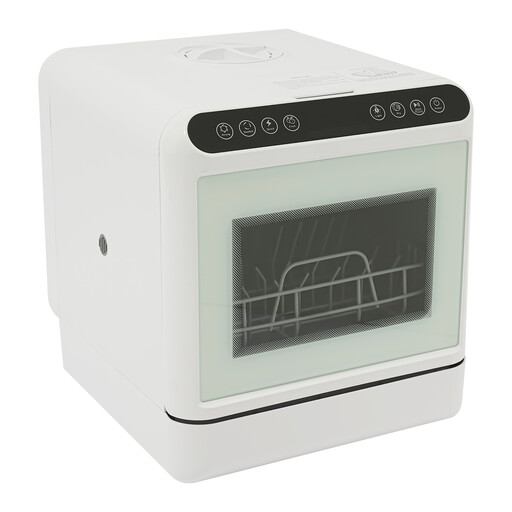
This compact countertop model could suit smaller loads of cutlery; check that the interior layout works for your crockery.
The product name lists three place settings, seven programmes and a display. It also says the appliance can be used with or without a water connection; check the relevant operating mode and drainage requirements before installation.
 No image available
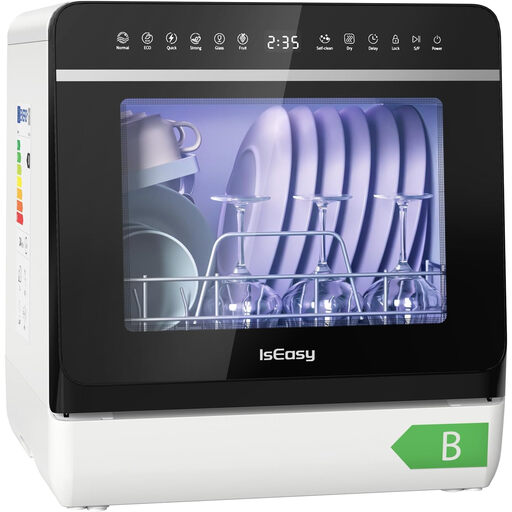
A countertop model with an integrated tank could suit a space without a usable fixed water supply; check how the water can be drained there too.
The product name lists a 1.32-gallon tank, hot-air drying and a 72-hour storage function. It describes the appliance as suitable for 4–6 people; compare this with the space you have and the loads you typically wash.
 No image available
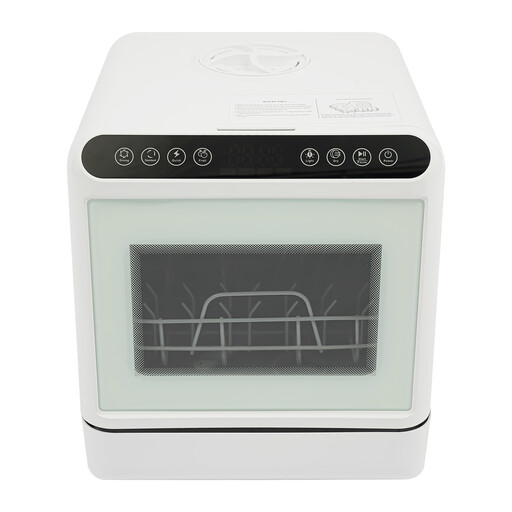
The product name highlights the tank and use without a fixed water connection. Before choosing it, check whether you can fill and drain it where you plan to put it.
The stated tank capacity is 5 litres. Check that the interior layout suits your cutlery and the crockery you plan to wash together.
 No image available
The integrated tank is useful for spaces where a fixed water supply isn’t available; you’ll still need to check the drainage separately.
The product name lists a 6-litre tank and touch controls. According to the product information, it needs an earthed EU socket with 220–240 V and 50 Hz.
 No image available
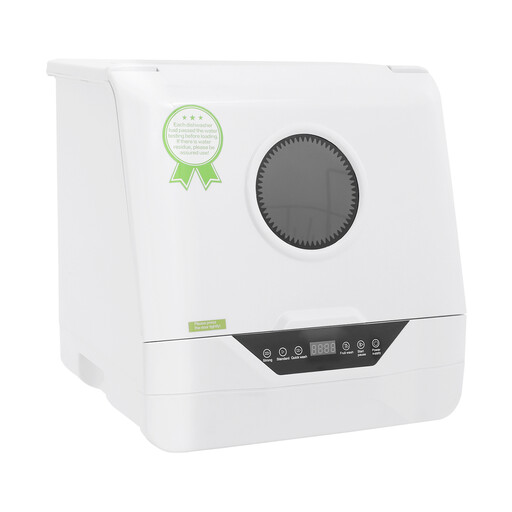
Designed as a small countertop model for a space with a water connection; check whether you can arrange the required connections there.
The product name lists 220 V, 800 W, four wash modes and a self-cleaning function. Compare these specifications with the requirements of your chosen location.
No. The glass-and-fork symbol indicates that an item is suitable for contact with food; it doesn’t automatically mean it’s dishwasher-safe. Check the cutlery manufacturer’s care instructions. This advice applies to cutlery that is specifically marked as dishwasher-safe.
The German Environment Agency advises against pre-rinsing, particularly with warm water, and recommends using the Eco programme with a full load. Load the cutlery so that other items don’t prevent it from being cleaned, and follow the appliance instructions.
The EU energy label lists energy consumption per 100 Eco cycles and water consumption per Eco cycle. To estimate your own costs, you’ll also need to know how many wash cycles you expect to run and your electricity and water tariffs.
Compare the label or product information sheet for the specific model. The European Commission says the label includes details such as the energy efficiency class and energy consumption per 100 cycles; check any other information for the exact model variant.
According to EU consumer information, purchases from a business seller are covered by a legal guarantee of at least two years from the date you receive the goods. This applies against the seller and is separate from any voluntary manufacturer’s guarantee.