Households preparing several portions in advance
If you want to wash boxes, lids and other dishes together, look at the usable basket space and whether you can fill a load in a way that suits your daily routine.


If you want to wash cookware as well as several lunchboxes, and can fill the machine regularly, start by looking at a suitable 60 cm model. A 45 cm model may fit a narrow built-in space, while a countertop dishwasher is an option if you don’t have room for a freestanding appliance. What matters most is whether the baskets can accommodate your boxes and lids, the care instructions for each item, and the Eco programme’s energy and water use and drying method. Place settings don’t tell you how many of your containers will fit or how dry they’ll be when they come out.
If you want to wash boxes, lids and other dishes together, look at the usable basket space and whether you can fill a load in a way that suits your daily routine.
You want to wash your containers in the machine, but only have a narrow built-in space. The dimensions of the space and the basket layout will help narrow down your options.
If there’s no room for a freestanding or built-in appliance, check whether a countertop model can fit your boxes and whether you can position and connect it suitably.
A good fit if: You can wash boxes alongside other dishes and fill the machine regularly.
The trade-off: It needs more kitchen width. A freestanding and a built-in model also have different installation requirements.
A good fit if: You have a suitable narrow built-in space and want to machine-wash boxes with other dishes.
The trade-off: Check whether several bulky containers will fit in the available basket layout.
A good fit if: There’s no room for a freestanding or built-in model and your usual load will fit in a countertop dishwasher.
The trade-off: Its smaller capacity may mean running extra cycles to wash several portions.
The German Environment Agency recommends using the Eco programme and running full loads. So compare consumption figures on the same Eco basis, taking into account the load you can actually fit in the machine.
| What matters when buying | What to check | Who it matters to |
|---|---|---|
| Loading several containers together | Measure your boxes and lids; check the basket layout and adjustable upper basket on the specific model. | If I want to wash several portions along with cookware, what matters to me is whether the boxes and lids will fit in the baskets together. For around 31% of consumers, fitting a large load in at once is the top priority. |
| Finding space for the appliance and connections | Check the available recess or floor space, door clearance and connections against the documentation for the specific model. | When space is limited, I first need to find out which type will actually fit in my kitchen. For around 25% of consumers, space for installation or placement is the top priority. |
| Washing and drying container parts | Read the care instructions for the box, lid and seal separately; check the programmes and drying method. | If I want to reuse dishwasher-safe plastic containers soon afterwards, the care instructions and drying results are what matter most to me. Around 25% of consumers put this first. |
| Consumption when running regular cycles | Compare kWh per 100 Eco cycles, litres per Eco cycle, Eco programme duration and capacity together. | If I regularly run full loads, I want to assess consumption figures on a comparable Eco basis. Around 19% of consumers prioritise running costs. |
The Verbraucherzentrale NRW explains that the Eco figures on the energy label are comparison values for standardised cycles. They don’t automatically show the consumption of every other programme.
The capacity shown on the EU energy label is based on a standardised measure. Whether your boxes and lids will fit together depends on their shape and the basket layout.
Measure your containers and compare their shape with the interior layout of the specific appliance.
If bulky boxes or lids won’t fit together, you may need to run extra cycles.
The glass-and-fork symbol indicates that an item is suitable for food contact; it doesn’t mean it can be washed in a dishwasher.
Check the care instructions for the box, lid and seals separately instead of relying solely on the symbol or an advertised hygiene setting.
The German Environment Agency’s recommendation for efficient dishwashing is based on full loads and the Eco programme. If a smaller load needs to be run more often, you should also take the number of cycles required into account when comparing models.
Compare consumption figures on the same Eco basis and with the kind of load you usually wash.
Extra cycles can affect the resources used; the extent depends on how you actually use the appliance.
AEG points out that with AirDry, the door can open during the drying phase, before the programme has fully finished.
Check the remaining-time display and the instruction manual before unloading dishes or containers.
The freestanding 60 cm SMS4EVW08E is an example of a larger appliance with an adjustable basket system.
The fully integrated 60 cm DIN28O35 is an example of a built-in option with an adjustable upper basket.
The fully integrated 45 cm SR65ZX22ME is an example of a slimline option for a narrow built-in space, with a flexible basket system.
The fully integrated 45 cm FSE32407Z is an example of a slimline built-in option with an adjustable upper basket.
The countertop MDWTT0602MW-WE is an example of an alternative when you don’t have a space for a full-size appliance.
This selection includes fully integrated built-in models, a freestanding dishwasher and a countertop appliance to suit different spaces and load sizes. Before choosing, check the dimensions of your recess or available space and whether your boxes will fit in the baskets.
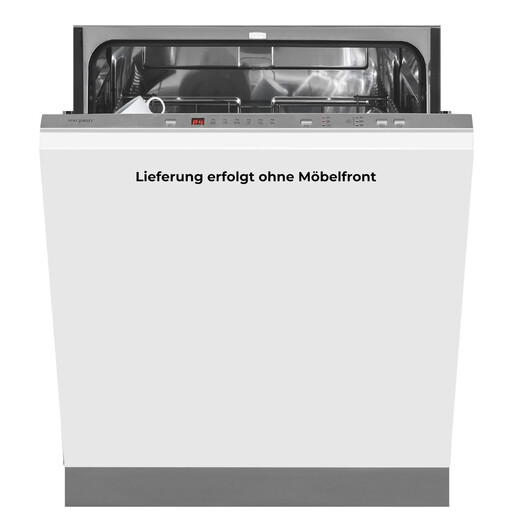 No image available
The stated capacity and height-adjustable basket are worth considering if you wash different types of items together.
The product name lists 12 place settings, six programmes, 49 dB and energy class E.
As a fully integrated appliance, it needs a suitable built-in space.
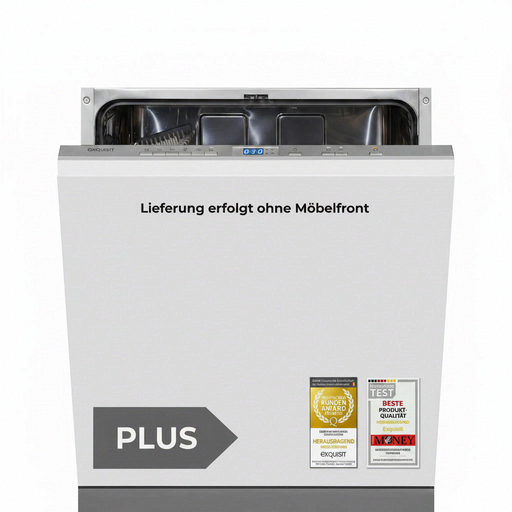 No image available
The stated capacity and height-adjustable upper basket may be useful when washing dishes together.
The product name lists 13 place settings, six programmes and an Eco mode.
As a fully integrated appliance, it needs a suitable built-in space.
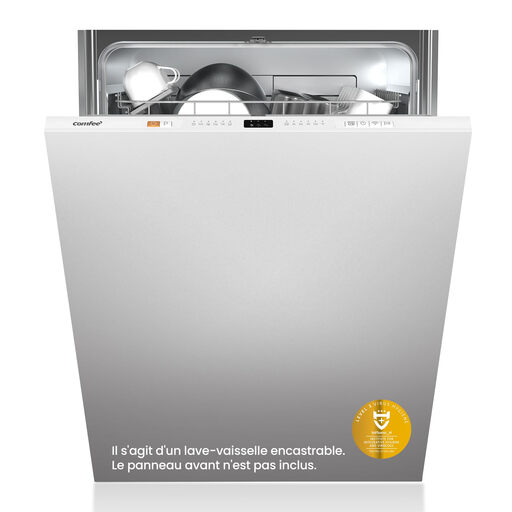 No image available
The stated half-load function is useful to consider if you’ll sometimes run a smaller or partial load.
The product name lists 12 place settings, eight programmes, Extra Dry and Half Load, as well as energy class E.
The product information says the front panel is not included. As a fully integrated appliance, it needs a suitable installation space.
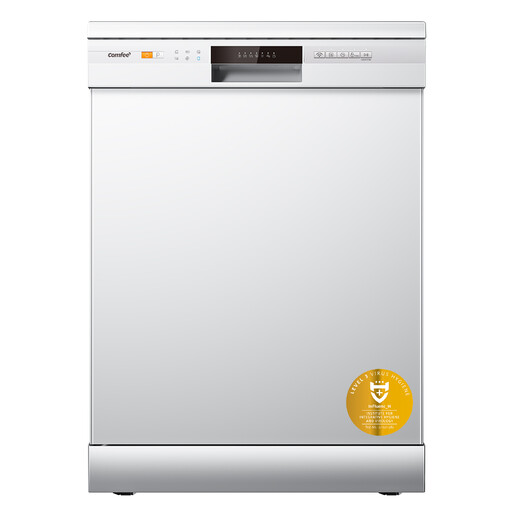 No image available
This freestanding model is designed to be installed outside an integrated built-in space.
The product name lists 12 place settings, eight programmes and energy class E.
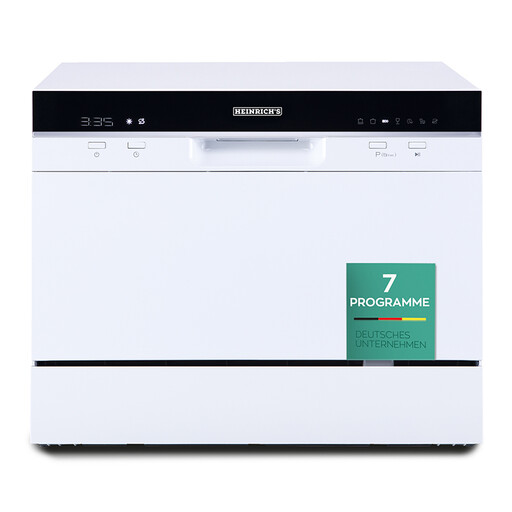 No image available
A countertop model may be an option if you don’t have space for a larger appliance.
The product name lists six place settings, seven programmes, 47 dB and energy class D.
Its stated capacity is smaller than that of the selected full-size models.
No. The symbol indicates that an item is suitable for food contact; it doesn’t automatically mean it’s dishwasher-safe. Read the care instructions for the box, lid and, where applicable, seal separately.
The German Environment Agency advises against pre-rinsing dishes, particularly with warm water. Remove any large food scraps and follow the care instructions for the specific container. After washing, check whether the result meets your needs.
The EU energy label for household dishwashers shows, among other things, energy consumption per 100 Eco cycles, water consumption per Eco cycle, the Eco programme duration and the number of place settings. It doesn’t replace checking how your items fit in the baskets, or describe the consumption of every other programme.
Your statutory rights and a voluntary guarantee are different things; the Verbraucherzentrale explains that your statutory rights are a claim against the seller. The Federal Ministry for the Environment points out that online retailers have take-back obligations. Before ordering, check the arrangements for taking back or collecting your specific old appliance.