Kitchens with limited worktop space
If you want to keep your worktop clear or use as little space as possible, the appliance dimensions and where you place it are key. Also check that there’s enough room in front of the appliance to open the door.


First, measure the available space and your largest lunchbox with its lid open, then check the care instructions for every part. A compact model with a water tank may work if there’s no mains water connection and the box parts actually fit in the rack; a larger countertop model offers more standard place settings but takes up more worktop space. If you have a suitable spot on the floor, a slimline freestanding dishwasher is another option. Place settings are no substitute for checking that your lunchbox fits.
If you want to keep your worktop clear or use as little space as possible, the appliance dimensions and where you place it are key. Also check that there’s enough room in front of the appliance to open the door.
If you regularly wash lunchboxes, lids and inserts, check both their care instructions and whether they actually fit in the rack.
If there’s no suitable water supply, a model with a tank may be an option. You’ll still need a practical way to route the drain hose.
Suitable if: there’s no suitable mains water connection and the lunchbox parts fit in the rack.
Trade-off: you’ll need to fill the tank by hand, and a drain is still required.
Suitable if: you can connect both the water supply and drain, and regularly have several or larger lunchboxes to wash alongside your dishes.
Trade-off: the larger rack usually takes up more worktop space; you’ll also need to check the hose route and door clearance.
Suitable if: you have a suitable floor space and the right connections, and want to keep your worktop clear.
Trade-off: the appliance needs floor space and the right installation.
Suitable if: you only have a few lunchboxes to wash, or your existing dishwasher has enough room for them.
Trade-off: washing by hand takes time and effort; you can’t assume that buying a new appliance will automatically save you money.
| Consideration | What to look for | Who is it especially relevant to? |
|---|---|---|
| Available space and rack capacity | Check the appliance’s height, width and depth, the space in front of the door, and the size and layout of your largest lunchbox parts. Place settings are only a point of comparison. | If I have limited worktop space, there needs to be room for both the appliance and the lunchboxes when open. Around 31% of consumers put available space and usable rack capacity first. |
| Suitability of lunchbox parts | Check the care instructions for the box, lid and seal individually. Arrange the parts in the rack and make sure the spray arms can move freely. | If lids, seals or inserts have different care instructions, each part needs to be suitable for dishwashing. Around 25% of consumers prioritise material compatibility and the fit of their lunchbox parts. |
| Water supply and drainage | For the specific model, check whether it uses a tank or mains water connection, as well as the installation instructions and how to route the drain hose. | If connecting to the mains water supply is difficult, I still need a practical way to drain the wastewater. Around 25% of consumers prioritise water connections and drainage. |
| Consumption and care | Compare Eco figures, load capacity and programme duration for appliances of a suitable size, and follow the model’s care instructions. | If I want to save resources, the load I can fit in the appliance needs to be appropriate for the selected programme’s consumption. Around 19% of consumers prioritise low running consumption for the loads they actually wash. |
The standard capacity doesn’t tell you how open boxes, lids and inserts will sit in the rack. Larger parts may also get in the way of the door or spray arms.
Measure the largest parts and check the rack, door clearance and spray arms before you buy.
If the lunchbox parts don’t all fit at once, you may need to run extra cycles.
A tank can replace a mains water connection, but not necessarily the drain. According to Klarstein, the Klarstein Aquatica connects directly to a tap, so it isn’t described as a model with a tank.
Check the water supply, drainage and actual installation location for the specific model you want.
A dishwasher’s advertised programme temperature doesn’t confirm that a particular lunchbox, seal or insert can withstand it.
Choose a programme based on the care instructions for every lunchbox part, not just the programme’s advertised features.
According to the German Environment Agency, the efficiency benefit compared with washing by hand depends in particular on running a full load. If you need to spread your lunchboxes across several cycles, their actual requirements matter too.
Compare Eco figures for appliances of a suitable size and consider how many loads you’ll need to run day to day.
Bomann offers the TSG 5702, a model with a water tank, and the wider TSG 7405 countertop model.
Midea offers the ST 5.31 wi countertop model for 3 place settings and the ST 3.6F wi as an alternative for 6 place settings.
According to Klarstein, the Aquatica, article number 10047348, is a countertop model for 2 place settings that connects directly to a tap.
This selection includes models with water tanks and countertop models for kitchens with limited worktop space, as well as a slimline freestanding dishwasher if you want to keep your worktop clear. Before choosing, check the dimensions of your lunchboxes and the connections available where you plan to install the appliance.
 No image available
For a small worktop and kitchens where a fixed mains water connection isn’t essential.
According to the Joybuy product listing: 3 place settings, 7 programmes and operation with or without a water connection.
 No image available
For kitchens with enough worktop space for a countertop model with the stated standard capacity.
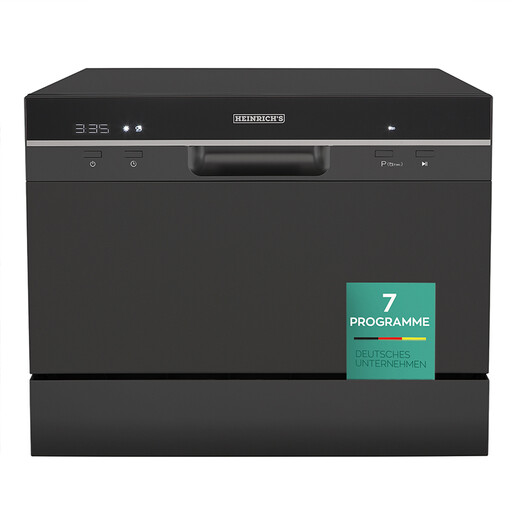
According to the Joybuy product listing: 6 place settings and 7 programmes. This capacity doesn’t confirm that a particular lunchbox will fit.
 No image available
For households with a suitable space on the floor that want to keep the worktop clear.
According to the Joybuy product listing: freestanding, 45 cm wide, 10 place settings and energy class C. A water connection and drain are required.
 No image available
For a worktop with enough space for a countertop model with the stated tank supply.
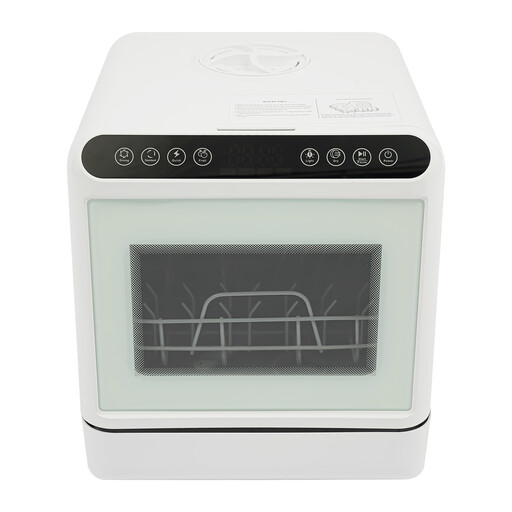
According to the Joybuy product listing: 6-litre water tank and touch controls.
 No image available
For kitchens where a countertop model with a tank is an option and the lunchbox parts fit in the rack.
According to the Joybuy product listing: integrated 5-litre tank and 6+3 programmes.
Check the instructions for each individual part. A food-contact label doesn’t mean an item is dishwasher-safe, and a statement about the container doesn’t confirm that the lid or seal can go in the dishwasher.
The integrated tank means the Bomann TSG 5702 doesn’t need a fixed water supply, but it still needs a drain. Bomann lists an inlet hose and a drain hose as included. Follow the installation instructions for the specific model.
Compare the Eco figures for appliances of a suitable size and try to run a full load. The German Environment Agency recommends the Eco programme and advises against pre-rinsing, especially with warm water. Follow the appliance instructions for care and water softening.
Your statutory rights against the seller are separate from a guarantee. According to the Verbraucherzentrale, additional repair rights have applied since 31 July 2026; dishwashers are among the types of appliance covered. If your appliance develops a fault, check the conditions for the specific right you want to rely on.
Appliances covered by EU rules carry an energy label with a scale from A to G. The European Commission says it includes information such as energy consumption for 100 Eco cycles, water consumption per Eco cycle, capacity, programme duration and noise levels. Where possible, compare appliances in the same suitable size category.