Living alone without a fixed water supply
You’d like to wash plates in a machine, but can’t install a fixed water supply where you plan to put it. So check whether a tank-fed model will work and how the wastewater will drain away.


Choose a dishwasher for one person based on the diameter of your dinner plates, the space available and whether you can accommodate the inlet and drain – the number of place settings alone isn’t enough. A tank-fed model could work if there’s no fixed water supply; a plumbed-in countertop model or a slimline freestanding dishwasher may suit you if you have the space and enough crockery. The German Environment Agency describes an efficiency advantage over handwashing when a dishwasher is fully loaded and run on the Eco programme.
You’d like to wash plates in a machine, but can’t install a fixed water supply where you plan to put it. So check whether a tank-fed model will work and how the wastewater will drain away.
You may have a water connection, but you’ll need to consider the available space, the appliance’s dimensions and the diameter of your dinner plates together. Klarstein specifies a maximum plate diameter of 26 cm for the Oceana.
You need to wash more than just plates – perhaps cups, cutlery or cookware too. A larger basket could be useful if you can save up your crockery and fill the machine suitably.
A good fit if: You can’t install a fixed water supply where you plan to put it, and your crockery fits in the basket.
Bear in mind: There’s less basket space and you’ll need to fill the tank by hand. Even with a tank-fed model, you’ll need to plan for wastewater drainage.
A good fit if: You have a suitable water inlet and drain, as well as enough clear space.
Bear in mind: Compact external dimensions don’t necessarily mean your dinner plates will fit inside.
A good fit if: You have space and connections for a 45 cm appliance, and regularly have extra crockery to wash.
Bear in mind: It takes up more room than a countertop model. The efficiency advantage over handwashing described by the German Environment Agency applies when the dishwasher is fully loaded and run on the Eco programme.
A good fit if: You only have a few plates to wash or would rarely be able to fill a dishwasher.
Bear in mind: You won’t need to find space for an appliance, but this alone doesn’t mean you’ll use less water or energy than a dishwasher.
First check the connections and available space, then make sure your plates will fit. Only after that should you consider what basket capacity suits the amount of crockery you usually wash.
| What to consider | What to check before buying | Who should pay particular attention |
|---|---|---|
| Water inlet and drain | Check whether the model has a tank, its dimensions and the drainage route at your chosen location. | If there’s no fixed water supply where I plan to put it, I’ll need a suitable tank-fed model and still have to plan for drainage. Around 36% of consumers put the lack of a water supply at the top of their list. |
| Available space and plate fit | Measure your largest dinner plate and compare it with the stated maximum plate diameter or reliable basket specifications. | In a small kitchen, my largest dinner plate needs to fit inside; the external dimensions alone won’t tell me that. Around 29% of consumers prioritise limited space or whether their plates will fit. |
| Consumption with small loads | Consider kWh per 100 Eco cycles, litres per Eco cycle and how full you can load the machine. | If I usually wash just a few items, I want to know whether I can save up my crockery for a full Eco load. Around 21% of consumers prioritise consumption with small loads. |
| Space for extra crockery | Picture a typical day’s load and check the basket layout and appliance dimensions. | If I have cups, cutlery or cookware to wash as well as plates, I’ll need useful basket space for those too. Around 14% of consumers prioritise space for extra crockery. |
An integrated tank deals with the water supply; it doesn’t automatically take care of wastewater drainage.
Check the inlet and drain separately, and follow the instructions for your chosen location.
The capacity rating doesn’t guarantee that a particular large dinner plate will fit in the basket. Klarstein specifies a maximum plate diameter of 26 cm for the Oceana.
Measure your largest plate and compare it with the stated limit or basket diagram for the specific model.
The efficiency advantage over handwashing described by the German Environment Agency applies to a full dishwasher on the Eco programme.
Factor in how much crockery you expect to wash and how often you’ll run a cycle.
Bomann offers a range of countertop models, including a tank-fed option and a model with a higher stated capacity.
The Oceana is a countertop dishwasher that connects to a tap.
Gorenje describes the GS520E15W as a freestanding dishwasher that’s 45 cm wide.
These options include tank-fed models for locations without a fixed water supply, as well as slimline freestanding dishwashers if you need extra basket space.
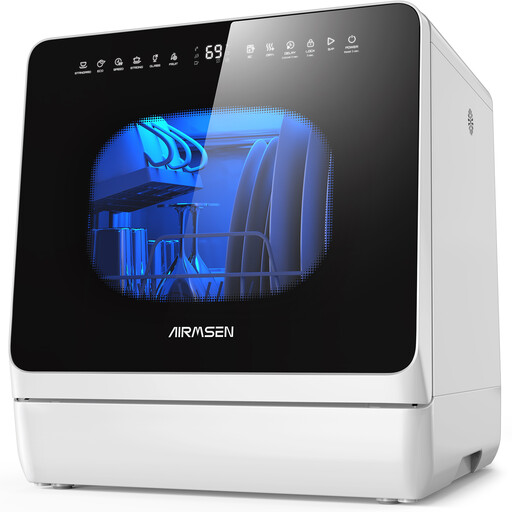 No image available
For a location without a fixed water supply; the product description lists an integrated 4.9-litre tank and a maximum dinner plate diameter of 26 cm.
It also lists an integrated water softener, a delay start and a child lock.
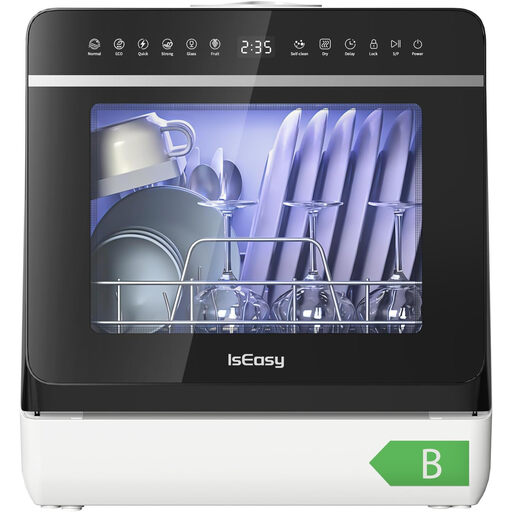 No image available
For small kitchens where a tank-fed countertop model could work; the description also mentions a tap connection as an alternative.
It’s listed as holding up to three place settings, with seven programmes and a delay start of up to 18 hours.
 No image available
For smaller kitchens with a tank-fed water supply; the product description lists an integrated 5-litre tank and a maximum plate diameter of 250 mm.
The product name lists 6+3 programmes.
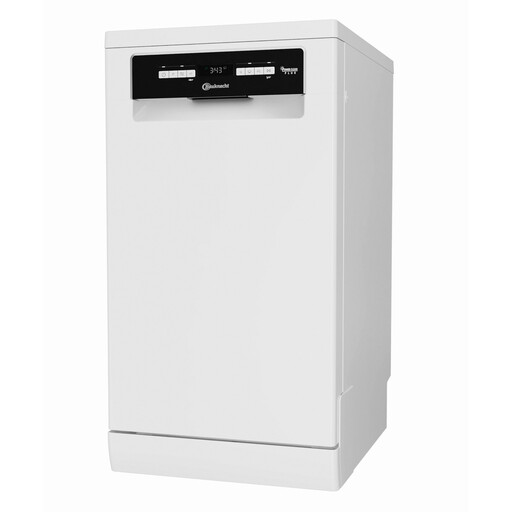 No image available
For a suitable space and regular loads that include extra crockery; this is described as a freestanding model that’s 45 cm wide.
It’s listed as holding 10 place settings, using 9 litres of water per Eco cycle and operating at 44 dB(A). According to the product description, the MultiZone function lets you use a single basket. The efficiency advantage over handwashing described by the German Environment Agency applies to a full Eco load.
 No image available
For a location with the necessary water and electricity connections; the product description lists a freestanding design that’s 44.8 cm wide.
It’s listed as holding nine place settings, using 9 litres of water and 0.704 kWh per Eco cycle. The efficiency advantage over handwashing described by the German Environment Agency applies to a full Eco load.
No. Measure your largest dinner plate and check the stated maximum plate diameter or basket dimensions for the specific model. Klarstein specifies a maximum of 26 cm for the Oceana; that limit doesn’t automatically apply to other models.
No. The tank supplies water but doesn’t automatically take care of wastewater drainage. Plan where the wastewater will drain safely and follow the instructions for the specific installation location.
Compare figures based on the same programme: the German consumer advice centre recommends using kWh per 100 cycles and litres per cycle for Eco comparisons. Also consider how full you can load the machine and how many cycles you’re likely to run.
No. If an item you’ve bought is faulty, your statutory rights are against the seller. A manufacturer’s guarantee is an additional voluntary offer with its own terms. The German consumer advice centre says that statutory liability for sellers generally lasts for two years from delivery.