A household with staggered breakfast times
You load the bowls as you go and are wondering whether you can save them up until the next regular wash. Remember to include the rest of the day’s dishes, too.


Choose based on the total amount of crockery you’ll have by the next wash and the space available, rather than just the breakfast bowls. A full-size 60 cm dishwasher on the Eco programme may be a good fit if you regularly have other dishes to wash. If you consistently have smaller loads, a 45 cm or countertop model may suit your space and needs better. A quick programme saves time, but it won’t necessarily use less energy or water. Also check that your bowls fit in the rack.
You load the bowls as you go and are wondering whether you can save them up until the next regular wash. Remember to include the rest of the day’s dishes, too.
You’re looking for a style of dishwasher that fits the space available and can handle the amount of crockery you usually have.
You want to reuse your bowls between meals and are weighing up the programme time against energy and water use.
First, count the dishes you’ll have by the time you usually run the dishwasher, then compare that with the space available and the rack layout. The German Environment Agency says a dishwasher is more efficient than washing by hand when it’s fully loaded. The consumer advice centre also points out that quick programmes can use more water and electricity.
| What matters | What to check before buying | Who may find it especially important |
|---|---|---|
| Saving up and loading | Your usual total load by the time you run the dishwasher, place settings, rack layout and Eco programme duration. | If I load bowls as I go, the whole load by the time I plan to run the dishwasher matters to me. Around 36 % of consumers prioritise saving up dishes and loading the machine appropriately. |
| Choosing the right style | Available floor or built-in space, appliance dimensions, door clearance, and water inlet and drainage. | With limited kitchen space, I want an appliance that will actually fit where I plan to put it. Around 29 % of consumers prioritise finding the right style of dishwasher. |
| Having dishes ready to use again | Programme duration and available quick or half-load options; check the consumption figures for the specific programme separately. | If I need the same bowls again soon, programme time matters to me, but I don’t assume that a quicker wash uses less. Around 21 % of consumers prioritise being able to reuse dishes quickly. |
| Running costs | Compare kWh per 100 Eco cycles and litres per Eco cycle, and consider how often you usually run the dishwasher. | If I use my dishwasher frequently, I want to compare electricity and water figures for the same programme. Around 14 % of consumers prioritise running costs. |
A quick programme may use more water and electricity than the Eco programme. The figures on the EU energy label are based on Eco and don’t automatically tell you how other programmes perform.
Depending on the appliance and programme, a shorter cycle may mean higher water or electricity consumption.
Compare the Eco figures for regular use. Choose a quick programme when saving time matters more to you, and check the figures for that specific programme.
A large dishwasher won’t necessarily be right if you rarely fill it with your bowls and other dishes. Conversely, a small interior may not have enough room for everything you use in a day.
Choosing the wrong size could mean running small loads more often or not having room for other dishes.
Estimate the total amount of crockery you usually have by the next wash. Check that the bowls fit in the racks without blocking the spray arms or other dishes.
Tank and water connection options vary by model. Bomann lists an integrated tank for the TSG 5702, while the TSG 7405 is described as having a water connection.
You’ll need to fill a tank yourself. For a model that connects to the water supply, allow space for the inlet and drainage hoses.
Check the connections and dimensions for the exact model variant, as well as how it drains.
The details below refer to specific product ranges and manufacturer information. They aren’t a general assessment of every appliance from each brand.
Built-in models in 45 cm and 60 cm widths for different space and load requirements.
The range includes 45 cm built-in models, with features for varying loads depending on the model.
Countertop models for smaller loads, including options with and without a fixed water supply.
60 cm freestanding models where you can compare larger loads with shorter programme options.
This selection includes countertop models as well as slimline and larger dishwashers. Compare the style and capacity with the space you have and the total amount of crockery you’ll have by the next wash.
 No image available
A countertop model for smaller loads, with a tank and flexible placement to consider.
The product title lists an integrated 5-litre tank, nine wash programmes, dimensions of 37 × 50 cm, a delay-start timer of 1–24 hours and energy efficiency class D. According to the product details, a separately available adapter may be needed to connect it to a tap.
 No image available
The slimline design may suit you if space is limited and the stated capacity is right for your total load.
The product title lists capacity for 10 place settings and energy efficiency class C.
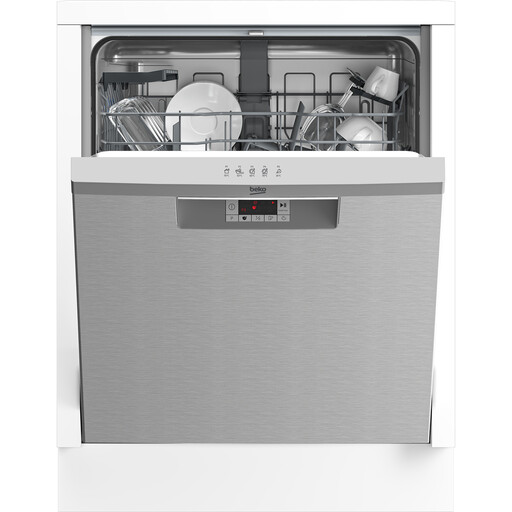 No image available
If you tend to save up a larger load, the stated capacity can help you judge whether it’s a good fit for your usual dishes.
The product title lists Quick&Shine, SelfDry, 44 dB and energy efficiency class C. The product details say the fully integrated version requires a suitable built-in space; the front panel isn’t included.
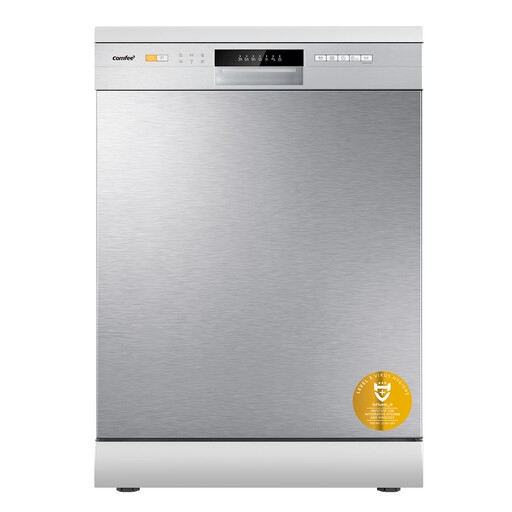 No image available
A freestanding model with a stated capacity for households that save up other dishes as well as breakfast bowls.
The product title lists a half-load function, a 72-°C hygiene programme, a stainless steel interior, 49 dB and energy efficiency class E.
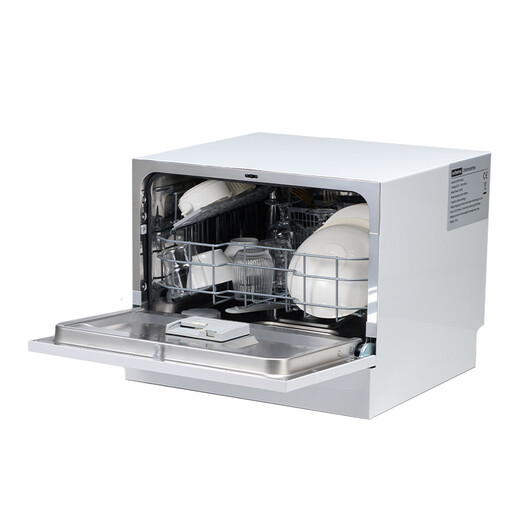 No image available
The countertop design and stated capacity are worth considering for smaller loads; check that you have enough space before buying.
The product title lists a 30-minute quick programme, a delay start of up to 24 hours and eight functions.
No. The German Environment Agency recommends removing larger food scraps, but not pre-rinsing dishes by hand. Load them so the water jets can reach the surfaces.
No. The EU energy label lists figures including electricity use per 100 Eco cycles, water use per Eco cycle and the Eco programme duration. You may need to check the manufacturer’s figures separately for other programmes.
With a tank model, remember to allow for filling the tank and drainage, as well as space for the appliance and a power supply. Bomann lists an integrated 5-litre tank and a supplied drainage hose for the TSG 5702; check the instructions for the exact model variant.
No. According to the consumer advice centre, your statutory rights entitle you to make a claim against the seller if there’s a fault. A guarantee is an additional voluntary service, subject to its own terms and conditions.
The German Federal Ministry for the Environment lists authorised collection points and retailers obliged to take back old electrical appliances as disposal options. Whether your old appliance is collected when you buy online depends on the legal requirements and the arrangements made at the time of purchase. Confirm collection before placing your order.