Small kitchen with no spare floor space
If you want to keep your worktop clear, see whether you can put a slimline freestanding dishwasher in a suitable spot away from the worktop.


If you have limited worktop space, a slimline freestanding dishwasher could be a good fit, provided you have a suitable floor space and the necessary connections. If you want to place the appliance on the worktop, choose between a small tank-fed model and a larger tabletop dishwasher with a mains water connection based on the space available, door clearance, cutlery storage and the amount of crockery you wash. Then compare the Eco programme consumption figures on a like-for-like basis. The model features mentioned are supplied by the manufacturers and are not the result of comparative cleaning tests.
If you want to keep your worktop clear, see whether you can put a slimline freestanding dishwasher in a suitable spot away from the worktop.
A tank-fed model may suit small loads of cutlery and crockery, as long as you have a suitable space for it and a safe way to drain the wastewater.
If you have a water connection, compare the cutlery storage and capacity of a larger tabletop dishwasher with those of a slimline freestanding model.
A good fit if: you wash small loads, can’t use a fixed water supply and have a suitable worktop space.
The trade-off: Its lower stated capacity may mean running extra cycles for larger loads. You’ll still need to plan how to drain the wastewater.
A good fit if: you have enough space and the necessary connection, and want to wash more than just cutlery on a regular basis. Bomann lists six place settings and a cutlery basket for the TSG 7405.
The trade-off: The appliance takes up worktop space permanently. The water inlet, drain and open door also need extra room.
A good fit if: you can keep your worktop clear and have a suitable floor space and the necessary connections. Midea lists nine place settings and dimensions of 845 × 448 × 600 mm (H × W × D) for the MDWEF936WW.
The trade-off: The appliance takes up floor space and needs room for the door to open. Its larger capacity is only useful if you regularly have enough crockery to fill it.
| What matters | What to check before buying | Who it matters most to |
|---|---|---|
| Worktop space and overall footprint | Measure the space available, clearance beneath wall cupboards, room for the door to open, and access to the water inlet and drain. | If I have limited worktop space, I want to know in advance whether the appliance will fit there or needs another suitable spot. In this breakdown, around 33% of consumers prioritise where the appliance will go. |
| Cutlery storage and the rest of the load | Check the basket or tray on the specific model, space for long cutlery and that the spray arms can move freely. Place settings refer to the full load. | If I want to fit my cutlery in with the rest of my crockery, I check the storage on the specific appliance rather than looking only at its capacity. Around 25% of consumers prioritise suitable cutlery storage. |
| Water supply and wastewater | Check whether the model uses a tank or a mains connection, and how it is designed to drain, in the instructions for that model. | If there’s no fixed water supply where I want to put the appliance, I need a suitable operating mode and a safe way to drain the wastewater. In this breakdown, around 25% of consumers prioritise connection options. |
| Consumption and running costs | Compare kWh per 100 Eco cycles and litres per Eco cycle. Verbraucherzentrale recommends these figures when buying an appliance, and the European Commission includes them on the EU energy label. | If I want to estimate consumption for my usual load, I compare Eco figures on a like-for-like basis. Around 17% of consumers prioritise ongoing energy and water use. |
For the Exquisit GSP206-030D silver, the manufacturer gives a depth of 50 cm with the door closed and 81 cm with it open. So even if an appliance fits when closed, it may take up too much space when you open it.
Before ordering, measure the available space, height, door clearance and route for the connections required by the specific model.
Tank-fed models designed for this use don’t need a fixed water supply, but the wastewater still needs to be drained away.
Check the instructions for the exact model to see how it drains before deciding where to put it.
Filling the tank by hand takes time. Depending on where you install the appliance, you may also need extra accessories to drain it safely.
Place settings describe the stated capacity of the full crockery load. A cutlery basket and a cutlery tray are different features.
Check the model instructions to see how to load your cutlery and whether it will fit alongside the rest of your crockery.
Midea offers mini tabletop dishwashers, larger tabletop models and slimline freestanding dishwashers. The features mentioned relate to the specific models listed.
According to the manufacturer, the TSG 7405 is a tabletop dishwasher with room for six place settings and a cutlery basket. It comes with a water inlet hose and a drain hose.
According to the manufacturer, the LIFE DWT30 (MD370022) is a mini dishwasher for three place settings, with tank, mains connection and bucket operation.
The GSP206-030D silver is a tabletop dishwasher sized for six place settings.
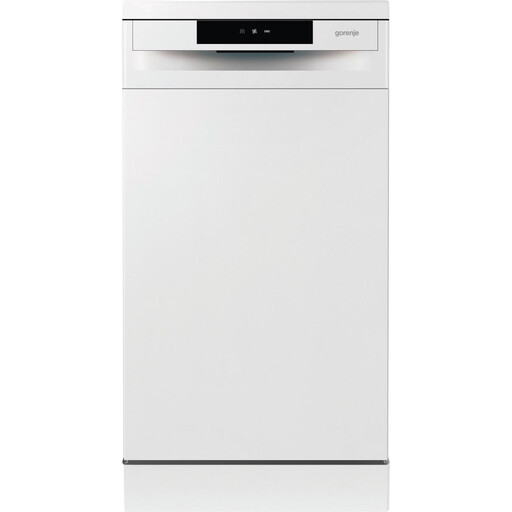
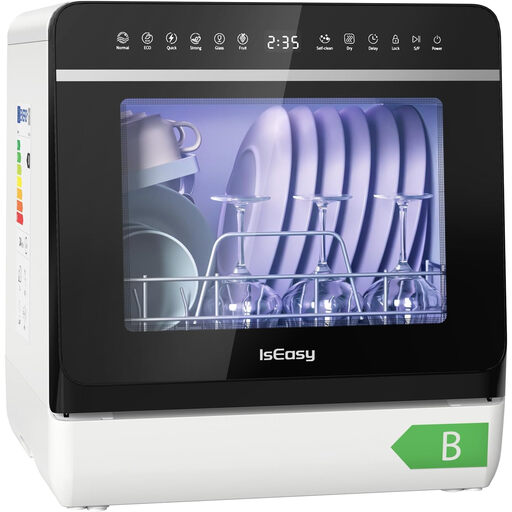
This selection includes slimline freestanding dishwashers for a suitable floor space, as well as a mini tabletop dishwasher with a water tank for small loads.
 No image available
A slimline freestanding option if you can keep your worktop clear and have a suitable floor space with water and electricity connections.
The product name lists a width of 45 cm, nine place settings and five programmes.
 No image available
A slimline freestanding option if you want to keep your worktop clear and have a suitable floor space and water connection.
The product name lists a width of 45 cm, ten place settings and energy rating C.
 No image available
A slimline freestanding option if you can keep your worktop clear and have floor space and the necessary connections.
The product name lists nine place settings, six programmes and a width of 45 cm.
 No image available
A slimline freestanding option if you want to keep your worktop clear and have a suitable space and fixed connections.
The product name lists a width of 45 cm, ten place settings and energy rating E.
 No image available
For small loads if you can’t use a fixed water supply and have a suitable space and a drain.
The product name lists an integrated 5-litre water tank. As a tabletop model, it takes up worktop space.
No. According to Verbraucherzentrale, the glass-and-fork symbol indicates that an item is suitable for contact with food, not that it is dishwasher-safe. Follow the cutlery manufacturer’s care instructions.
Yes. On models designed for tank operation, the tank replaces the fixed water supply, not the need to drain wastewater. Check the instructions for the specific appliance and plan a suitable drain before setting it up.
Compare the stated kWh per 100 Eco cycles and litres per Eco cycle, using figures for the same programme. Also consider how many loads you’re likely to be able to fill efficiently.
Check the instructions for the specific model for guidance on loading cutlery, as well as filter care and cleaning. A cutlery basket and a cutlery drawer differ in how you load your cutlery and how much space the appliance provides for it.
The European Commission lists an A to G scale, along with details such as energy use per 100 Eco cycles, water use per Eco cycle, capacity and noise levels. The label won’t tell you whether the appliance will fit your space or accommodate your cutlery.