
Lieferung heute & morgen

Qualitätsgarantie

Willkommens-Angebote freischalten: KOSTENLOSE Lieferung | Bis zu 80 % RABATT | Kostenlose 30-Tage-JoyPlus-Testphase
App herunterladen
Whether you are assembling furniture, carrying out gluing work, repairing plumbing or maintaining a vehicle, DIY clamps and pliers need to be suited to the task at hand. Water pump pliers are not automatically suitable for every type of fastening, and a screw clamp with a wide span cannot replace a corner clamp. The key considerations are the intended use, dimensions, material and controllable force transmission.
A wide opening is useful when working on broad workpieces or pipes. However, it says nothing by itself about clamping force, stability or throat depth. With a one-handed clamp, you should therefore also check how much force it can apply and how deeply the jaws reach into the workpiece.
Pipe pliers or water pump pliers can grip round, flat or angular workpieces. However, flexible plastic pipes, spring clamps and flexible hoses require specially designed jaws and a suitable construction. For example, hose clamp pliers for automotive work should cover the intended diameter range and the shape of the hose clamps.
When working with wood, hard or sharp-edged jaws can leave pressure marks. Plastic or TPU protective caps reduce this risk, but they do not replace correctly measured clamping force. For frequent use, details about the type of steel, heat treatment, coating and corrosion protection are also relevant. Vague claims such as ‘extra strong’ should not be used instead of specific figures.
The span describes how far the jaws can open. The throat depth indicates how far from the edge of the workpiece the force is applied. A compact clamp is often sufficient for small picture frames or model-making projects. Larger dimensions are useful when assembling panels or furniture components.
Clamping force is sometimes specified in kilograms. This figure is useful for comparison, but it must not be equated with the permissible load of the completed piece of furniture. Workpieces should be secured evenly and without excessive tightening.
A quick-release clamp saves time when positioning workpieces. With a one-handed clamp, the trigger should operate precisely and the jaw should hold securely once released. Depending on its design, a model with a reversible jaw can also be used as a spreader.
With pliers, an easy-to-understand adjustment mechanism is important. A push-button adjustment can be quicker than a simple sliding mechanism. For pipes, nuts and fittings, the maximum jaw opening and a clearly defined tooth profile are also important.
Chrome vanadium steel is used in many types of pliers and can be verified for hand tools by checking the product details. For clamps, hardened steel bars, reinforced nylon bodies and corrosion-protected surfaces can be beneficial. For woodworking, soft, non-marking pads and non-slip handles are practical features.
With hose clamp pliers made from reinforced nylon, bear in mind that they may only be intended for suitable flexible lines. Hard, reinforced or high-pressure lines must not be worked on solely because they look similar to flexible hoses.
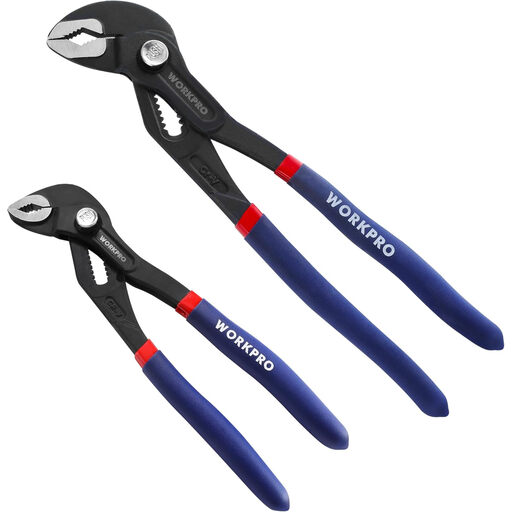
Why this product suits this profile: Two sizes cover smaller and larger jobs involving round, flat, square and hexagonal workpieces. This makes the water pump pliers suitable for general assembly and maintenance tasks.
The product details specify lengths of 180 mm and 250 mm, along with maximum openings of 33 mm and 43 mm, rather than making only a general claim of universal suitability.
Chrome vanadium steel, push-button adjustment and non-slip synthetic resin handles; two plier sizes in the set.
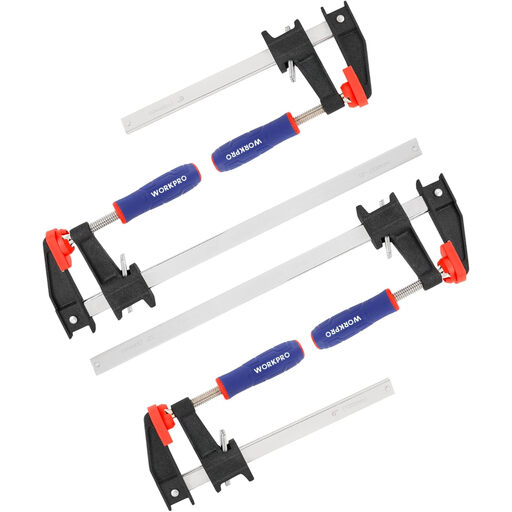
Why this product suits this profile: The set combines two spans for different woodworking, assembly and repair tasks. The specifications state an 80 mm throat depth and a clamping force of 272 kg.
Span, throat depth and clamping force are listed separately. Protective caps help reduce direct contact between the metal jaw and the workpiece.
Four clamps in 150 mm and 300 mm variants, nickel-plated alloy steel and quick push-button adjustment.
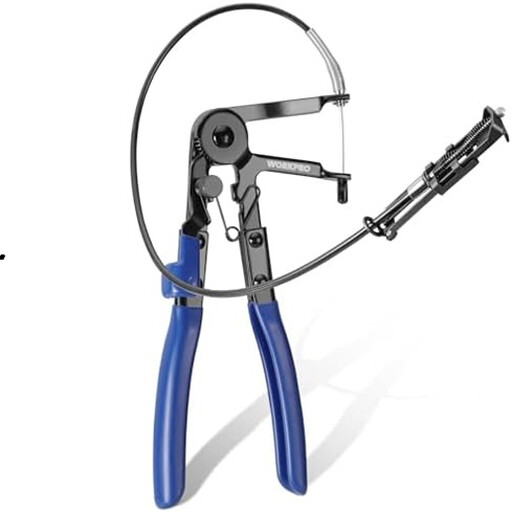
Why this product suits this profile: These hose clamp pliers are designed for hard-to-reach areas during vehicle repairs, such as fuel, oil and radiator hoses.
The flexible 67 cm cable provides access to confined areas. The stated working range of 10 to 50 mm and ratchet lock make controlled operation easier.
Heat-treated carbon steel, PVC-coated handle and holding function for compressed spring clamps.
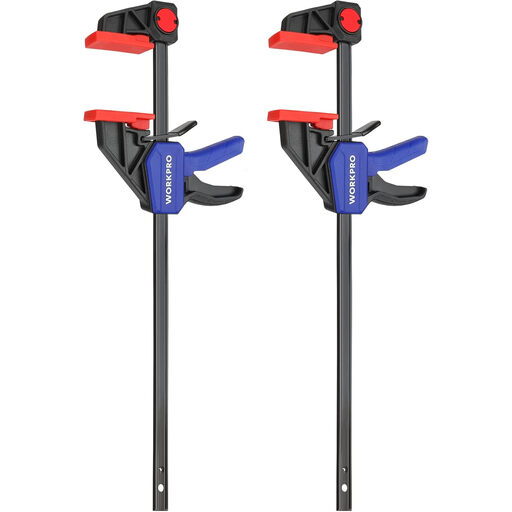
Why this product suits this profile: This clamp is suitable for gluing, aligning and securing larger workpieces. It can also be used as a spreader.
The product description specifies a 305 mm span, 440 mm spreading width, 60 mm throat depth and a maximum force of 68 kg.
Hardened steel rail, soft protective pads, one-handed operation and conversion from clamp to spreader.
We have put together a complete, regularly updated list of products that fully meet these strict selection criteria and the safety regulations applicable in the EU.
This depends on the material, the size of the workpiece and the glued joint. Smaller one-handed clamps are often sufficient for lightweight frames or model-making projects. For larger panels, several clamps with a sturdy rail and a higher stated clamping force are advisable. Excessive pressure can deform wood or squeeze adhesive out of the joint.
Use clamps with soft pads, or place protective pieces of wood, plastic or cork between the jaw and the workpiece. The clamp should be positioned straight and tightened only enough to hold the workpiece securely.
After use, remove dust, moisture and adhesive residue from metal surfaces. Moving mechanisms can be lightly oiled if necessary. Storing tools in a dry place reduces the risk of corrosion. Before each use, check that the jaws, rails, handles and locking mechanisms are undamaged.