
Lieferung heute & morgen

Qualitätsgarantie
App herunterladen
Kategorien
For professional content creation, audio quality is paramount. A wireless microphone system that delivers reliability, flexibility, and high-fidelity recording is an essential tool for content creators, vloggers, and journalists. The DJI Mic series addresses these demands with specialised features like Noise Cancelling and 32-bit Float Recording. This article breaks down the technical specifications and applications of the latest DJI Mic models to help you make an informed choice.
The selection of a suitable wireless microphone system is based on objective, technical parameters. The following criteria are crucial for evaluating performance and suitability.
The range defines the maximum distance between the transmitter (TX) and receiver (RX) at which a stable signal transmission is guaranteed. Models like the DJI Mic 2 offer a manufacturer-stated range of up to 250 metres under FCC-standard conditions. Newer systems, such as the DJI Mic 3, use dual-band anti-interference technologies to ensure lossless audio transmission even in signal-dense environments like trade fairs or busy city centres. The specified range is an ideal value that can be reduced in practice by obstacles and radio interference.
Audio quality is determined by factors such as frequency response, sample rate, and bit depth. A sample rate of 48 kHz is standard in this segment and provides adequate sound resolution for video content. A key feature is 32-bit Float Recording. This format offers an extremely high dynamic range that virtually eliminates digital clipping from loud sound sources. Recordings remain usable even with unexpected volume spikes, which significantly simplifies post-production and increases audio reliability.
Intelligent Noise Cancelling is an algorithm-based feature that analyses and reduces ambient noise in real-time to enhance speech clarity. Systems like the DJI Mic 2 and Mic Mini offer an integrated Noise Cancelling function. This is particularly useful for outdoor recordings, in vehicles, or in other uncontrolled acoustic environments. Some models offer different levels of noise reduction to allow for adaptation to the specific situation.
A modern vlogging microphone must be compatible with a wide range of devices. The DJI Mic systems typically come with USB-C and Lightning adapters, enabling direct connection to Android smartphones and use as a clip-on microphone for iPhone. A 3.5mm TRS output on the receiver ensures compatibility with most cameras. Another feature is the direct connectivity of some transmitters with DJI Osmo products (e.g., Osmo Action or Osmo Pocket) via DJI OsmoAudio, making the receiver redundant for certain use cases.
Operating time is critical for mobile productions. Battery life specifications refer to the transmitters and receiver individually, as well as the total runtime when combined with the charging case. A charging case that stores and recharges both the transmitters and the receiver significantly increases operational uptime. For example, the DJI Mic 2's charging case provides a total runtime of up to 18 hours.
Based on the technical criteria mentioned above, here is our selection of DJI Mic wireless microphones.
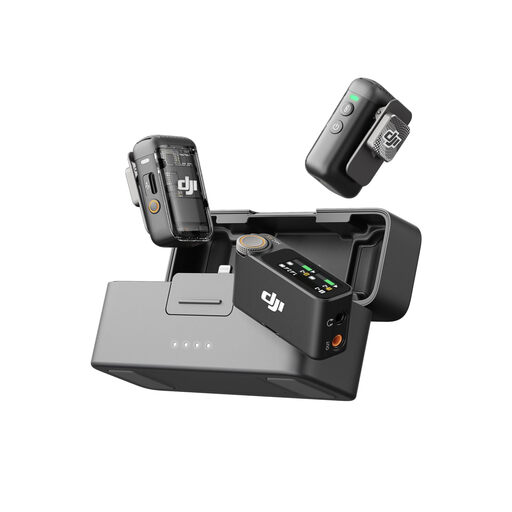
Why we recommend this product: The DJI Mic 2 is an all-in-one system that is ready to use out of the box. The combination of two transmitters, a receiver, and a charging case offers a complete solution for interviews or two-speaker scenarios. The internal recording function with 32-bit Float provides a high degree of protection against audio loss.
Pros:
Who it's for: Content creators and journalists who need a reliable and user-friendly two-channel solution for interviews, vlogs, and documentaries.
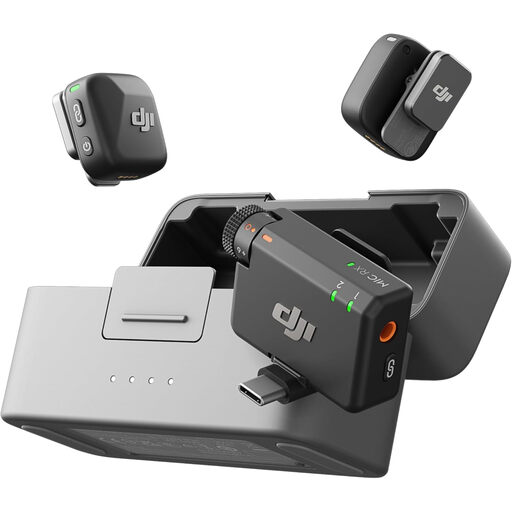
Why we recommend this product: The DJI Mic Mini focuses on extreme portability and exceptionally long battery life. With a transmitter weight of just 10 grams (according to the manufacturer), it is extremely discreet to wear. The total runtime of up to 48 hours with the charging case is a significant technical advantage for long productions.
Pros:
Who it's for: Mobile vloggers, travellers, and streamers for whom minimal weight, maximum discretion, and exceptionally long battery life are top priorities.
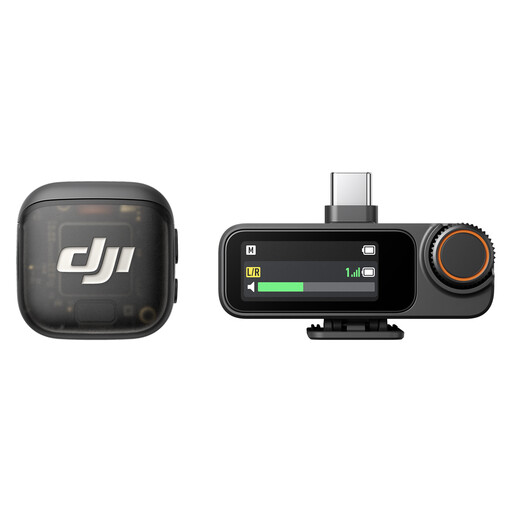
Why we recommend this product: The DJI Mic 3 is designed for scalability and professional use cases. The ability to pair up to four transmitters with one receiver and synchronise the signal to up to seven additional receivers opens up possibilities for complex setups like podcasts or group interviews.
Pros:
Who it's for: Professional filmmakers, podcasters, and production teams who require an expandable and technically advanced system for multi-person recordings.
If the models presented here do not exactly meet your specific requirements, you can find a broader selection of systems in our main category. There, you can compare different configurations and brands based on your technical needs.
Discover more models in the Wireless Microphone category.
1. Is the DJI Mic compatible with an iPhone? Yes, DJI Mic systems, such as the DJI Mic 2, typically come with a Lightning adapter that allows for direct connection to compatible iPhone models. This makes it a functional clip-on microphone for iPhone.
2. What does 32-bit Float Recording mean on the DJI Mic? 32-bit Float Recording is an audio recording format with a vast dynamic range. In practice, this means the recording will not distort (clip), even if the sound source unexpectedly becomes very loud. This eliminates the need for manual adjustment of the input gain and safeguards the audio recording against quality loss.
3. Can I use the DJI Mic 2 for two-person interviews? Yes, the standard DJI Mic 2 kit includes two transmitters (TX) and one receiver (RX). You can attach a transmitter to each person and record both audio signals simultaneously, either as a combined mono track or on separate channels for more flexibility in post-production.