
Lieferung heute & morgen

Qualitätsgarantie

Willkommens-Angebote freischalten: KOSTENLOSE Lieferung | Bis zu 80 % RABATT | Kostenlose 30-Tage-JoyPlus-Testphase
App herunterladen
Choosing the right dog carrier can be a challenge. The market offers a dizzying array of models, from basic pet totes to large, foldable dog crates for the car. Many products promise comfort and safety, but their shortcomings often become apparent all too quickly. The wrong choice isn't just frustrating; it can also compromise your pet's safety and well-being.
As your Joybuy Product Recommendation Officer, I'm here to help you identify common purchasing pitfalls and make an informed decision. We'll focus on the objective features that truly matter, so you can find a durable and functional transport solution.
Many pet owners invest in products that quickly prove to be impractical or unsafe. Pay close attention to these three common flaws to avoid a costly mistake:
To find the right transport solution, you should focus on three core parameters. These will help you separate the wheat from the chaff and select a product tailored to your pet's needs.
The choice of material largely depends on the intended use. Hard-shell carriers made of robust plastic offer a high level of impact protection and are often the only option approved for air travel. Their disadvantages are their heavy weight and bulky size.
A foldable dog crate made from durable polyester fabric (often called Oxford fabric) with a lightweight yet sturdy steel frame is a flexible alternative. It provides sufficient protection for car transport or vet visits and can be stored compactly when not in use. Look for tear-resistant mesh inserts and high-quality zippers.
The most important rule for size is: your pet must be able to comfortably stand, turn around, and lie down stretched out inside the carrier. To determine this, measure your dog's back length (from the tip of the nose to the base of the tail) and its height (from the floor to the highest point of its head while standing). Add about 10–15 cm to both measurements to find the ideal internal dimensions for the carrier.
Good ventilation is essential. A high-quality dog carrier or cat carrier should have generous mesh panels on at least three sides to ensure constant airflow.
Consider the situations for which you'll need the transport solution:
Based on these objective criteria, we have identified several products that offer a suitable solution for different use cases.
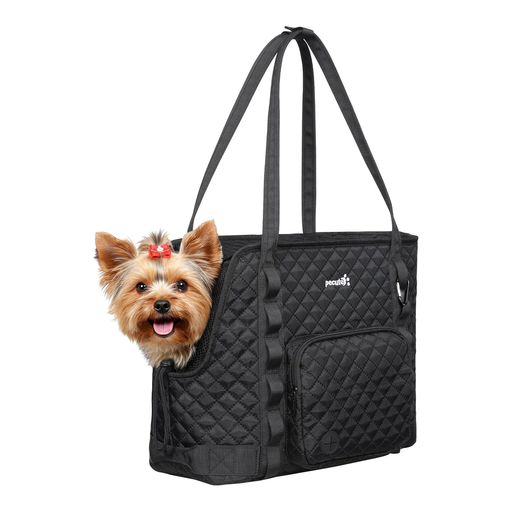
Why it's a good fit: Weighing only 0.7 kg, this dog tote is suitable for transporting pets up to 5 kg. It's a practical solution for daily errands, vet visits, or short outings where a bulky carrier would be impractical.
The tote counters the "unstable construction" pitfall with a removable hard base for stability and an integrated safety tether to secure your pet.
Two spacious outer pockets offer practical storage for treats, waste bags, or personal items. The lightweight nylon material is easy to clean.
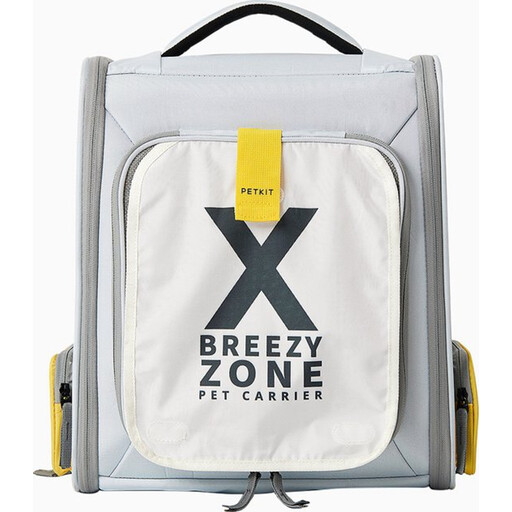
Why it's a good fit: This dog backpack is designed for mobile pet owners who take their small pet (up to 6 kg) on hikes or travels. It keeps your hands free while ensuring your pet is safe and comfortable.
It addresses the "insufficient ventilation" and "claustrophobia" pitfalls with large mesh panels and a unique, expandable enclosure that increases your pet's space during breaks.
A roll-down shade can be lowered as needed to reduce external stimuli and provide a secure den for anxious pets. The design is foldable for easy storage.
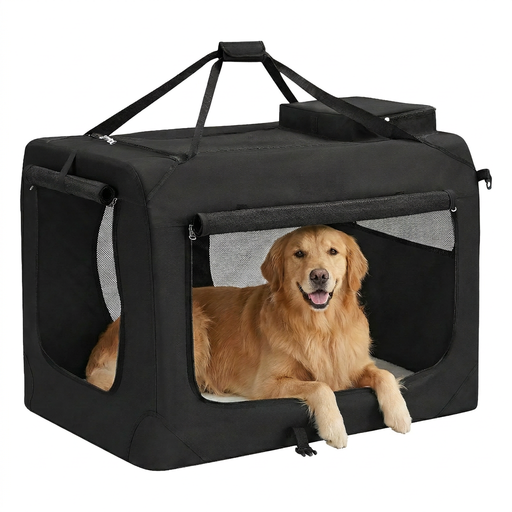
Why it's a good fit: This extra-large, foldable dog crate is designed for transporting large dog breeds in the trunk or on the back seat. It provides a secure and spacious environment for long car rides or as a resting place during travel.
It avoids the "misleading size" pitfall with its generous dimensions of 122 x 79 x 79 cm. The sturdy steel frame and durable Oxford fabric counter the "unstable construction" pitfall.
Despite its size, the crate folds flat and can be stored in the included bag. Multiple mesh windows provide 360-degree ventilation and a good view for the pet.
We've compiled a comprehensive list of products that meet these objective selection criteria.
The carrier must be large enough for your dog to stand up comfortably, turn around without difficulty, and lie down in a natural position. As a rule of thumb: measure your dog's length and height, then add 10 to 15 centimetres to each to get the minimum required internal dimensions.
Start the acclimatisation process in a calm environment. Place the open carrier in your living room and put a familiar blanket, toy, or treats inside. Let your pet explore the carrier at its own pace. Initially, close the door for only a few moments and gradually increase the duration. Always associate the carrier with positive experiences.
Foldable dog crates with a sturdy metal frame offer good safety for car transport, especially when properly secured in the trunk or on the back seat. They prevent the animal from moving freely inside the vehicle and distracting the driver. However, for air travel, only IATA-compliant hard-shell carriers are typically permitted. Always check the specific regulations of the airline.