
Lieferung heute & morgen

Qualitätsgarantie

Willkommens-Angebote freischalten: KOSTENLOSE Lieferung | Bis zu 80 % RABATT | Kostenlose 30-Tage-JoyPlus-Testphase
App herunterladen
A dog house and dog playpen solution must suit the animal, the location, and the actual purpose of use. An outdoor dog house has different requirements than an indoor dog crate. For puppies, cats, or rabbits, a flexible puppy pen or small animal enclosure may be more appropriate.
In product images, many models appear spacious, sturdy, and weatherproof. In practice, however, incorrect dimensions, unsuitable materials, or inadequate safety features often lead to poor purchases. The following criteria help distinguish marketing claims from verifiable product features.
For a dog house, it is not just length, width, and height that matter. Wall thicknesses, door frames, raised floors, and partitioned areas reduce the actual available lying space. The dog should be able to turn around, stand up, and lie down stretched out inside. At the same time, the house should not be disproportionately large if it primarily serves as a protected retreat.
For a dog playpen, the floor area is crucial. The height must also match the animal's jumping ability and behavior. A low playpen may be sufficient for calm puppies but could be unsuitable for climbing or jumping dogs.
A weatherproof dog house requires more than just a roof. Relevant features include a water-protected roof, a dry base, adequate ventilation, and a location without permanent waterlogging. A raised floor can reduce direct contact with damp ground. For extended outdoor use, screws, frames, roof surfaces, and the floor should be regularly checked for damage.
An insulated dog house can influence heat exchange inside but does not replace a suitable location or monitoring of the animal. In extreme temperatures, illness, or unsupervised long-term outdoor keeping, a house should not be considered the sole protective measure.
A foldable dog playpen saves space during storage. For travel, however, weight, connecting elements, packed size, and anchoring to the ground are also important. A metal playpen can be sturdy but, depending on the design, can reach a considerable weight. On grass or soft ground, ground anchors can increase stability; on a balcony or indoor floor, non-slip and floor-protecting solutions are advisable.
Measure the dog from the tip of the nose to the base of the tail, as well as from the ground to the highest point of the body. For the indoor house, additional freedom of movement should be planned. For a dog kennel with a door, check whether the opening can be used without bumping the head or back.
With modular enclosures, a variable shape offers advantages. Eight individual elements can be arranged, for example, in a square, rectangle, or octagon. This is practical when the available space in the garden, living room, or on the terrace changes.
Wood can blend harmoniously into a garden but requires suitable surface care and a dry location outdoors. Metal grids allow visual contact and air circulation. Pay attention to:
An enclosure for rabbits or guinea pigs is not automatically suitable for adult dogs. The manufacturer's information on animal type and size should therefore be considered before purchase.
Removable floor panels, removable bowls, or wipeable surfaces make regular cleaning easier. For textile products, information on washing temperature and drying should be checked. A dog bed for all seasons with a reversible or removable insert can be flexible but must be regularly checked for open seams and exposed filling material.
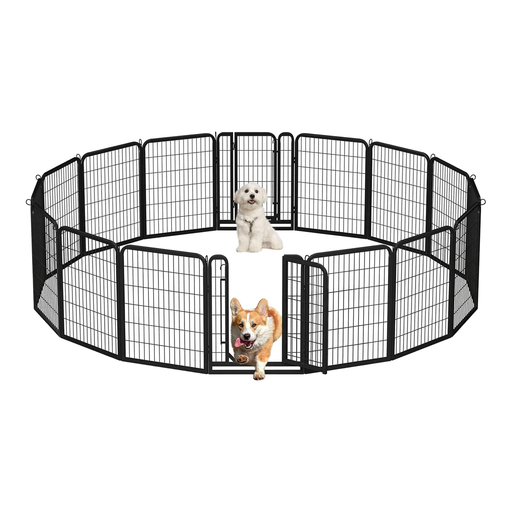
Why it fits: The playpen can be used flexibly for home, garden, camping, or storage.
16 panels, two doors, locking mechanism, and 16 ground anchors are specifically stated. Anchoring outdoors should still be checked.
Water-repellent metal surface, foldable construction, and rounded edges.
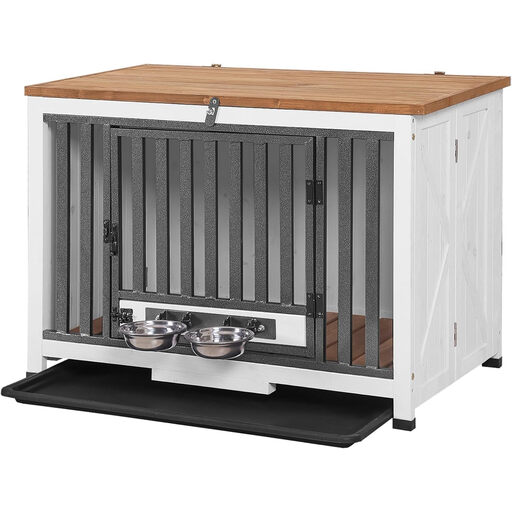
Why it fits: An option for owners seeking an indoor dog crate with furniture-like aesthetics.
The product specification explicitly states indoor use. This prevents unsuitable outdoor application.
Steel frame, fir wood panels, foldable roof, removable floor panel, and pull-out drip tray.
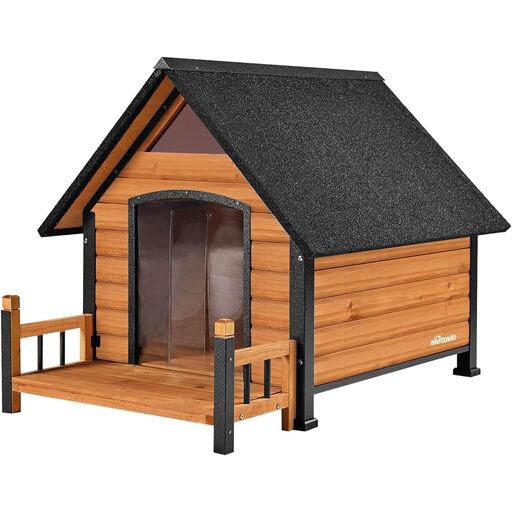
Why it fits: The combination of a protected interior and a covered or open lying area suits a garden location.
The sloped, water-protected roof, raised design, and removable floor panels are stated as specific features.
Full iron frame, dimensions of 32.9 × 45 × 32.6 inches, and separate porch.
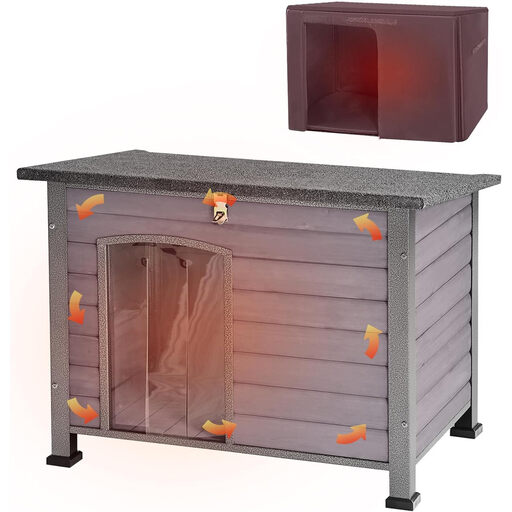
Why it fits: The stated size L is aimed at small, medium, and large dogs; before purchase, the interior area should be compared with the dog's body measurements.
The product description explicitly mentions insulated and weatherproof features, as well as placement on a level, well-drained surface.
Dimensions of 85 × 64 × 56 cm, wooden construction, steel frame, and specification for indoor and outdoor use.
The full selection includes products for various sizes, materials, and areas of application, taking practical safety criteria into account.
Choose a level, stable location with good drainage. The roof should not permanently face the weather side. A raised floor can protect against rising moisture. Regularly check the roof, floor, screws, and door lock. For a dog playpen on grass, use the included ground anchors according to the soil conditions.
The lifespan depends on the material, care, weather, and the dog's behavior. Wood should be checked for moisture and damage; metal grids require inspection for rust, bent elements, and loose connections. A general statement in years is therefore not appropriate. If visible damage occurs, the affected part should be repaired or replaced before the animal continues to use the house or enclosure.
In addition to the purchase price, expenses for cleaning, spare parts, floor mats, or additional fastenings may arise. For an outdoor house, care products may be needed depending on the material. A foldable dog playpen can save storage space and be suitable for travel but also requires regular checks. For cats, rabbits, and guinea pigs, it is also necessary to check whether the enclosure is actually designed for the respective animal species.