
Lieferung heute & morgen

Qualitätsgarantie

Willkommens-Angebote freischalten: KOSTENLOSE Lieferung | Bis zu 80 % RABATT | Kostenlose 30-Tage-JoyPlus-Testphase
App herunterladen
A dog playpen promises a safe space for your puppy and flexibility for you. In reality, however, many models prove to be inadequate, leading to frustration instead of peace of mind. Before you make a purchase, it's crucial to understand the common pitfalls that often only become apparent after a few weeks of use.
Many dog owners invest in an outdoor enclosure only to find it can't withstand the demands of daily life. The three most common problems that lead to a poor investment are:
A well-considered choice based on objective criteria will protect you from these disappointments and ensure the playpen serves its purpose for the long term.
To avoid making a poor purchase, you should focus your attention on three decisive technical features. These define the safety, durability, and functionality of a dog playpen.
The foundation of any durable enclosure is its material. A metal pet playpen is the most common choice, but the differences in quality are significant. Look for a solid powder coating. This electrostatically applied layer of paint is more resistant to scratches and impacts than a simple wet paint finish and offers more effective protection against corrosion. Check the product description for details on the type of coating. A good outdoor pen should be explicitly described as rust-resistant. The craftsmanship is equally important: all edges must be rounded and welds smooth to prevent injuries.
The stability of a playpen depends on the thickness of the bars and the design of the connecting elements. For outdoor use, models with ground stakes are essential to prevent shifting or tipping over on uneven ground. The height of the panels is a critical safety feature. As a rule of thumb, the dog should be able to stand on its hind legs without reaching the top edge with its front paws. For a puppy playpen, the bar spacing is also crucial. It must be narrow enough that the puppy cannot stick its head through and get trapped.
A flexible, foldable dog run allows you to adapt the shape and size of the enclosure to your space—whether it's an octagon in the garden or a rectangle used as a room divider indoors. The connection of the individual elements should be tool-free yet stable. However, the most important safety aspect is the door latch. A simple slide bolt is insufficient. Look for models with a self-locking mechanism or a latch that requires an additional securing step. This prevents your dog from opening the door on its own by shaking it or with clever manoeuvres.
Based on the quality criteria mentioned, we have identified products that are well-suited for specific requirement profiles.
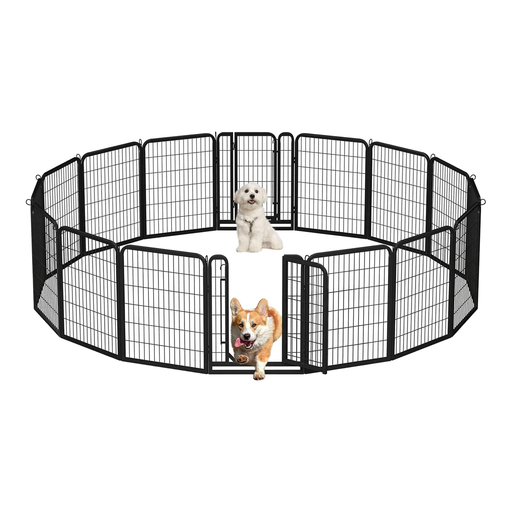
Why It's a Match: Ideal for dog owners who need a large, customisable outdoor dog enclosure or a way to section off living areas. The 16 panels allow for various configurations and provide ample space for multiple or larger dogs.
The water-resistant coating counteracts susceptibility to rust. The 16 included ground stakes provide necessary stability outdoors, solving the issue of unstable structures on soft ground.
High modularity thanks to 16 individual panels and two doors. The rounded edges minimise the risk of injury to your pet.
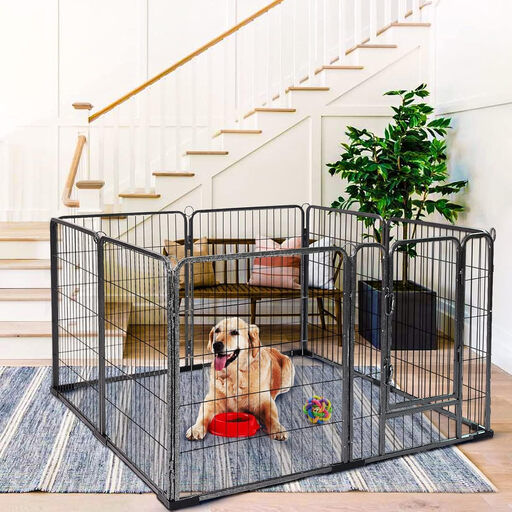
Why It's a Match: Specifically designed for indoor use and raising puppies. The non-slip foam pads protect sensitive floors like hardwood or laminate while also reducing noise.
The secure locking mechanism prevents unwanted opening by the dog. The rounded connecting rods and non-slip features counteract instability and potential floor damage.
Floor-safe and noise-dampening features. The tool-free assembly and foldable design make it highly practical for flexible use within the home.
We've compiled a complete, up-to-date list of products that fully meet these strict selection criteria and safety standards.
The required height depends on the size, age, and jumping ability of your dog. For small breeds and puppies that don't climb, heights of 60 to 80 cm are often sufficient. For medium-sized or particularly active dogs, you should choose a height of at least 80 cm, preferably 100 cm. Make sure that when your dog stands on its hind legs, it cannot get its front paws over the top edge.
This heavily depends on the material and coating. Models made of powder-coated metal are designed for extended outdoor use due to their high rust resistance. Nevertheless, it is recommended to regularly inspect the enclosure for damage to the coating or signs of rust, especially at the connection points. Models without such a high-quality coating should be stored in a dry place when not in use to maximise their lifespan.
The introduction should be gradual and positive. Make the time in the puppy playpen pleasant from the start by placing its favourite toy, a blanket, and a water bowl inside. Begin with very short periods while you stay nearby, and slowly increase the duration. The playpen should never be used as a form of punishment but should be established as a safe retreat.