
Lieferung heute & morgen

Qualitätsgarantie

Willkommens-Angebote freischalten: KOSTENLOSE Lieferung | Bis zu 80 % RABATT | Kostenlose 30-Tage-JoyPlus-Testphase
App herunterladen
Running with your dog can be a rewarding experience that strengthens your bond and keeps you both fit. However, choosing the right equipment is crucial for safety and comfort. An unsuitable leash can quickly sour the shared workout. Many dog owners invest in running leashes that later prove to be impractical or even unsafe. We'll show you the most common shortcomings of running leashes and what to look for to make an informed decision.
Before deciding on a model, it's helpful to know the typical flaws that often only become apparent with use. These three points frequently lead to dissatisfaction and, in the worst-case scenario, dangerous situations.
Many leashes advertise a shock absorber, but the execution varies greatly. A material that is too stiff transfers the dog's sudden pulls directly to the runner's hips, which can lead to joint strain. The opposite is a material that is too stretchy, creating an uncontrollable "bungee effect." This gives the dog too much leeway, making control difficult and potentially dangerous in unpredictable situations.
Using a hands-free dog leash only works if the waist belt fits securely. Many budget models use narrow, unpadded straps that slip, chafe, or loosen during movement. Another risk is buckles made from low-quality plastic, which can break under the tension of a dog that stops abruptly.
A dog leash for running is exposed to the elements and mechanical stress. Weaknesses often appear at the seams, which can give way after contact with moisture, or on carabiners that corrode quickly. The strap material itself can also fray or lose its tear resistance with regular use, posing a significant safety hazard.
To avoid the pitfalls mentioned above, you should pay attention to a few objective criteria when making your selection. These features are the primary determinants of a running leash's functionality, safety, and longevity.
A high-quality elastic running leash features an integrated, precisely calibrated shock absorber. It should be strong enough to gently cushion abrupt jolts but simultaneously offer enough resistance to allow for clear communication with your dog. This component is essential for protecting the joints of both human and animal, especially during sudden changes in direction or stops.
The running leash with a waist belt is of central importance. Look for the following features:
Look for durable materials like high-tensile nylon, which is both tear-resistant and weatherproof. The seams should be multiple and cleanly stitched (double or cross-stitching). The carabiner that attaches to the dog's harness should be made of rust-proof metal and have a smooth-operating yet secure locking mechanism. Reflective elements on the leash and belt also increase visibility during runs at dawn or dusk.
Based on the quality criteria mentioned, we present an option that is well-suited for a specific user profile.
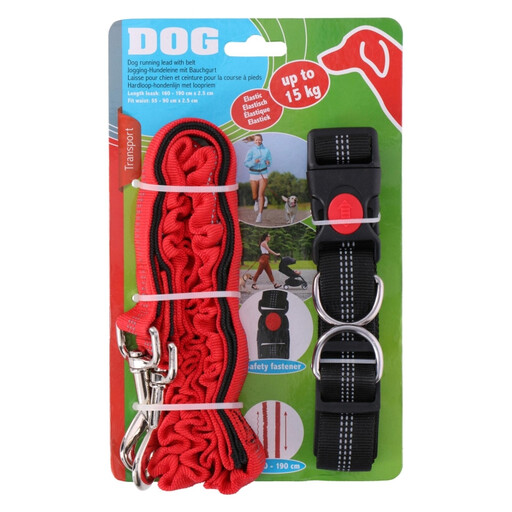
Why This Fits Their Persona: This set is ideal for runners who want to start jogging with their small to medium-sized dog (up to 15 kg). It provides a complete, coordinated system of leash and belt, specifically designed for the needs of this weight class, enabling safe, hands-free guidance.
The integrated elastic buffer system provides controlled shock absorption and prevents the bungee effect. The adjustable waist belt (55-90 cm) with a safety buckle ensures a stable fit. Crafted from high-tensile nylon for enhanced durability.
A complete system with an adjustable leash length (160-190 cm) and an integrated shock absorber, specifically designed as a running leash for small dogs up to 15 kg.
We have compiled a complete, real-time list of products that fully satisfy these strict selection criteria and UK safety regulations.
The ideal length depends on the dog's training level and the running environment. A leash with an adjustable length (e.g., between 1.5 and 2 metres) offers flexibility. In busy areas, a shorter setting allows for more control, while on open trails, a longer setting gives the dog more freedom of movement.
An elastic running leash is particularly beneficial for dogs that are already well-behaved on a leash. For dogs that pull heavily or puppies still learning leash manners, the elasticity can complicate training. In this case, it is advisable to first practice with a static leash before switching to an elastic model for sport.
Start with short walks, using the leash attached to the belt, without actually jogging. Let the dog get used to the new range of motion and the fact that the pull is coming from your hips, not your hand. Reward calm behaviour and slowly increase the pace once the dog has become accustomed to the new equipment.