
Lieferung heute & morgen

Qualitätsgarantie

Willkommens-Angebote freischalten: KOSTENLOSE Lieferung | Bis zu 80 % RABATT | Kostenlose 30-Tage-JoyPlus-Testphase
App herunterladen
Dog toys should suit your pet's daily life, size and play style. A small plush toy may quickly be damaged by a determined chewer, while a heavy fetch toy could be impractical for a small dog. Terms like "robust", "dental care" or "interactive" alone don't tell you much about whether a toy is actually suitable.
"Bite-resistant" or "long-lasting" aren't uniformly protected technical categories. What really matters is the material combination, the construction and the recommended dog size. A toy made from nylon or natural rubber might be suitable for medium-sized dogs, but still may not hold up long-term for particularly strong chewers.
Chew toys for dogs, tug toys for dogs and fetch toys for dogs all serve different purposes. A rope is great for shared tug games, but not necessarily for unsupervised chewing. A frisbee for dogs needs enough open space and should match your pet's energy level.
A dog toy with a squeaker can increase your dog's interest. However, if the squeaker becomes loose or the material starts to crack, there's a risk of swallowable parts. With ropes, fibres can also come loose. That's why owners should check the toy before and after use, and replace damaged products.
The size must suit your dog's mouth, build and play style. A product that's too small could be swallowed, while a toy that's too large is awkward to carry. For small and medium-sized dogs, compact balls and knot ropes are usually more manageable. Medium and large dogs can benefit from larger dummies, rings or sturdier chew toys.
Look for specific details:
When choosing robust dog toys, the construction matters more than any single marketing word. Multi-layer products can combine different properties. The "Dog toy Animal 2AS Incl Tennis", for example, reportedly combines an outer PES polyester layer, a CT cotton-TPU inner layer, a PP frame and HTF reinforcements. The toy measures 45 × 13 × 10 cm and weighs 160 g.
TPR, latex, natural rubber, nylon, polyester and cotton differ in hardness, elasticity and care requirements. For dental care toys for dogs, textured surfaces or rope fibres can support chewing. However, mechanical cleaning doesn't replace regular dental care or a veterinary check-up.
Washable balls or wipe-clean dummies are easier to maintain after outdoor play. Clean products according to the manufacturer's instructions with water or a mild, suitable cleaning agent. Check regularly for:
With aggressive chewers, continuous supervision is especially important. No dog toy is indestructible for every dog.
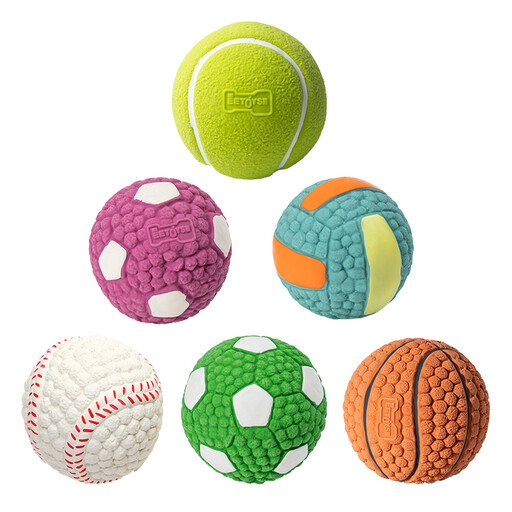
Why this product suits the profile: The ball supports simple fetch, retrieve and training games. The soft latex construction and the described squeaker element make it suitable for owners who want to try several play styles with one compact product.
The product details mention material, areas of use, washability and checking for damage. This makes it easier to match your choice to cleaning and usage needs, rather than focusing only on the squeak.
Soft latex material, textured surface and washable construction according to the product description.
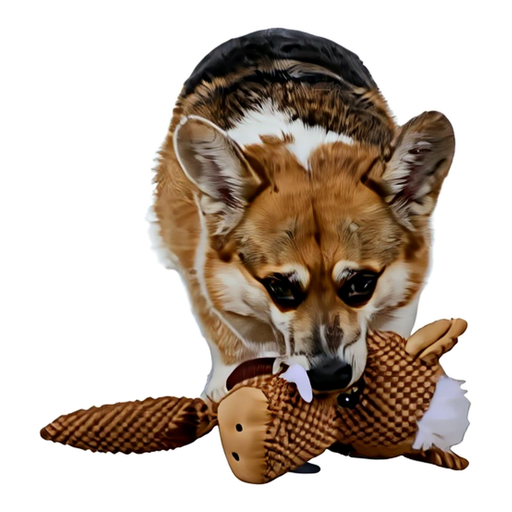
Why this product suits the profile: The stated multi-layer construction and the 45 × 13 × 10 cm format are aimed at owners who want to compare material build and specific measurements before buying.
The description mentions several layers and explicitly advises supervision, regular checks and replacement if damaged. This avoids making a blanket claim of indestructibility.
PES, cotton-TPU, PP and HTF reinforcement; 160 g weight for carrying and throwing.
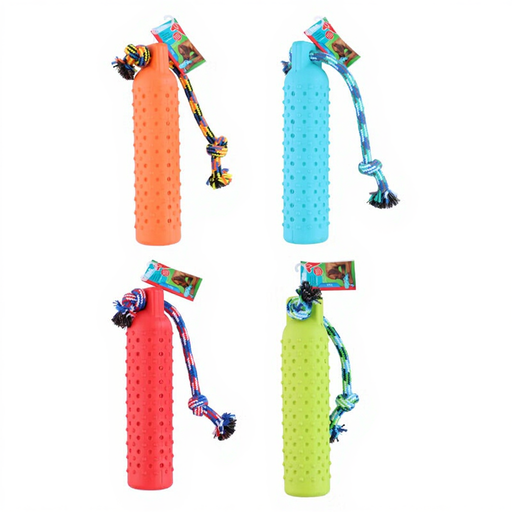
Why this product suits the profile: The training dummy is described as suitable for medium and large dogs and features a 33 cm long polyester handle. It's ideal for fetch training, recall exercises and games in the garden or park.
The specific target audience, the 460 g weight and the dimensions of 28.5 × 6.5 × 6.5 cm make it easier to check whether the toy suits your dog and the intended use.
Robust rubber construction, highly visible colours and integrated polyester handle according to the product description.
We've put together a full, regularly updated list of products that fully meet these strict selection criteria and the safety regulations in force in the EU.
The lifespan depends on chewing behaviour, intensity of use and storage. A toy used outdoors every day needs more care than a product for occasional indoor play. Allow wet toys to dry completely and don't store TPR or latex products permanently in direct sunlight or extreme heat.
With ropes and plush toys, a particularly thorough check for loose fibres and seams is recommended. A tug game should be stopped when the material gives way significantly or pieces start to tear off. A dog rope is also not a substitute for a secure lead and should not be used unsupervised.
For large dogs, depending on play style, larger dummies, rings, balls or more robust chew toys may be appropriate. Check the dimensions, weight and the explicitly stated target audience. Small products can pose a choking hazard and are therefore not automatically suitable.
It's not possible to give a fixed timeframe reliably. What matters is the condition and usage. Replace the product as soon as cracks, holes, loose parts, significant wear or protruding fibres become visible. With intense chewing, checks should be more frequent.
Textured surfaces and rope fibres can support chewing and work mechanically on the surface of the teeth. However, they don't replace regular oral care or a veterinary assessment. Claims about dental care should therefore be understood as a supporting product feature, not a medical effect.