
Lieferung heute & morgen

Qualitätsgarantie

Willkommens-Angebote freischalten: KOSTENLOSE Lieferung | Bis zu 80 % RABATT | Kostenlose 30-Tage-JoyPlus-Testphase
App herunterladen
Modern TVs offer impressive picture quality, but their sound often falls short. The slim design leaves little room for powerful speakers, resulting in a weak and uninmersive audio experience. Dialogue in films can be hard to understand, and action scenes lack impact. A Dolby Atmos soundbar is an effective solution to improve your TV's audio and bring a true cinematic feeling into your living room.
This guide will help you understand the technical features and make an informed decision. We'll present a selection of models for different needs and explain what matters when choosing the right audio system.
The selection of soundbars is vast. To find the right model for your needs, you should be familiar with a few technical basics.
The number of channels indicates how many separate audio tracks a system can reproduce.
The right connection is crucial for transmitting high-quality audio formats like Dolby Atmos. A soundbar with eARC (Enhanced Audio Return Channel) is the current standard for this. Unlike the older ARC standard, eARC can transmit uncompressed, high-bandwidth audio signals. The result is lossless, detailed sound, exactly as the sound engineers intended. Another advantage: with HDMI eARC, you can conveniently control the soundbar's volume with your TV remote.
A subwoofer is responsible for reproducing low frequencies (bass). Explosions, engine noises, or the deep notes in a piece of music only achieve their full impact with one. Many modern systems include a wireless subwoofer. This offers maximum flexibility for placement in the room, as you only need a power outlet and don't have to run any intrusive audio cables to the soundbar.
Based on the criteria above, we have compiled a selection of Ultimea Soundbar models that cater to different home cinema experience requirements.
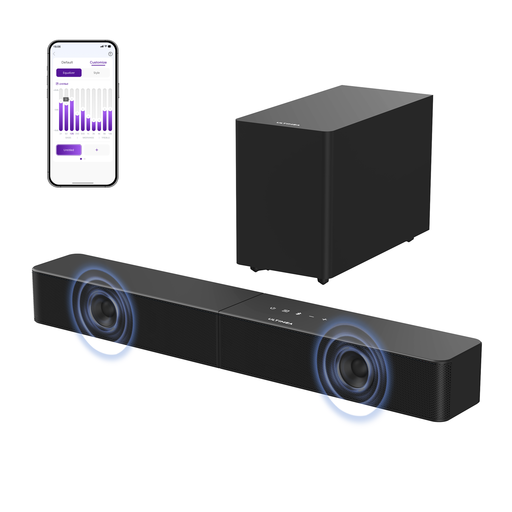
Why it stands out: The Poseidon R3T is a powerful 2.1-channel system designed for clear dialogue and robust bass. With a peak power of 240 watts, it delivers room-filling sound. According to the manufacturer, its VoiceMX technology analyses audio signals in real-time and enhances vocal frequencies to keep dialogue intelligible even in loud scenes. Meanwhile, the BassMX technology, combined with the wireless subwoofer, provides a deep and precise bass foundation. Control is convenient via the remote or the Ultimea app, which offers a 10-band equaliser for sound customisation.
Advantages:
Who is it for? For users seeking a straightforward and significant improvement in their TV's audio. It's ideal for small to medium-sized rooms and for anyone who values clear dialogue and tangible bass in movies and music without wanting to install a complex surround sound system.
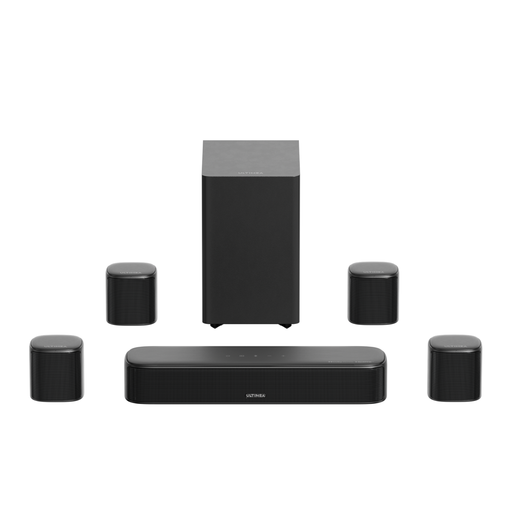
Why it stands out: The Aura S5T is designed as a complete home cinema system, offering a 7.1-channel setup with Dolby Atmos. The system consists of a soundbar with three front channels, four dedicated surround speakers, and a 5.25-inch subwoofer. With 420 watts of peak power and HDMI eARC support, it is engineered for the lossless playback of high-resolution 3D audio. According to Ultimea, the SurroundX technology aims to precisely position sound details in the room, creating an immersive listening experience. The four surround speakers also offer flexible placement.
Advantages:
Who is it for? For home cinema enthusiasts looking for a comprehensive and room-filling surround experience. This system is designed to reproduce the soundscapes of movies and games with Dolby Atmos in rich, three-dimensional detail.
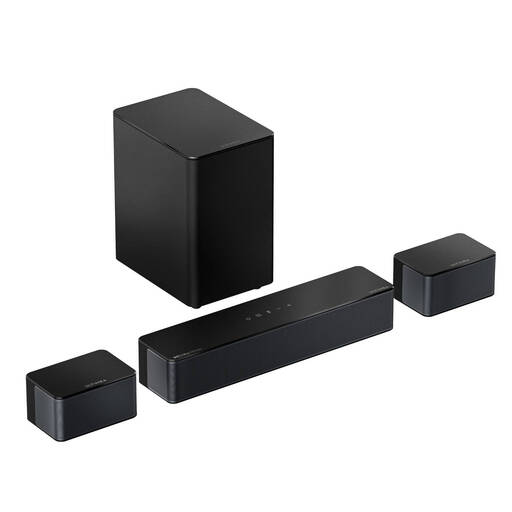
Why it stands out: The Poseidon M4T offers a balanced compromise, combining a 5.1 soundbar with Dolby Atmos technology. The system includes three main channels in the soundbar, two wired surround speakers, and a wireless 5.25-inch subwoofer. With 450 watts of peak power and HDMI eARC, it's equipped for a dynamic 3D sound experience. A special feature is the adaptable surround speakers, which can be positioned flexibly in the room thanks to long cables. Dedicated EQ modes for movies, music, or dialogue allow for quick adjustment of the sound profile to suit the content.
Advantages:
Who is it for? For users who want a true surround experience with the benefits of Dolby Atmos but prefer a more compact solution than a 7.1 system. It's an excellent choice for creating noticeable spatial depth in movies while allowing for a flexible installation.
If our selection doesn't include the perfect model for your individual needs, or if you're interested in other configurations, we invite you to explore our wider collection.
Discover our full range of hi-fi speakers.
The main advantage of Dolby Atmos is its ability to create a three-dimensional sound field. By simulating height channels, it gives the impression that sound is coming not just from the front and sides, but also from above. This leads to significantly enhanced immersion, as objects like helicopters or rain sound realistically positioned overhead.
A subwoofer isn't strictly necessary, but it is highly recommended for a complete audio experience. A soundbar with a subwoofer can cover the entire frequency spectrum, especially the low frequencies below 100 Hz. These are crucial for the impact of explosions, deep instruments, and general effects in movies, and cannot be adequately reproduced by a soundbar alone.
The connection is straightforward. Connect the HDMI port labelled "eARC" or "ARC" on your soundbar to the corresponding HDMI eARC/ARC port on your TV. Use an HDMI cable that supports high data rates. After connecting, the devices usually recognise each other automatically. You may need to change the audio output in your TV's settings to the external audio system (HDMI eARC).