
Lieferung heute & morgen

Qualitätsgarantie

Willkommens-Angebote freischalten: KOSTENLOSE Lieferung | Bis zu 80 % RABATT | Kostenlose 30-Tage-JoyPlus-Testphase
App herunterladen
A soundbar with Dolby Atmos can significantly enhance your TV’s sound. However, product descriptions do not always make it easy to identify the right system. Channel configurations, wattage figures and terms such as “3D sound” alone say little about whether a system will work well in your living room.
This buying guide from the Joybuy Product Recommendation Officer explains the most important criteria and shows which features suit different usage profiles.
Dolby Atmos is an audio format containing object-based sound information. To process this information, both the playback device and the soundbar must be compatible. Many models create the impression of height using upward-firing speakers, known as up-firing drivers. Their effectiveness depends, among other things, on ceiling height, ceiling material and seating position.
A soundbar with Dolby Atmos can also process Atmos signals virtually. This is not the same as a system with several physical speakers. Check whether the model you want has genuine up-firing channels or merely uses a virtual surround function.
Figures such as 350, 500 or 1,500 watts are usually peak or maximum values. They do not fully describe volume, frequency response or distortion during normal operation. For choosing a system, speaker configuration, room size, subwoofer and connection standard are generally more informative.
A large room will often benefit from a separate subwoofer and additional surround speakers. In a small living room, however, a compact 3.1.2 system may be more practical.
With a wireless soundbar, audio signals are often transmitted wirelessly between the soundbar and the subwoofer or rear speakers. However, the individual components still require a power supply. Surround systems may also need cables between certain speakers.
Before buying, check the following:
The first number represents the main front or side channels, the second represents a subwoofer channel and the third represents height channels. For example, 3.1.2 comprises three main channels, one subwoofer channel and two height channels.
A 5.1 soundbar or 5.1 system typically adds two surround channels. A 7.1 soundbar can provide a wider soundstage when used with additional speakers. However, the channel number alone does not guarantee a particular audio experience. What matters is whether the channels are physically present or generated virtually.
HDMI eARC offers greater bandwidth than ARC and is particularly suitable for multi-channel audio and compatible Dolby Atmos signals. If your TV and soundbar support HDMI eARC, the connection can usually be made with a single HDMI cable. HDMI-CEC may also allow you to control the volume using the TV remote.
Optical inputs, AUX and USB are useful for older TVs or additional devices. However, they cannot replace HDMI eARC in every situation. Also check whether games consoles, Blu-ray players or streaming devices can be connected directly to the soundbar.
A soundbar with a subwoofer takes the strain off the soundbar’s compact drivers when reproducing low frequencies. A wireless subwoofer offers greater placement flexibility, but it still requires a power socket and should not be completely enclosed in a cabinet.
For surround sound, rear speakers should be positioned to the sides of or behind the seating position. Make sure they are stable, that sound can travel freely and that cables are routed safely. For wall mounting, consider the wall type, bracket and distance from ventilation openings.
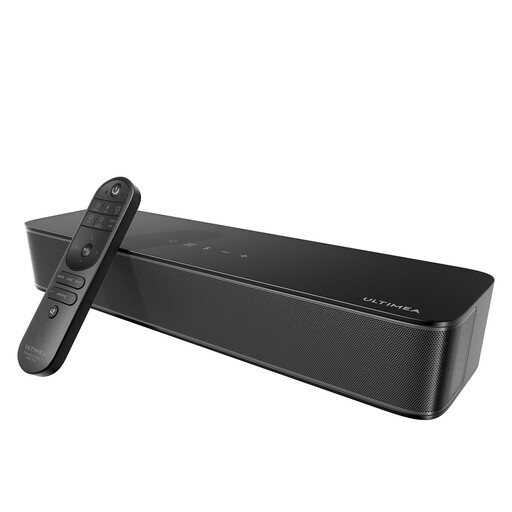
Why this product suits the profile: The 2.1 system integrates the subwoofer into the soundbar housing, reducing the need for separate components. An optical input, AUX, USB and Bluetooth 5.4 allow connection to a wide range of TVs.
The channel configuration is clearly stated as 2.1 and does not claim to be a physical Atmos surround system. This helps reduce the risk of buying based on exaggerated 3D sound claims.
Built-in 76 mm subwoofer, app control and a ten-band equaliser with several sound profiles.
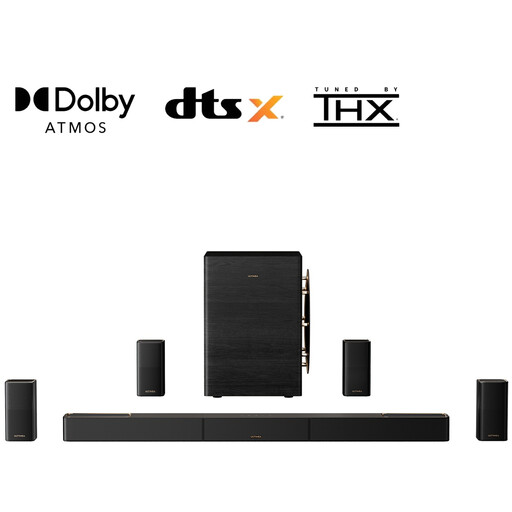
Why this product suits the profile: This system is designed for film fans with enough space for a soundbar, four wireless rear speakers and a separate subwoofer.
The specifications state 9.1.6 channels, 19 speakers and specific HDMI 2.1 functions. This makes it easier to compare the configuration with your room and source devices.
HDMI eARC, HDMI 2.1 with 8K and 4K/120 Hz passthrough, a 10-inch subwoofer and app-based equaliser.
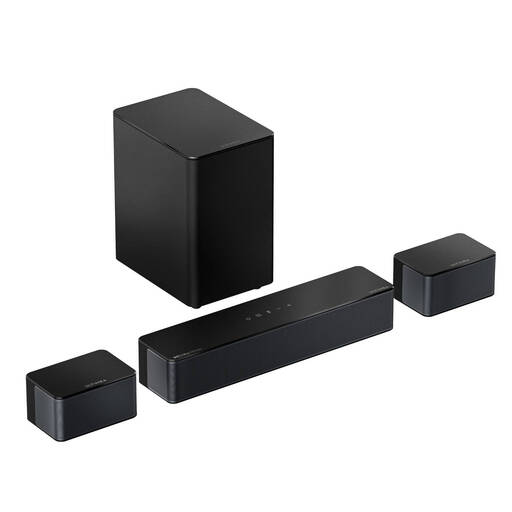
Why this product suits the profile: Film fans, gamers and users with multiple seating positions get a 5.1 system with two surround speakers, a wireless subwoofer and HDMI eARC.
The two surround speakers are specified as coming with 20-foot extension leads. Buyers can therefore plan their cable requirements before setting up the system.
HDMI eARC, Dolby Atmos, six sound modes, plus separate adjustments for bass, treble and voices.
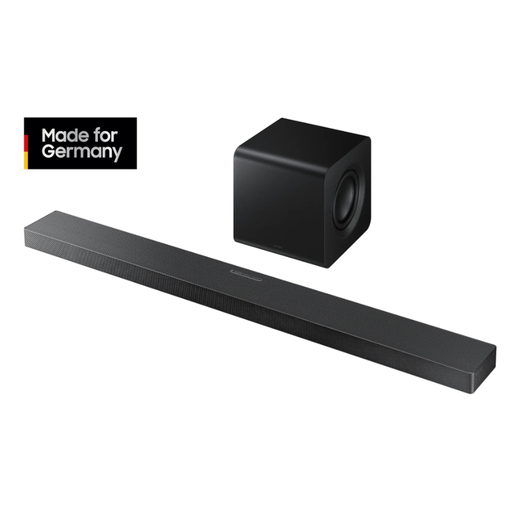
Why this product suits the profile: If you use a Samsung TV, compatible devices can take advantage of Q-Symphony. The soundbar can be placed on furniture or mounted on the wall.
The 3.1.2 configuration, wireless 6.5-inch subwoofer and built-in up-firing speakers are all clearly specified.
Dolby Atmos, DTS:X, HDMI ARC, Wi-Fi, Bluetooth 5.2, room optimisation and dialogue enhancement.
We have put together a complete, regularly updated list of products that fully meet these strict selection criteria and the safety regulations applicable in the EU.
No. The TV or playback device must be capable of outputting Dolby Atmos. HDMI eARC is particularly suitable for the connection. Older devices may have an optical connection, but this does not transmit every multi-channel format in the same way.
Its lifespan depends on usage, volume, ventilation and software support. Place the devices somewhere dry and away from heat sources, do not block any ventilation openings and use the supplied power adapters. With systems controlled via an app, firmware updates can help maintain compatibility; the manufacturer specifies the relevant update periods.
Power consumption is shared between the soundbar, subwoofer and, where applicable, rear speakers. It is usually lower in standby than during operation, although additional components require their own power connections. Look for automatic standby functions and switch the system off completely when you will be away for an extended period.