
Lieferung heute & morgen

Qualitätsgarantie

Willkommens-Angebote freischalten: KOSTENLOSE Lieferung | Bis zu 80 % RABATT | Kostenlose 30-Tage-JoyPlus-Testphase
App herunterladen
Modern TVs offer impressive picture quality, but their sound often can't keep up. The slim design leaves little room for powerful speakers, resulting in a thin and underwhelming audio experience. A soundbar with a subwoofer and Dolby Atmos is an effective solution to elevate your home cinema's audio to a new level, creating an immersive soundscape that puts you right in the middle of the action.
This article serves as a guide. We'll explain the key technical features you should look for and present a selection of models to help you make an informed decision.
Choosing the right soundbar depends on your individual needs and room layout. The following points will help you better understand the technical specifications.
The number combination in a soundbar's product description, such as 2.1 or 5.1.2, describes the speaker configuration.
For example, a 7.1 soundbar system offers a more comprehensive surround sound system than a 2.1 system by distributing audio more precisely throughout the room.
The right connection is vital for transmitting high-resolution audio. While optical cables and standard HDMI ARC ports are sufficient for many applications, a TV soundbar with HDMI eARC (Enhanced Audio Return Channel) is the recommended choice for lossless Dolby Atmos playback.
HDMI eARC offers significantly higher bandwidth than its predecessor, ARC. This allows uncompressed audio data, such as that found in Dolby TrueHD (a carrier format for Dolby Atmos), to be transmitted from your TV to the soundbar without any loss of quality. This ensures you hear the audio exactly as it was mixed in the studio.
The subwoofer is responsible for reproducing low frequencies (bass), giving explosions, music, and sound effects the necessary foundation.
Here is a selection of soundbar systems that cater to different needs and use cases.
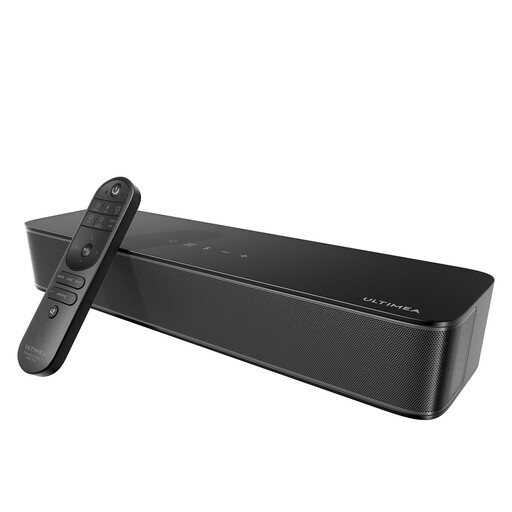
Why It Stands Out The Ultimea Poseidon M20 is a compact all-in-one solution that delivers powerful sound despite its small footprint. With two speakers and an integrated subwoofer in a single enclosure, it's a straightforward upgrade for any TV.
Key Features
Who It's For Users looking for a significant sound improvement over their TV speakers who also value a space-saving, minimalist design without a separate subwoofer box. Ideal for small to medium-sized living rooms, bedrooms, or gaming setups.
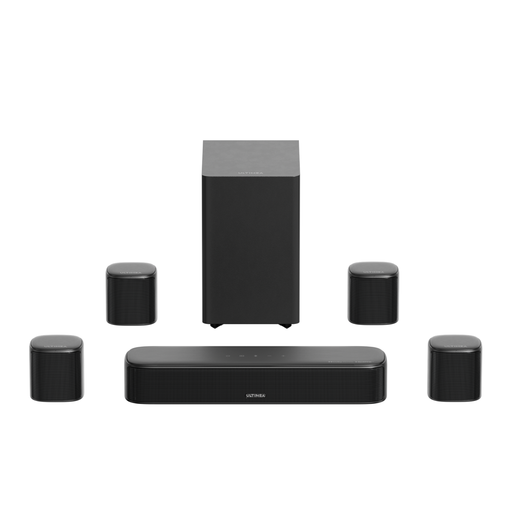
Why It Stands Out The ULTIMEA Aura S5T is a complete home cinema system with a soundbar that delivers an immersive 7.1-channel Dolby Atmos experience. With four dedicated surround speakers and a powerful external subwoofer, this system is designed to produce room-filling, cinema-like sound.
Key Features
Who It's For Home cinema enthusiasts and discerning film and gaming fans seeking a complete surround sound system for a maximally immersive experience. A great choice for anyone considering one of the best soundbars for movies in terms of its price-to-performance ratio.
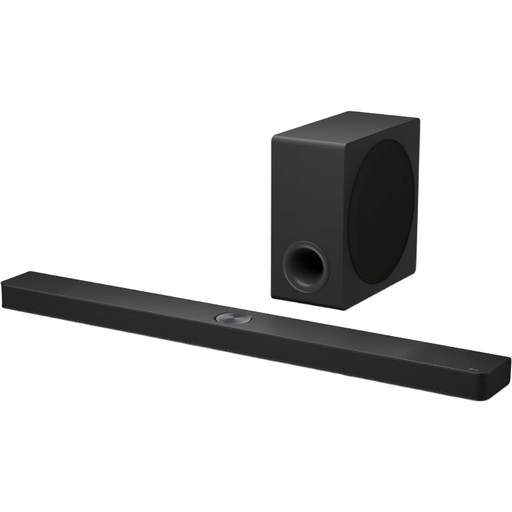
Why It Stands Out The LG DS90TY is a high-performance system from an established brand, boasting a 5.1.3-channel configuration. The standout feature is its three up-firing channels, which enable even more precise and impressive reproduction of height effects in Dolby Atmos.
Key Features
Who It's For Users looking for a premium system with high performance, advanced features, and precise 3D sound reproduction. Its three height channels make it particularly appealing to Dolby Atmos lovers who value the exact localisation of overhead sound effects.
A high-quality audio system only unleashes its full potential with the right connections. Especially for using features like HDMI eARC, a compatible, high-quality cable is required to ensure stable and lossless signal transmission.
For an optimal connection between your TV and your new soundbar, you can find a selection of suitable TV cables designed for high data rates here.
Traditional surround sound (like 5.1 or 7.1) distributes audio on a horizontal plane around the listener (front, sides, rear). Dolby Atmos adds a vertical dimension by placing sound objects in three-dimensional space. This is achieved through dedicated height channels that reflect sound off the ceiling, creating the impression that noises (e.g., rain or a helicopter) are actually coming from above.
For the best possible experience, a TV with an HDMI eARC port is recommended. This connection has the necessary bandwidth to pass uncompressed Dolby Atmos signals to the soundbar. The TV itself must also be able to process and pass through Dolby Atmos audio. Most modern 4K TVs support this feature.
Wattage indicates the maximum electrical power the soundbar's amplifier can deliver. Higher wattage generally allows for higher maximum volume and greater dynamic range without causing distortion. This is especially advantageous in large rooms. However, wattage is not the sole indicator of sound quality. The efficiency of the speakers, the quality of the drivers, and the digital signal processing play an equally important role in the final sound.